Nord Stream: another Ukrainian deep strike
- October 19, 2026
- Roger Moorhouse
- Themes: Geopolitics, Ukraine, War
Bojan Pancevski’s account of the Nord Stream sabotage reveals an operation that foreshadowed how Ukraine would take the war to Russia.
The Nord Stream Conspiracy, Bojan Pancevski, Hutchinson, £25
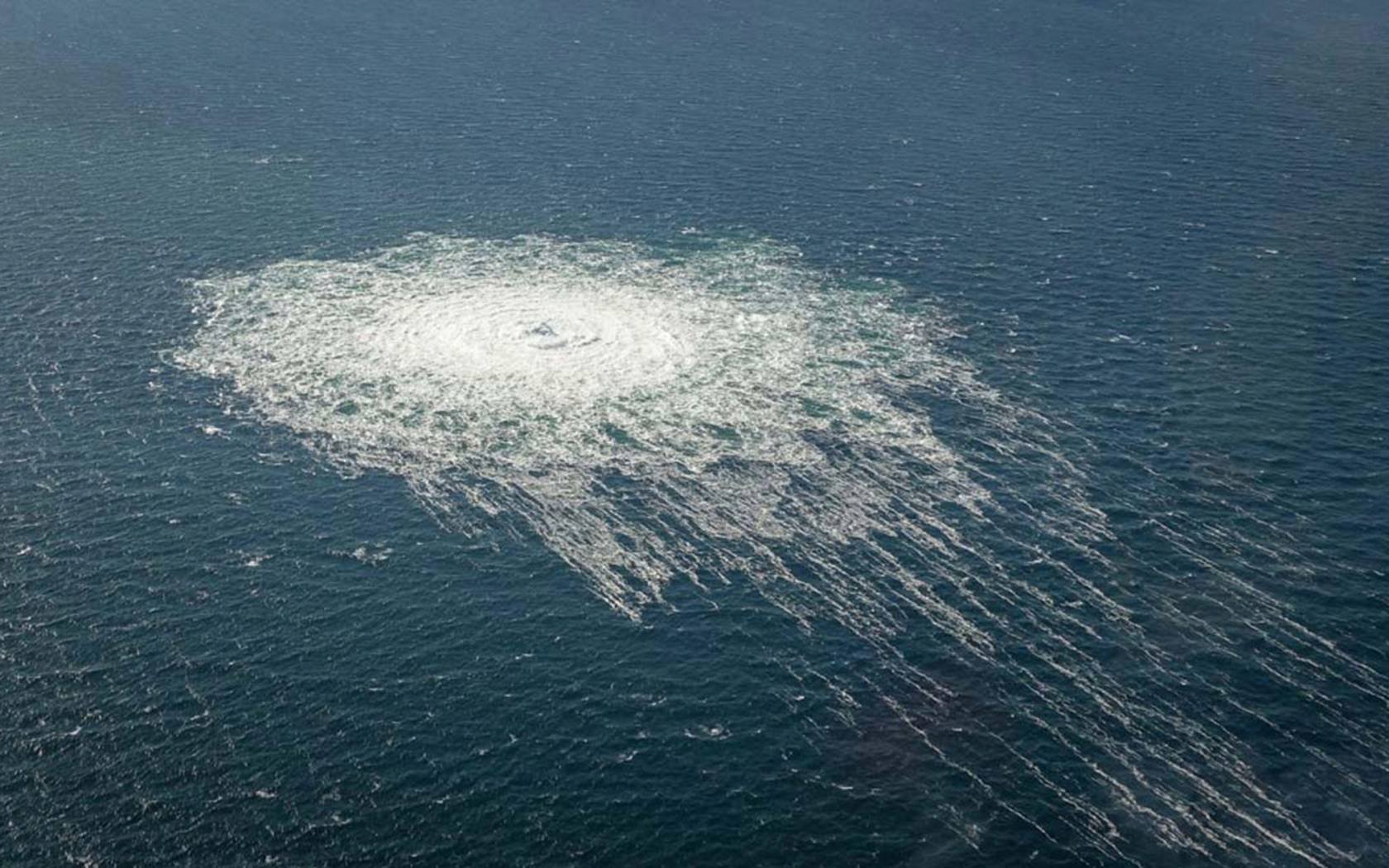
On the night of 26 September 2022, the seabed near Bornholm in the eastern Baltic was violently shaken. At first, seismologists thought they were recording an earthquake, but they were not. Beneath the waters east of Bornholm, enormous explosions had ripped open the Nord Stream pipelines, rupturing three of the four lines that had been built to carry Russian gas to Germany. As millions of cubic metres of gas began bubbling towards the surface, the blame game began. Who was responsible?
It was an extraordinary act of sabotage, certainly, but almost immediately it became something like a geopolitical Rorschach test. For many, the obvious suspect was Russia. Russia had masterminded the Nord Stream pipeline – agreed by Gerhard Schröder, who went on to chair the project’s shareholders’ committee, and championed by Angela Merkel – with the express strategic intention of making Germany, and western Europe by extension, dependent on Russian gas supplies. What the Germans sold to themselves as a noble mission of civilising Moscow by trade – the now infamous Wandel durch Handel – was in reality a Kremlin plot to use economic dependency to induce political dependency – the much less catchy Ohnmacht durch Abhängigkeit.
For those who imagined Russian fingerprints on the crime, the logic ran that Moscow wanted to demonstrate the vulnerability of western infrastructure, to punish Germany for having the temerity to stand up for Ukraine or to frighten European governments into perpetual dithering. Some even painted the affair as an elaborate insurance scam. In that first autumn of the full-scale war in Ukraine, all of these explanations seemed plausible.
Then there was the opposite theory: that the United States was behind it, eliminating a pipeline that Washington had long regarded as a strategic liability, and of which President Biden had warned, weeks before the invasion: ‘We will bring an end to it.’ The veteran journalist Seymour Hersh imagined a spectacular version of the theory, one that inevitably involved a conspiracy at the highest levels of the CIA. Others pointed to Poland, or – hilariously – Britain. Meanwhile, a fourth possibility lurked in the background: that the attack had been carried out by Ukrainians determined to hit Russia in its wallet and render the Russo-German economic relationship lame, once and for all.
For years, these various competing explanations and conspiracy theories have swirled. But now, it seems, the matter can be put to rest. In The Nord Stream Conspiracy, Bojan Pancevski, the Wall Street Journal’s chief European political correspondent, presents us with a plausible, evidence-based conclusion. Pancevski has spent years following the story, speaking to officials and intelligence officers and to those who were close to the operation itself. His conclusion is startling, not least because it is so much less grandiose and elaborate than many of the wild theories that preceded it. The destruction of Nord Stream, he argues, was a Ukrainian operation, authorised at the highest levels of the Ukrainian leadership. It was not the work of a vast American covert-action programme, nor of Russian saboteurs, but of a small group of Ukrainian military and intelligence personnel, using civilian divers, ingenuity and a surprisingly modest budget.
Pancevski deftly reconstructs the background to the operation through a cast of Ukrainian intelligence and military figures whose identities he conceals with codenames to protect them. The group he calls ‘the Startup’ emerged from the strange, improvised world of Ukrainian clandestine warfare. It consisted of veterans of the opening months of the full-scale war as well as intelligence officers and recruits from the world of industry. All of them were men who had learned, during the years of conflict with Russia, to compensate for their limited resources with audacity and ingenuity.
The operation itself reads like fiction. The saboteurs rented a small yacht, the Andromeda, assembled a six-person crew and set out into the Baltic Sea. They faced difficult and sometimes dangerous conditions, descending to the pipelines at depths of around eighty metres to place their explosives. They suffered delays, logistical mishaps and bad weather, but they succeeded, and three of the four lines were destroyed. It was, Pancevski suggests, the most consequential act of sabotage in history.
Alongside the story of the operation, the second great strand of Pancevski’s book is the official investigation by the German authorities: a dogged piece of sleuthing which painstakingly pieced together the fragmentary and often scattered evidence of the crime. For those with a naïve faith in international cooperation, the intelligence world that the investigation revealed is a rather discomfiting one: a world in which governments deflect and obstruct and in which even friendly intelligence services sometimes prefer to withhold critical information.
Pancevski ably combines those twin strands of his story, and the characters involved are well drawn and engaging. The result is a book which rattles along with all the urgency of a thriller. There are moments, perhaps, when an abundance of detail threatens to slow the narrative, but they are few and far between, and the central story is so extraordinary, and so briskly and convincingly told, that it hardly matters.
Most importantly, perhaps, The Nord Stream Conspiracy brings closure to a story that for four years seemed almost designed to defeat coherent explanation. Pancevski has forensically reconstructed the sequence of events that led to the sabotage operation and has explained not only the competing theories as to its authorship, but also the meticulous way that German investigators followed the evidence to its logical conclusion. Questions remain, of course, not least about precisely who in Kyiv knew what and when, but the issue of who sabotaged Nord Stream is now surely settled.
In an age when Ukraine is renowned for its audacious deep strikes against Russian energy infrastructure, it is perhaps easy to forget how confusing the sabotage of Nord Stream appeared when it happened. What remains for us to ponder is not so much the question of who blew up Nord Stream, as what that extraordinary operation tells us about the complex nature of modern warfare.
Roger Moorhouse
More from Geopolitics

Gdynia and the dream of a maritime Poland

Is Latin America’s pink tide ebbing in Brazil?

Hezbollah’s Venezuelan money machine

Japan and South Korea must master transactional diplomacy

The Middle East’s coalitions of convenience



More from War
Gdynia and the dream of a maritime Poland

Vasily Grossman’s account of humanity’s darkest hours

Britain’s information war against Nazi Germany

The coming Turkish-Israeli struggle for supremacy


