The unknown painter behind Manhattan’s Gilded Age interiors
- October 20, 2026
- Jane Coombs
Though his name is all but forgotten, James Wall Finn’s paintings adorn some of Manhattan’s most beautiful rooms. Such obscurity suits a man who sought recognition only from peers and patrons.
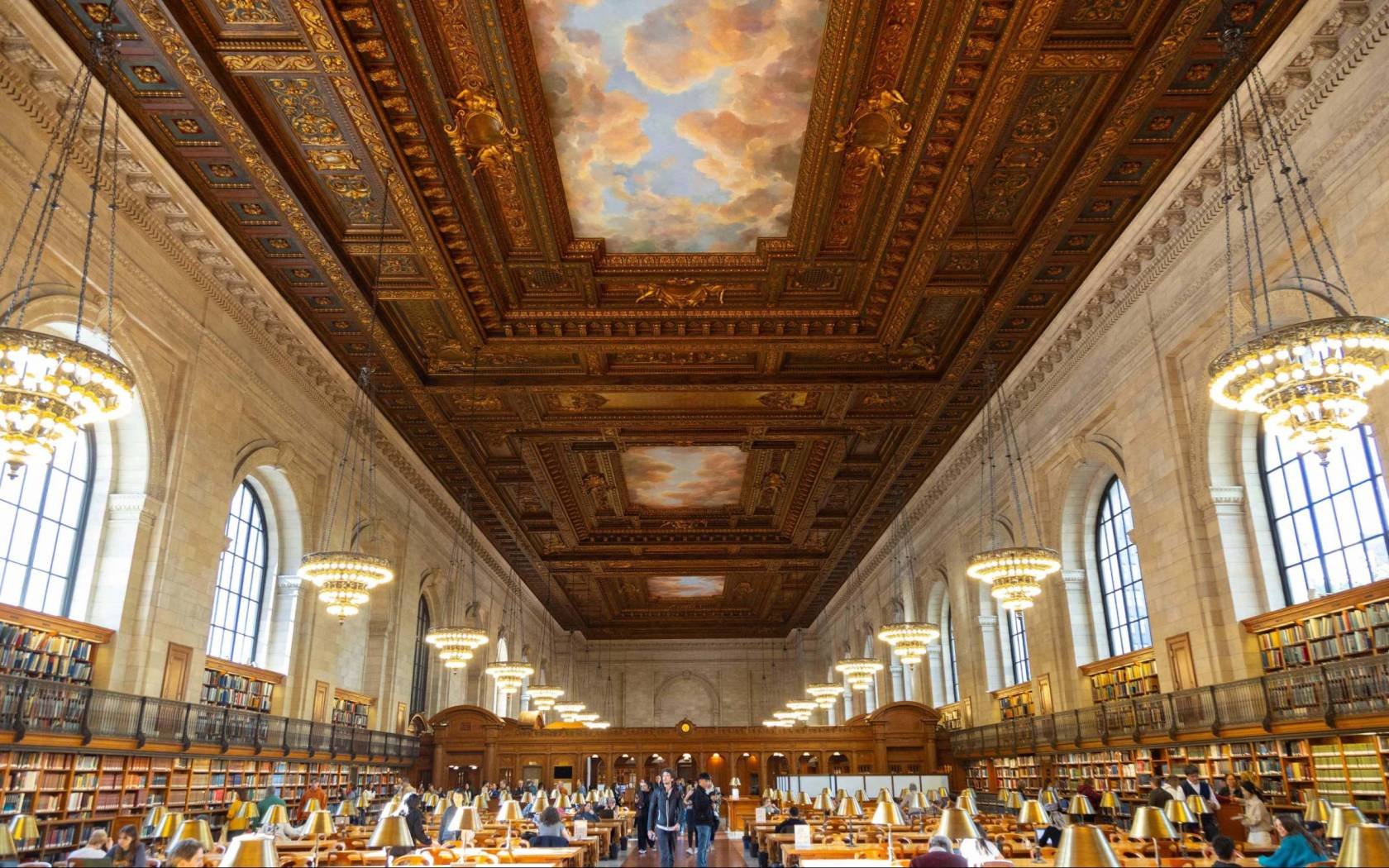
The magic is in the details. A blue sky peeking out between puffs of pink-tinted clouds. A grinning man encircled by a garland held up by two floating cherubs. A smattering of pale green leaves woven across a white trellis. A fading coat of arms on dark coffered wood.
It dawned upon me recently that some of the most beautiful interiors open to the public in Manhattan – the Rose Main Reading Room of the New York Public Library, the Lyceum Theatre, Villa Albertine and the Morgan Library – owe a good deal of their charm to decorative paintings by the same man, James Wall Finn (c.1866-1913).
His name is unknown many of the visitors thronging these beloved spaces, even those familiar with the prominent Gilded Age architectural firms – such as McKim, Mead & White and Carrère & Hastings – and patrons, such as John Jacob Astor IV, William Payne Whitney and JP Morgan, who engaged him for their most ambitious projects. Yet it is worth remembering that there was always a real person behind all that gold leaf and paint.
Finn had the good fortune to live at a time when the best American architects were being trained at the École des Beaux-Arts in Paris, where they learned to approach buildings as complete works of art. Collaborating closely with painters, sculptors and artisans from the earliest stages suddenly became a crucial practice, as architects strove to achieve a unified effect across the exterior and interiors of their constructions.
Finn may well have considered his own obscurity, especially in contrast to his famous rooms, the sign of a job well done. A decorative rather than a fine artist, he was tasked with carrying out the architect’s vision as closely as possible, ensuring that his wall paintings perfectly enhanced every other visual element. A 1910 article in the New York Architect magazine heaps praise on Finn for his ability to do just this, noting that his decoration has ‘attracted attention because of its similarity to the work of the best European masters in the one essential respect – its adaptability to and harmony with the architectural features of the building in which it is found’.
Royal Cortissoz, the staunchly anti-modern yet influential art critic of the New York Tribune, lauded him in similar terms in his 1923 book American Artists. Including the late Finn in his hall-of-fame line-up alongside Winslow Homer and other far more famous painters, he writes that his career was ‘comparatively inconspicuous, but uncommonly rich in good work’. While his technique was so prodigious he could ‘do anything’, it was the Italian Primitives, above all the ‘rich yet restrained method of Pinturicchio’, that he was most passionate about.
These skills and interests no doubt endeared him to the Gilded Age titans funding this ‘American Renaissance’, who were eager not only to display their wealth in their new mansions, but also their erudition and good taste. Often modelling themselves on the Italian patrons of the 15th and 16th centuries, especially in supporting craftsmen and collecting precious artefacts, many also believed they had a moral duty to provide the public with beautiful spaces, such as libraries. Finn was just the man for the task.
For the vast Rose Main Reading Room of the New York Public Library, built by Carrère & Hastings, he smartly emulated Venetian painter Tiepolo’s clear blues and rosy clouds in aperture-like rectangular ceiling paintings (recreations are currently on display; the originals deteriorated due to water damage). Working with Stanford White on the Payne Whitney Mansion on Fifth Avenue, now the French cultural centre Villa Albertine, he took inspiration from Rome’s Villa Giulia for his delicate grapevines and putti adorning the entrance’s shallow dome. He was similarly able to imitate and adapt mythological paintings by Giuseppe Cesari for the ceilings of the Morgan Library’s North Room, originally the office of JP Morgan’s personal librarian Belle da Costa Greene. For Morgan’s sumptuous study, Finn decorated a 16th-century Florentine coffered ceiling (purchased specially by chief architect Charles McKim), with aged-looking coats of arms sourced from a book of Renaissance breastplates. It was done with such accuracy that it has ‘fooled at least one historian’, according to architecture critic Henry Hope Reed Jr.
Finn also lent his hand to popular Broadway theatres. Remnants can still be seen today in the lobby of the Lyceum Theatre, which contains his whimsical portraits of the celebrated 18th-century British actors David Garrick and Sarah Siddons, each flanked by idealised muses in pastoral settings. So enmeshed was he in the theatrical world that he even belonged to the Players, a club primarily for thespians founded by actor Edwin Booth (the respectable brother of John Wilkes).
Much does not survive, including his mural cycle The Seasons, completed for the Fifth Avenue mansion of JJ Astor shortly before Astor went down with the Titanic. The mansion was torn down in 1926; two rooms are now preserved in the Ringling Museum in Sarasota, minus Finn’s paintings. Astor also enlisted him to paint a large mural titled Masque of Flora, much praised but known only from photographs, for the dining room of his Knickerbocker Hotel, later gutted for office space.
How did he win such elite commissions? We can piece together parts of his life from press reports and the writings of his artist friends. Born in New York, Finn appears on the November 1892 register of students at the École des Beaux-Arts atelier of painter-sculptor Jean-Léon Gérôme. He later assisted American artist Edwin Austin Abbey at his studio at Morgan Hall in Fairford, Gloucestershire, overlapping with John Singer Sargent. Abbey was at work on his Arthurian mural cycle, and Sargent on his Triumph of Religion cycle, for the new Boston Public Library designed by McKim.
His early attempts at a career in fine art earned him an honourable mention at the Paris Salon of 1896 for La Boxe américaine, a dramatic painting showing an injured bare-knuckle boxer being carried out of the ring unconscious and nearly naked, amid a crowd of top-hatted spectators. Known only from a catalogue illustration, the painting clearly borrows from depictions of Christ’s descent from the cross in its positioning of the central figure, and gives a tantalising glimpse of the kind of complex work Finn may have created had he ‘made it’ as an easel painter.
Finn returned to Europe fairly often, making copies and sometimes touring with architects to find sources of design inspiration. In 1903 he even bought a house in the artists’ colony at Giverny, Monet’s home, next door to his sculptor friend Frederick MacMonnies. He returned there with his family just before his untimely death in 1913. For his efforts he was handsomely rewarded: newspapers report him leaving $300,000 to his wife in his will.
In 2019, the Greenwich Village Society for Historic Preservation marked his former New York home with a plaque, but I still think it is quite all right if we struggle to remember the names of decorative artists like Finn, and let them rest in unvisited tombs. They sought recognition only from their peers and patrons, after all, not the public. The best tribute is to keep enjoying and preserving the gorgeous spaces they helped make all the more beautiful, and more human.