Thomas Mann’s hideous homecoming
- November 2, 2026
- David Thomson
Paweł Pawlikowski’s ‘Fatherland’ follows the writer through a postwar Germany still haunted by genocide. It is a restrained yet devastating masterpiece.
Imagine something hideous has occurred. Something that seemed like the end of history. Something beyond control or belief. Even so, in defiance of outrage and shame, time has kept passing by. Its flow does not hear our horror. In 1945, ’46 was welcomed in, and so on. No matter that some survivors then were left to wonder if ‘survival’ was worth the having.
In ’45, wistful slogans were exchanged, like ‘victory’ and ‘surrender’, as if it was over and settled. It? The hideousness, the revelation of our nature. I’m not talking about just the physical damage and the human losses: the corpses ploughed back into the ground; the picturesque ruin in the old cities; or even the way some countries were closed down to travel, rescue or hope. I mean the recognition.
There was something worse. It was the realisation that, all over Europe, respectable common people had looked away from the hideous and inhuman and tried to believe it had not occurred. They overlooked the fact that some people had disappeared; they failed to notice the smell and the smoke drifting down the road from that vague institution nearby. So many of them (formerly known as us) had been too crushed and afraid to acknowledge evil. We have the habit of telling ourselves that the hideous is only a story, like a horror film.
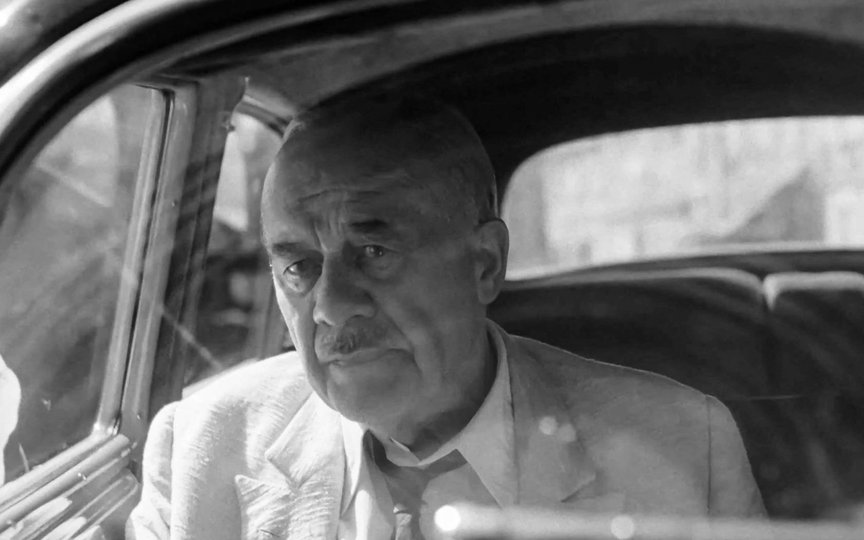
By 1949, Thomas Mann was ‘a great author’ and a German shaken by how the hideousness had been possible. He had escaped once, back in 1933, abandoning Germany for safer places where he could write. He took a stand; he set an example. His Nobel Prize for literature reached back to 1929 and it had recognised Buddenbrooks (1901), Death in Venice (1912) and The Magic Mountain (1924), among other books. Mann had been an American citizen since 1944 and had a home in the Pacific Palisades in Los Angeles, California. He had a wife and six children. He did all he could. In 1947, he published Doktor Faustus (in German first), renewing the warning legend of yielding to the devil. He set the old story in the Germany he had had to give up, and in the Nazi empire that arrived in 1933. But, in 1949, because he had been awarded the Goethe Prize, he went back to his fatherland. In the film, his daughter Erika drives him to Frankfurt to accept the prize. That journey is the structure of Fatherland, the new film by Paweł Pawlikowski.
Mann had done all he could, but he was 74 years of age in 1949 and devastated. He had understood the horror of Germany, though he was not Jewish and not personally persecuted. But his dismay sprang from a sense of horror at what his culture could do. He saw and foresaw the hideousness. That is why his son Klaus had told him to get out of Germany in ’33.
In fact, Fatherland begins with Klaus. It is a single, sustained shot in a bedroom before dawn. The naked figure of Klaus is sitting on the floor next to the bed. There is an androgynous figure in the bed, sleeping or pretending to sleep. Klaus is on the phone talking quietly so as not to wake him/her. He is talking to his sister Erika on the trip she is making with their father. Klaus is about 40, desperate and hopeless. In the course of the conversation, the figure in the bed gets up, naked, and goes to the bathroom for some sort of solace or repair. As I said, this is just one shot, beautiful but fateful, or suicidal. There is something in Klaus that has survived but been ruined. You can feel the dread in the black-and-white photography; it is like a smell. The film creates this with an uncanny stillness, as if the room, the bed, the dawn and the nakedness are eternal – and now.
Klaus’ whispering seems in awe or envy of his father. He is wretched in his own way. But Klaus was a success by 1949. He had become a writer himself and he was known for his novel, Mephisto (1936), the story of a brilliant but unprincipled actor who stayed in Germany and became a Nazi hero. That man, Gustaf Gründgens, had been Klaus’ lover before he married Erika Mann. This is not a simple narrative. The epic title, Fatherland, also makes us aware of intimate family confusions.
Still alive, and active in 1949, Gründgens appears at a reception for the Manns in Frankfurt; he wants to remind Erika of their past and to seek rehabilitation. Instead, she slaps him in the face – it is one of two instances of physical force in this film, in which a background ocean of violence surrounds the desert island of attempts at human decency.
Mephisto is more than a sidebar. Another version of the Faust legend, the novel is the basis for the 1981 movie, Mephisto, by István Szabó, where Klaus Maria Brandauer played an actor named Hendrik Höfgen.
In the film, it is in Frankfurt, too, that Thomas and Erika learn of Klaus’ suicide. Two grandsons of Richard Wagner approach Thomas to win his endorsement for the Bayreuth Festival tributes to the famous composer’s work. But Thomas treats them as accomplices in the Nazi disgrace. He dismisses them, and moves on, held together yet shattered. There is no such thing as lasting survival, or an escape from compromise.
The war is said to be over, but its imprisonment endures. One of the most intriguing things about Fatherland is the way the inescapable confinement of everyone in the hideous experience is offset by the lyrical, expansive freedom of the passing road as seen from the car in which Erika is driving Thomas. Time and again, in broken cities or in the countryside, Pawlikowski gives us these rapturous tracking shots. There is one, in open country, driving towards the sun, seen through a web of trees, that is ravishing. Does that mean life and nature still have a chance in history, or is it a gentle, lethal irony from a director whose work has been distinguished by calm, gracious yet unsentimental views of destruction and dismay in Europe in the 20th century, and now? I am thinking of Ida (2013) and Cold War (2018).
This is history for Pawlikowski and the rest of us. He was born in Warsaw in 1957, during the actual Cold War. He would learn that one of his grandmothers had died in Auschwitz. He was 14 when he and his mother left Poland to live in Britain. Paweł studied literature and philosophy at the University of Oxford, and his first films are English – Last Resort (2000) and My Summer of Love (2004). The latter paired Natalie Press and Emily Blunt (in her first film) as teenagers living in Yorkshire. It views them coolly, from a distance. Pawlikowski has seldom felt an urge to wrap his characters in affection.
Those English movies are romantic and comic, compared with Ida, Cold War and Fatherland, the trilogy that may be the great achievement of modern cinema. Yet there is a modesty to Pawlikowski that is awesome when set beside some grandiloquent, sprawling ‘masterpieces’ of our times. Ida is 82 minutes long; Cold War is 88 minutes; Fatherland is back to 82. We are used to cinematic ambition as big (and pretentious) as battleships. But simplicity and restraint do count for something. Ida won the Oscar for the best foreign-language film; Cold War took the directing prize at Cannes, an award that was repeated earlier this year for Fatherland. Even so, I feel the trilogy has been underrated in the vacuous culture that reckons Christopher Nolan is a master. Pawlikowski does not ask to be loved any more than he sentimentalises his characters.
Which takes me back to the burnished look of these films and their precious instinct that film as an art is misguided in trusting departures from black-and-white imagery. Pawlikowski does not make arty films in which the imagery stops the story to admire itself. But he depends on the force and the simultaneous distancing of black and white, the way it tells us we are seeing something that has been chosen. The choosing is not heavy-handed or an advertisement for the director. It simply fulfils a medium that has it in its power to deliver the real and the lifelike while being inhabited by unseen and poetic feelings for meaning. So in Fatherland the picturing is beautiful but the content – what the film is about – is indelibly hideous.
That is there in the dawn opening that I tried to examine in detail – and that granular detail teaches us how to watch Fatherland, as much as Ida or Cold War. So the highways and the sunlight are set beside the enclosing interiors and the sudden small spurts of outrage. One of these is the slap to Gründgens’ face. The other occurs much later, as the Manns move on from Frankfurt to accept another prize in Weimar, in what was eastern Germany as well as the heart of Hitler’s Reich.
The reception in Weimar is less lavish but as ingratiating and hollow as the treatment in Frankfurt. But it has its slap, too. There is a sudden moment when a man bursts in on Thomas and Erika to tell them that shocking things are still happening. He tells them of camp premises that are used for dissidents or people who are resolved to notice – it is a place called Buchenwald, just outside Weimar, that became available for rent after 1945. Then that man is hurried away by guards who do not need to wear uniform.
The three films are all shot, in whole or in part, by Łukasz Żal, who has also shot Hamnet and Jonathan Glazer’s piercing The Zone of Interest.
There are other credits to note. In that single opening shot, as Klaus Mann, August Diehl establishes a state of mind for the film that reminds us of how he sustained Terrence Malick’s A Hidden Life (2019). The complex but barely written role of Erika is hard to imagine without the intelligence of Sandra Hüller, who by now is established as one of the finest and least vain actresses working in film. Then there is Hanns Zischler as Mann. In advance, one might foresee a magnificent opportunity for acting: the great writer, a tragic father, a remorseless if helpless recorder of history. He seems fit for Anthony Hopkins or Daniel Day-Lewis? No, Mann has to be German. Zischler (generally a supporting actor) is also crushed, mundane and beginning to be overtaken by age. Pawlikowski, Zischler and Żal have combined to let us realise that no ‘greatness’ can challenge the hideous.
All of this means so much more because the details of 1949 are in our past but with us today. Warsaw is still in a danger zone, and the director has gone back to live there. Suicide is more on our minds – not just as a choice but as a way nations seem inclined. Camps are being made available. The betrayal of Ukraine is happening now, instead of in history. There are faces to be slapped. And they are as much ours as those of characters who died a long time ago, some of them well ahead of the official death certificates.
David Thomson


More from Germany

The consumer-voter is killing German politics

Britain and Germany: Europe’s original special relationship

Germany’s flyover country takes its revenge

Germany must relearn the language of power-politics