Thomas Mann’s other fatherland
- October 21, 2026
- Mateusz Stróżyński
Paweł Pawlikowski’s new film shows Thomas Mann adrift in postwar Germany. The novelist had long been drawn eastwards, especially to Poland.
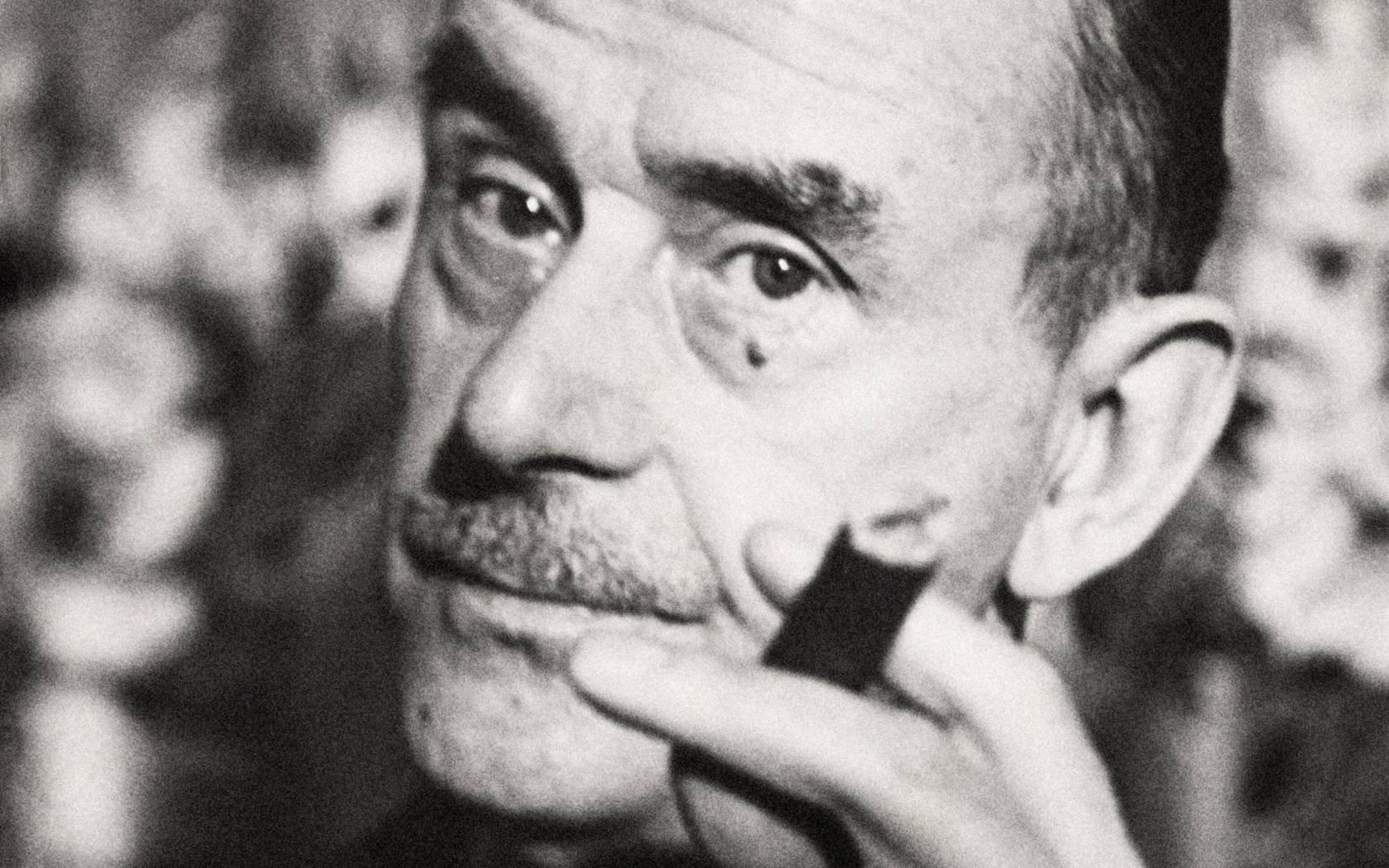
In May of this year, the Polish filmmaker Paweł Pawlikowski received the Best Director award at the Cannes Film Festival for his black-and-white film Fatherland, which tells the story of the great novelist Thomas Mann’s return to Germany after the Second World War. Fatherland concludes what appears to be a trilogy of historical dramas, along with Ida (2013) and Cold War (2018), which were also shot in black and white. Pawlikowski seems to be gesturing towards the famous ‘Three Colours’ trilogy created by his compatriot Krzysztof Kieślowski (Trois Couleurs, 1993-94). There are obvious thematic and stylistic continuities between these films. In the context of this trilogy, it is striking that Fatherland focuses on Germany, while the two preceding films explore postwar communist Poland. Perhaps we can understand Pawlikowski’s decisions better if we remember that Thomas Mann had a complicated relationship with Poland – a relationship that tells us something significant about European culture.
In 1911 Mann spent a holiday on the Lido in Venice, where he was aesthetically and erotically attracted to a Polish boy from an aristocratic family, Władysław ‘Władzio’ Moes – who was 10 at the time. The experience inspired him to write one of his most celebrated works, Death in Venice (published in 1912). The Scottish novelist Gilbert Adair, whose most famous story Love and Death on Long Island (1990) was partly inspired by Death in Venice, wrote a novella-length study about the real as well as the fictional life of Władzio/Tadzio, The Real Tadzio (2001). As it happens, Adair’s book was translated into German, but not into Polish.
Thomas Mann’s literary work was read with great interest in Poland, even at the beginning of the writer’s career. Once Poland had regained independence at the end of the First World War and The Magic Mountain (1924) had made Mann an international celebrity, he came to occupy a commanding presence in Polish culture. His influence would only grow after he was awarded the Nobel Prize in 1929. In March 1927 Mann visited Warsaw at the invitation of the Polish PEN Club and was honoured in the most immoderate terms. There is even a book-length academic study of this visit, edited by Roman Dziergwa, which includes the German and Polish texts of Mann’s speeches, along with the interviews he gave to the press.
The political context of the visit is worthy of note. After the First World War, the Weimar Republic refused to accept its new borders with Poland. The Germans contemptuously referred to their new neighbour as a Saisonstaat (‘a one-season-state’), conspiring with Soviet Russia to bring it down in Rapallo (1922) and waging a trade war against it from 1925 to 1934. Thomas Mann, however, was treated with reverence, not only as an outstanding German writer, but as a semi-official envoy of the Weimar Republic. The PEN Club visit gave hope for some improvement in German-Polish relations.
In Death in Venice, Mann depicts the Grand Hotel des Bains as a symbol of the cosmopolitan, international character of prewar Europe: ‘Subdued voices were speaking most of the principal European tongues. That uniform of civilisation, the conventional evening dress, gave outward conformity to the varied types. There were long, dry Americans, large-familied Russians, English ladies, German children with French bonnes. The Slavic element predominated, it seemed. In Aschenbach’s neighbourhood Polish was being spoken.’
A contemporary reader of the novella unfamiliar with the history of Central and Eastern Europe will not realise that, when Mann wrote these words, there was no country called Poland on any map of Europe. Aschenbach, who delights in the musical, soft tones of Polish, gives not a single thought to the fact that the Poles, unlike the Germans, French, English or Russians, had been robbed of their country, which was then partitioned between Germany, Austria and Russia.
Aschenbach did not seem bothered by the fact that, at the time of his vacation on the Lido, his own fatherland was energetically trying to annihilate the Polish language, its culture and national identity in the parts of Poland Germany ruled. A Prussian Settlement Commission was created by Otto von Bismarck in 1886. Its purpose was the settlement of Germans in Polish territories and the eradication of Polish culture, along with any use of its beautifully melodious language in the public sphere. Between 1908 and 1910, not long before Mann’s stay in Venice, the Commission built its headquarters in Poznań (then the capital of Greater Poland), a grand neo-baroque building, which now belongs to the Faculty of Polish and Classical Philology of Adam Mickiewicz University.
Thomas Mann, unlike the majority of modern readers, was well aware of all of that. He was born in the Hanseatic city of Lübeck and remained acutely conscious that Enlightenment narratives about civilised ‘Western’ Europe and the uncivilised ‘Eastern’ side belong more to literature than reality, despite the very real influence of this concept on the Realpolitik of great powers. The Baltic Sea, indeed the entire Baltic region, play a significant role in Mann’s oeuvre. It is hard to forget the poignantly exquisite descriptions of Baltic Sea beaches in his early novella Tonio Kröger, or the depiction of the eternal nunc stans as a long walk along the beach in The Magic Mountain: the beach where eternity can be glimpsed is, again, a Baltic one.
A few years after his visit to Poland, Mann built a summer home in the picturesque fishing village of Nida, on the Curonian Spit. He wrote much of his tetralogy Joseph and His Brothers (1933-43) there. The house was paid for largely with his Nobel Prize money. His wife Katia had been born into the Pringsheim family, then one of the wealthiest Jewish families in Germany, and critics have noted more than a whiff of antisemitism in Mann’s depictions of his in-laws, most notoriously in his story The Blood of the Walsungs (1905). Nida was, at the time, a part of Lithuania; the Germans annexed it in 1939. Hermann Göring turned Mann’s house into a hunting lodge. Mann loved this sort of irony in literature; it also seems to have permeated his life.
Mann’s sense that not only he, personally, but also all of Germany belonged to Central Europe, existing between the West and the East, can be glimpsed in his political views as well as literary narratives from the period of the First World War and its immediate aftermath. Mann hated the Entente – or rather, its Western participants: France, Great Britain and (from 1917) America. Mann was always capable of delighting in French or English literature, but he nursed a visceral animosity towards what he saw as the rationalistic, abstract, democratic, liberal spirit of the Western anti-German coalition. The humiliations of the Armistice of 1918 and the Versailles Treaty aggravated the feeling, which can be seen throughout what survives of his private (and very frank) diaries from years 1918 to 1921. Some sections were destroyed after his daughter Erika managed to rescue them from the Nazis, who would have given a great deal to make Mann’s private thoughts public. (They appeared in English, abridged, as Diaries 1918-1939.)
In the diaries we find, quite apart from Mann’s astonishing levels of narcissism and hypochondria, an almost absurd diversity of views on international and internal German politics. The world remembers Mann as an American citizen and as the eloquent advocate of liberal democracy that he became in the late 1930s and 1940s. Yet, in the years following the First World War, Mann regularly gave voice to private obsessions of quite a different kind.
On one day he records his hatred for the revolution in Munich, complaining that Bavaria’s new government was run by Jews or ‘the Jewish literati’ (entry on 8 November 1918). On another, Mann would fantasise about a grand alliance between a Communist-led Germany and Soviet Russia that could defeat the despicable coalition of America, Britain and France and establish a Soviet World Republic; this would be ‘good for the case of socialism’ (3 January 1919). On another occasion, still Mann is seen complaining that the revolution disrupts the schedule of his daily walks in a park; we can only hope that this is unrelated to his Palm Sunday conclusion that the Munich revolutionaries should all be shot dead, largely because they failed to win (13 April 1919). A month later Mann welcomes with relief the reactionary ‘White’ forces and their violent anti-communist purges because, as he notes, a military dictatorship is always better than mob rule (5 May 1919).
Earlier, on Easter Sunday, Mann confesses he is almost willing to forgive the Entente, because Winston Churchill has suddenly had a marvellous plan to unite Germany with Britain and France and march against the Soviet Union and Communism in general. However, in the same entry, he changes his mind and decides that it would be better to join the Soviets and destroy the odious capitalists – especially France, this despicable ‘Shylock’, always demanding more money. France, concludes Mann, is fundamentally Jewish in its essence (20 April 1919).
While reading his interwar diaries, we may question whether the great German novelist should have expended any of his considerable talents and literary resources on these intellectual pursuits. In the final year of the First World War, Mann published a 600-page essay on politics – or rather, on the need to stay away from it: Reflections of a Nonpolitical Man. A charitable interpretation might be that his political views are best likened to his complaints about painful dental procedures or the condition of his intestines, which cover as much space in his diaries as his reflections on international affairs. When he notes with satisfaction how he and Katia discovered that mushrooms they had for dinner were the cause of a particularly unpleasant case of diarrhoea, we can almost forgive the great writer the quality of his geopolitical analyses. Something external to him always needed to be blamed for personal discomfort, whether the Entente, the Soviets or poisonous mushrooms.
Mann simply could not imagine a world in which Germany was not among the great powers, or treated with respect, or entitled to an air of cultural superiority over lesser nations. Although he felt personally offended that the German delegation at Versailles was seated at ‘the narrow side of the table between the Czechs and the Romanians’ (7 May 1919), he felt authentic warmth towards Poles throughout his life. More than that, he knew and appreciated Polish literature. Even so, shortly before the end of the First World War he wrote in his diary that, even if the Western powers were to rob Germany of its territories (including those which were given to Poland at Versailles), the Germans would surely ‘correct the injustice’, either in a peaceful manner, or by starting another war (15 October 1918). A chilling comment in hindsight, to be sure, but in the same entry Mann mentions (in addition to the exact price of a goose that he had for dinner, and which seems to have gone down well) that he was contemplating a new novel, and that it would include a character known as ‘Madame Chauchat’, who would become an almost mythical figure in 20th-century literature, and reflect on the Slavic world in general.
If Mann’s attitude towards ‘the West’ (by which he meant France and Britain) was a blend of cultural appreciation and political hatred, his attitude towards ‘the East’ clearly involved a deep fascination, as well as a sympathy: he felt at home in the in-between realm that was Central Europe. In The Magic Mountain, the sublime object of erotic desire, ‘the great Thou’ of Hans Castorp’s life, is a Russian lady, Claudia Chauchat, who boasts distinctly Asiatic features. I have no idea whether Mann read the famous Scythians by Alexander Blok (‘We are the Scythians! We are the slit-eyed Asians!/ Try to wage war with us – you’ll try no more!’), but he certainly loved the imaginative intersection of the East and the West in Central Europe. His works hint throughout that Germany’s relationship to the East is that of a culturally superior coloniser to a fascinating but still essentially inferior element.
You can see glimpses of this in Madame Chauchat, who is a Russian, and a citizen of an empire that Hans Castorp and his comrades-in-arms will invade in 1914. The hint is more clearly visible in Pribislav Hippe, who was not only Hans Castorp’s teenage crush, but also a forerunner of his more mature infatuation with Chauchat. Pribislav Hippe is, like Chauchat, what Blok referred to as ‘a slit-eyed Asian’, but a more familiar type on account of his Slavic descent: he came from Mecklenburg, a region that was gradually colonised by Germans from the Carolingian period onwards. Pribislav is thus a fascinating instance of a Slavic boy turned into a German one because his family lived in the Baltic region.
Mann’s admixture of fascination, adoration and a very German feeling of colonial superiority is also at the heart of Death in Venice. Tadzio and his Polish family are clearly differentiated from the Russian tourists at the Hotel des Bains. When he was working on the novella, Mann couldn’t have known that in real life the Moes family lived in the part of Poland that was under Russian rather than German rule. Nor would he have been aware that the Moes family was largely of Dutch and German descent.
Still, Tadzio, like Hippe and Chauchat, is a symbol of the East for Mann. The beautiful boy belongs to Europe. Aschenbach imagines Tadzio as Phaedrus, a protagonist of Plato’s eponymous dialogue, talking to Socrates in a garden just outside Athens. On the other hand, Tadzio is also envisioned as a stranger, a Dionysus who comes from the savage East to invade European civilisation and its inherent order. We can see this in how Mann links Aschenbach’s love for Tadzio to his contracting cholera. As Mann explains, Asiatic cholera came to Venice from ‘the hot, moist swamps of the delta of the Ganges, where it bred in the mephitic air of that primeval island-jungle, among whose bamboo thickets the tiger crouches, where life of every sort flourishes in rankest abundance’. It spread through to Afghanistan and Persia, finally coming to Moscow in the north, but also to Venice in the south. In the beautiful scene where Aschenbach observes Tadzio and his family praying at the Basilica of San Marco, the church boasts ‘the crowded splendour of the oriental temple’, and its cloying sacrificial incense mingles with ‘the odour of the sickened city’.
Of course, the route from India through Afghanistan and Persia to Europe is the one taken by Dionysus himself, whom Mann refers to in his novella more than once as ‘the stranger god’. He must have been familiar with the prologue to Euripides’ Bacchae, a play that ends in a rather more violent downfall and death than Aschenbach’s in Death in Venice. In The Bacchae, Dionysus proclaims that behind him lie Lydia, Phrygia, Arabia, Bactria and the whole of Asia; now he has come to Greece to demonstrate his divinity to its people. In an intriguing complication, Aschenbach is described as having been born in Silesia, an originally Slavic region, which first belonged to Poland, then to Bohemia, then became Germanised, and finally returned to Poland in 1945. Not only was Aschenbach born in a region between the West and the East, where Poles, Czechs and Germans lived together; his mother was also the daughter of a Bohemian musical conductor. Aschenbach thus partly belongs to the non-German, ‘Eastern’ element of Europe that Mann describes as an ‘ardent, obscure impulse’ present and active in Aschenbach’s unconscious.
It is not a coincidence, then, that Aschenbach has written a book about Frederick II Hohenzollern, whom Germans call ‘the Great’. In fact, Aschenbach’s life-long effort to master his desires and senses to become a true German intellectual is compared by Mann to Frederick’s conquest of Aschenbach’s ‘native province of Silesia’ (referring to the annexation of Habsburg Silesia in 1740, followed soon, we may add, by the annexation of Polish Prussia in 1772). The entire project of Bildung is thus depicted as a colonial conquest of the East and what it represents: ‘beauty constant under torture’, as represented for Aschenbach by the figure of St Sebastian. Frederick II’s homoerotic side seems to have fascinated Mann: when he was still only the Crown Prince, his father, Frederick William I, made him watch the execution of his beloved, so that love and death intertwine in his story as well. Mann associates all this with the image of the first ‘King of Prussia’ as a war-waging German hero who saw himself as the instrument of Enlightenment among the Poles, Lithuanians and native Prussians, whom he contemptuously referred to as ‘the Iroquois of Europe’.
In a recent article on the political views of Mann, the Polish writer and scholar Wojciech Engelking points out that Tadzio functions in Death in Venice in much the same way that war does in Reflections of a Nonpolitical Man. He enables Mann to envisage the union of life and art, ‘noble madness’, which is expressed both in Aschenbach’s love for the Polish boy and in Germany’s world war. The union is violent, to be sure, and in both instances it results in death, but we could add the imaginary geographic dimension to Engelking’s interpretation: it is a union of the West and the East.
Let it be noted that Mann’s ‘colonial’ attitude compares in no way to the one demonstrated by his friend, André Gide, who described his sexual adventures with young Arab boys in Algeria as some kind of spiritual liberation. Nor does Mann’s attitude have anything in common with that of Michel Foucault, who, according to the French essayist Guy Sorman, sexually abused young boys in Tunisian cemeteries. Mann is far less overtly sexual. He is fascinated by the inherent role-reversals in this relationship: Tadzio, after all, is not some Polish ‘Iroquois’, but an overpowering Dionysus who subdues and destroys Aschenbach – who is himself Silesian-born and, through his mother, part Bohemian, and thus a representation of the tensions and conflicts inherent within Europe itself.
Luchino Visconti captured this dimension of Mann’s relation to the East intuitively in his Death in Venice. The film was released in 1971, in a very different international situation; it was shot a few years after the Warsaw Pact invasion of Czechoslovakia, which made even Jean-Paul Sartre feel disappointment with the Soviet Union. Silesia, like other formerly German territories, was Polish now, but Poland, like the eastern part of Germany, now belonged to the new Soviet-Russian Empire. There were no Polish actors in Visconti’s movie, but he included a great deal of Polish-language dialogue in it, as a means of echoing or even magnifying Mann’s descriptions of the Polish language in his novella, where he often compares it to music. Both the actor who plays Tadzio, Björn Andresen (who died last year), and Silvana Mangano, who plays his mother, speak a striking number of Polish phrases. The Italian actress in particular speaks it almost without an accent, although there is a certain artificiality in her manner which can, to some extent, be justified by the dignified, aristocratic demeanour that both Mann and Visconti emphasise as an essential characteristic of this Polish family. Visconti, tellingly, made his Aschenbach a composer rather than a writer.
Curiously, Visconti portrays the Russian element of international society differently from Mann. Although, following the novella, he shows the Russian family at the Hotel des Bains as loud and lively to the point of being vulgar, he also adds an element which isn’t (and couldn’t have been) in Mann. Towards the end of the film, a Russian woman, for quite some time, sings Modest Mussorgsky’s ‘Lullaby’ from his 1875 cycle Songs and Dances of Death. This is almost jarring in a movie which otherwise follows Mann’s text very closely. The melancholy song is completely out of character for the lively Russians whom Mann contrasts in his text with the dignified, subtle Poles. This scene probably results from Visconti’s own notion of the so-called ‘Slavic soul’.
The ‘Slavic soul’ is a purely Russian construct, one that has infuriated Central European writers from Joseph Conrad to Milan Kundera. Despite its lack of connection to reality, the concept continues to retain currency in western Europe and beyond even today. Can we hear in this poignant foreign-sounding song Visconti’s own fascination with the East, as anachronistically embodied in a rich Russian lady who sings it, having supposedly been born in a wild eastern steppe? The Polish émigré writer Gustaw Herling-Grudziński took a harsher view. His contempt for Mann’s ‘solemn hypocrisy’ in politics coloured his judgement not only of the novella but of Visconti’s masterly adaptation, too. He writes in his literary diary (8 April 1973) about Mann: ‘The mandarin of things aesthetic found his ideal cinematographic translator in Luchino Visconti.’
In one of his speeches delivered for the Polish PEN Club in 1927, Mann compared Goethe and Schiller to Dostoyevsky and Tolstoy. This was the only aspect of his visit that provoked substantial criticism among the Polish intelligentsia. Józef Birkenmajer (1897-1939), a Polish classicist and poet, noted bitterly how Mann seemed to think Polish literature to be very similar to its Russian counterpart. Birkenmajer asserted not only that Polish literature has a stronger kinship with Goethe and Schiller, but that it belongs firmly to the West. Birkenmajer, of course, had spent five years as a prisoner of war, first of the Whites and then of the Reds, before returning to Poland in 1920. He was not necessarily disposed favourably towards Russian culture in general. Jarosław Iwaszkiewicz (1894-1980), a great prose writer whose erotic interests and choices strikingly mirrored those of Mann, noted that the German writer didn’t understand that the Poles spoke the same European literary language as he did; on the contrary, he seemed to think, like other ‘Westerners’, that the only way to Poland led through Russia.
It’s hard to tell why Mann made this particular infelicitous comparison, since in his press interviews he emphasised that he was familiar with Adam Mickiewicz and other Polish Romantic poets, and that he especially liked Zygmunt Krasiński’s Undivine Comedy for its conservative, anti-revolutionary stance. However, Iwaszkiewicz and others weren’t aware that, a year before his visit to Poland, Mann had written a preface to the German translation of Joseph Conrad’s novel The Secret Agent. In this preface, he demonstrated a profound understanding of the relationship between Russia, Poland, England and Germany. Mann emphasised the Polishness of Conrad and suggested that he chose to become a British subject, not only because he wanted to be a sailor, but also because of the anti-Russian stance that was shared by Poles and Englishmen alike. Mann noticed with a certain pleasure how Conrad in The Secret Agent depicted the guttural ‘Asiatic’ sounds in the speech of one of the novel’s protagonists, associated with the Eastern contempt for freedom. Joseph Conrad, for Mann, was a Pole who ‘chose the West’, and thus embodied a more general historical orientation of Poland and its place in Europe.
It cannot be said, then, that Mann was trying to understand Poland ‘through Russia’; he knew quite well what Poland was. As an aside, it may be noted that the same Mann who in the above-mentioned 1926 preface described the Soviet Union as a non-European tyranny wrote an obsequious letter to the Soviet Literary Society in April 1937, in which he called the Soviet regime a dictatorship in the service of man, truth, and justice, praising the new Soviet constitution as the embodiment of social democracy. The problem was that Mann didn’t believe a word of his letter; he knew the truth about Soviet totalitarianism and knew that the author of the Soviet constitution, Nikolai Bukharin, had been arrested some months before and been accused of spurious crimes. In his diaries Mann confessed that he usually wrote flattering reviews of books which he didn’t really like, only because he didn’t want to make enemies among fellow writers. He couldn’t resist the temptation to flatter the Soviet Union’s establishment, since he enjoyed a high esteem there, thanks mainly to his old acquaintance, the Hungarian Communist philosopher György Lukács, who considered Mann a genius, despite the fact that Mann had portrayed him, grotesquely at times, as Naphta in The Magic Mountain. Even this unflattering depiction couldn’t shake Lukács’ admiration. Herling-Grudziński comments bitterly: ‘the cloud of incense probably helped to get Mann’s books published in Russia’.
Pawlikowski’s Fatherland shows us this opportunistic face of Mann. In his insatiable craving for applause Mann visits both Western and Eastern Germany. We are reminded of his remark in a diary that his evening was inevitably ruined every time the applause after his speech didn’t last long enough to have him called to the stage a second time. Mann delivers various high-minded speeches about humanity, art and the vocation of an intellectual, while his daughter Erika, presented in the film as refreshingly natural, rightly mocks his pomposity and narcissism. Above all, Mann appears in Fatherland to epitomise the impotent modern intellectual – an ineffectual yet elitist sage whom politicians don’t take seriously, although they are quite eager to use him for their current agenda. Perhaps this is due to the surprisingly vapid acting of Hanns Zischler as the great novelist. Pawlikowski’s Mann has neither fatherland nor home, neither in West Germany, which is going through fake denazification rituals while embracing American pop culture, nor in East Germany, which has turned into a philistine, Soviet-like tyranny, where Goethe is presented as a proto-Marxist and Soviet soldiers entertain Mann with Russian folksongs.
The real Thomas Mann, with all his selfish pettiness, still embodies the great European culture, which, Pawlikowski seems to suggest, is dying today, or perhaps has even committed suicide, just as Mann’s son Klaus does in the film. The most interesting element of Pawlikowski’s film is the final scene, in which Thomas and Erika share a rare moment of real intimacy, while listening to Bach’s chorale Jesus bleibet meine Freude being played in a ruined German church on a pipe organ. This alludes back to the beginning of the film, when Klaus tells Erika over the phone that he doesn’t believe in anything anymore. It also recalls a later scene, in which Erika tells her father about how Klaus said once that Bach’s music makes him almost believe in God. Thomas comments dryly that he thinks this is what Nietzsche said about Beethoven, but in fact Nietzsche said the opposite – namely, that we have to defend ourselves against Beethoven’s music, which, as he warns in Human, All Too Human, can ‘easily produce a resounding of the long silent, even broken, metaphysical string’. But this is a temptation to be overcome for Nietzsche, while for Klaus Mann in Pawlikowski’s film, as for Maurice Spandrell in Aldous Huxley’s Point Counter Point (1928), music (almost) serves as evidence for God’s existence and a praeparatio evangelica.
Mann in Pawlikowski’s film points out to Erika that Johann Sebastian Bach lived in ‘Eastern’ Germany. Well, we may add that Bach proudly bore the title of the Royal Polish and Electoral Saxon Court Composer, which even now shows us how complicated the history of this part of Europe was – a history which the real Thomas Mann knew very well. However we interpret the ending of the film, as either a metaphysical (or religious) experience, or else a moment of human contact in the world falling to pieces, I think Mann would have liked the irony of it. He would, at least, have understood what the title of Bach’s chorale meant. What Europe needs is never to stop listening to this ‘long silent, even broken, metaphysical string’.


