Nasser’s long road to Suez
- November 13, 2026
- Jack Dickens
- Themes: Empire, History, Middle East
The Egyptian leader’s decision to nationalise the Suez Canal in July 1956 was decades in the making.
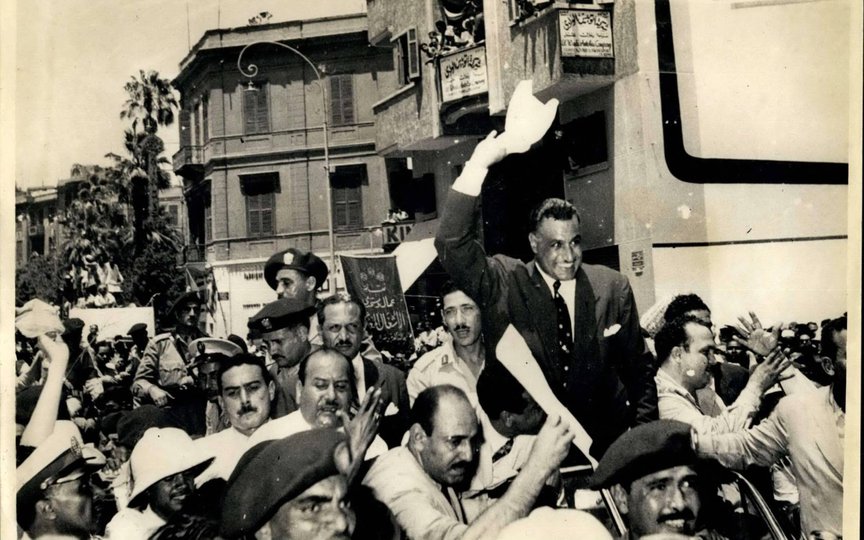
‘We shall not repeat the past. We shall eradicate it by restoring our rights in the Suez Canal… Egypt – the whole of Egypt – one national front – one unified and solid front – announces that it will fight to the last drop of its blood.’ With these words, President Gamal Abdel Nasser fired the opening salvo of the Suez Crisis, bringing his country onto a collision course with Britain and France and triggering an epoch-changing moment in world history. Nasser had arrived in Alexandria’s Al-Manshiya Square on 26 July 1956 to deliver a speech on the revolution that brought him and his fellow ‘Free Officers’ to power four years earlier. Amid the sweltering summer heat, excited crowds of Egyptians lined the streets to watch his motorcade arrive; others packed out Al-Manshiya Square in eager anticipation of what their president would say about his country’s deteriorating relations with the West.
Throughout his speech, Nasser railed against the imperial powers’ humiliation of his country, objecting to their historic control of the Suez Canal Zone through the Suez Canal Company, which he described as ‘a state within a state’. As he recounted the litany of wrongs that had been inflicted on Egypt, there was one name that he repeated over and over again: ‘Ferdinand de Lesseps’, the wily 19th-century French diplomat who negotiated and oversaw the Canal’s construction. Those who listened to Nasser’s speech were somewhat puzzled: why was their president so fixated on repeating the Frenchman’s name?
‘Lesseps’ was a code word. It sent a message to a team of 30 Egyptian officers and engineers who had tuned in to Nasser’s speech on the radio and were poised to take over the Suez Canal Company’s offices in Ismailia, Port Said and Suez itself. After hearing Nasser say de Lesseps’ name, they snapped into action, seizing all three premises in a bloodless takeover. Meanwhile, back in Alexandria, Nasser announced the end of Egypt’s humiliation and the nationalisation of the Canal. The effect on Egyptians around the country was electrifying.
Understanding the road that led Nasser to his decision to nationalise the Canal in July 1956 is important. The 70th anniversary of the Suez Crisis over October–November this year has produced a number of reflections on this episode from the perspective of Anglo-American relations and great-power politics. Commentators have also drawn parallels, some more dubious than others, with the current conflict in Iran. Yet at its heart, this was a crisis centred on Egypt, in which Egyptians also played a significant role. As the historian John Bew recently emphasised on the EI Podcast, the Egyptians ‘had a vote’ in 1956 through ‘their own ability to effect change and alter the political and geostrategic weather’. They were not simply pawns in a higher geopolitical game whose rules could be dictated in London, Paris or Washington.
Nowhere is this insight more important than in considering Nasser’s own motives. The week before Nasser’s nationalisation speech on 26 July 1956, the Eisenhower Administration had announced that it was withdrawing American aid for the Aswan High Dam, a vast hydroelectric project on which Nasser had staked his promise to elevate millions of Egyptians out of poverty. Nasser suspected that the real purpose behind the United States’ sudden withdrawal was to punish him for accepting a Soviet-backed, Czech-brokered arms deal, cut him down to size, and destabilise his government. It was, he told his close adviser and confidant Mohamed Hassanein Heikal, ‘an attack on the regime and an invitation to the people of Egypt to bring it down.’ Facing what he saw as a mortal threat, Nasser opted to nationalise the Suez Canal and use its revenues to finance Egypt’s modernisation.
Eisenhower’s manoeuvre was the straw that broke the camel’s back. But there had been many forks in the path that led to July 1956. In considering Nasser’s decision-making at that particular moment, we also need to appreciate the long and unhappy history of Britain’s imperial entanglements in Egypt. To those listening to his July 1956 speech across Egypt and the Arab world, Nasser described the Suez Canal as ‘an edifice of humiliation’ that had allowed his country to ‘become the property of the Canal’. With bitterness, he recalled the Egyptians who had died digging it, only for the waterway to end up in the hands of European powers. For, as he remarked scathingly, ‘the result of the words of de Lesseps in 1856, the result of friendship and loans, was the occupation of Egypt in 1882.’
In the 1870s, Egypt’s indebted Ottoman viceroy had been compelled to sell off his shares in the Suez Canal Company and to hand over control of the country’s finances to a cartel of European powers led by Britain and France. In 1875, Britain had acquired a 44 per cent stake in the Company, at a time when British trade accounted for 80 per cent of the commercial traffic flowing through the Canal. Then, in 1882, William Gladstone’s Liberal government invaded Egypt after a proto-nationalist revolt led by an Egyptian officer, Colonel Ahmed Urabi, threatened to upend the European system of financial control. Although Urabi was persuaded not to weaponise the Canal Zone, key figures in the Cabinet in London nonetheless became convinced that his revolt posed an imminent threat to freedom of navigation in the waterway, which was regarded as the vital lifeline to India. The revolt was crushed, and so began Britain’s long occupation.
The British expressed their intention to withdraw from Egypt many times after 1882, but failed to do so for one reason or another. In 1914, after the outbreak of the First World War, Egypt was declared a formal British protectorate. This state of affairs would not last: after the British faced a fully fledged national uprising in 1919, Edmund Allenby, the High Commissioner for Egypt and the Sudan, unilaterally declared Egypt’s independence in 1922. It soon became painfully obvious, however, that ‘independence’ meant two very different things to the British on the one hand and the Egyptian nationalist politicians who had led the 1919 revolution on the other.
For the British, independence meant a departure from direct oversight of Egypt’s civil administration while retaining control over the Suez Canal and all locations deemed vital to ‘the security of communications’; they were offering autonomy within the empire. For Egyptians, led by Saad Zaghloul and the liberal-nationalist Wafd Party, independence meant unqualified sovereign independence, including complete control over the Canal Zone, and they continued to call for a British military withdrawal.
Zaghloul’s successor as leader of the Wafd, Mustafa Al-Nahass, was eventually worn down by Britain’s stubborn refusal to withdraw on the nationalists’ terms. After a decade in which British diplomats had played the Egyptian palace against the parliament, stymying reform and sapping the nationalists’ energy, he signed the 1936 Anglo-Egyptian Treaty. Many saw it as a betrayal of the national cause, for it allowed the British to station 10,000 troops in the Canal Zone. And it permitted them to reoccupy the country in the event of war.
The true extent of Britain’s continued influence over Egyptian affairs was soon put to the test. In February 1942, as Erwin Rommel’s panzers menaced British forces in the Western Desert, the British ambassador Sir Miles Lampson took drastic political action in Cairo. Surrounding Abdeen Palace with troops and tanks on 4 February, he forced Egypt’s Axis-sympathetic King Farouk to dismiss his government and appoint a new one led by Britain’s enemies-turned-friends, the Wafd, who supported the Allies.
This palace coup was immortalised in the minds of many Egyptians as the ‘4 February 1942 Incident’. In particular, King Farouk’s capitulation left a deep, searing impression on young Gamal Abdel Nasser and his contemporaries, who viewed it as a national humiliation – a violation of Egypt’s honour, with the corrupt Al-Nahass prostrating himself before the insufferable arrogance of British imperialism.
At this point in time, Nasser was a junior officer in the British-trained Egyptian army, having enrolled in his country’s military academy in 1937. However, since his days as a schoolboy in the 1930s, he had been increasingly drawn to nationalist ideals and political activism. As he later recalled in The Philosophy of the Revolution (1954), ‘the first elements of Arab consciousness began to filter into my mind as a student in secondary schools, from where I went out with my fellow schoolboys to strike… every year as a protest against the Balfour Declaration’. And he wrote, ‘from the bottom of my heart I clamoured for complete independence [for Egypt].’
In his later speeches, Nasser proudly recounted how he joined in and led student demonstrations against the British. This included one in Al-Manshiya Square, Alexandria, the very place from which he would later announce the nationalisation of the Suez Canal. He even had a scar on his forehead, a wound acquired at another protest in 1935 – ‘a mark’, he said, ‘of honour reminding me of my national duty’.
For Nasser, the Abdeen Palace Incident in 1942 was just one of many insults that the British had dealt Egypt and its people, including the 1882 occupation and the 1936 Anglo-Egyptian Treaty. He proclaimed that, in the aftermath of the events of 4 February 1942, he and his fellow officers ‘spoke not of corruption and pleasure, but of sacrifice and of their willingness to give up their lives to save their country’s dignity… to redeem their country’s honour and to wash this shame away with their very blood.’ Like many disenchanted nationalists across the Arab world in the 1930s, he saw the army as a vehicle for personal advancement and national salvation.
His next formative experience came not in Egypt itself, but in Palestine, which erupted into civil war at the end of the British Mandate. Following the declaration of the State of Israel in May 1948, the Egyptian government committed the army to fight the Jewish forces, an intervention that ended in disaster and defeat for the Arab states. During the fighting, Nasser and his men were surrounded and bombarded by the Israelis in the Faluja Pocket, a Palestinian Arab village to the northeast of Gaza City; Nasser himself was wounded during the fighting. He and his men were eventually forced to withdraw ignominiously after the Egyptian government signed an armistice with Israel in February 1949.
Nasser’s war was over, but the experience of defeat had further convinced him that only sweeping change at home could restore Egypt’s fortunes. As he explained in The Philosophy of the Revolution:
As I trace the details of our experience in Palestine I feel a strange sensation. We were fighting in Palestine but our dreams were in Egypt… our hearts were hovering round our distant Mother Country, which was then a prey to the wolves that ravaged it. (…) We spoke of nothing but our country and how to deliver it.
In the years that followed the disaster in Palestine, Nasser’s fellow travellers in the Egyptian officer corps committed themselves to delivering Egypt from Britain’s continuing imperial presence. They organised into a clandestine group called the ‘Free Officers’, a vanguard within the army that also included Anwar Sadat, who would later succeed Nasser as president of Egypt.
Meanwhile, British troops remained in command of the Suez Canal. Worse still, the same carousel of corrupt and ineffectual politicians continued to hold power; their strategy of trying to talk the British out of the country had led to dead end after dead end. The solution, Nasser and his allies in the officer corps concluded, was for the Free Officers to organise secret cells, bide their time, and prepare to combat the British presence in Egypt wherever possible. They did not yet envisage seizing power – that would come later.
The Free Officers’ moment arrived after Egypt became engulfed in crisis during 1951–52. Al-Nahass and the Wafd had formed a government following elections in 1950, and swiftly resumed negotiations with the British to secure Egypt’s elusive independence. Yet after 19 months of diplomatic discussions had led nowhere, in October 1951 Al-Nahass and the Wafd government finally took the decision to abrogate unilaterally the 1936 Anglo-Egyptian Treaty. It was an act of desperation – and it plunged Egypt into chaos.
Thousands of Egyptians now mobilised in bands of guerrilla fighters, seeking to oust the British troops from the Canal Zone. People of all political persuasions – Wafdists, Communists, Islamists – and all walks of life, including peasants, workers and students, pledged to resist the British to the last bullet. Battles were fought between British forces and Egyptian policemen on the streets of Ismailia; trade unions declared a general strike; and tens of thousands flocked to Cairo on 26 January 1952 for a mass demonstration, a display of force that degenerated into a furious surge of rioting, looting and arson known as ‘Black Saturday’, in which over 50 Egyptians and 17 foreigners were killed by roaming mobs. The violence eventually subsided, but, as Eugene Rogan writes, these ‘terrible events… spelled the end of the political order in Egypt’.
Having witnessed the abject failure of parliamentary life in Egypt, and the country’s spiral into anarchy, the Free Officers put their faith in a military solution. They began to conspire to overthrow King Farouk, dismiss the country’s politicians, and impose a solution to the national crisis. It was his duty as a soldier, Nasser later wrote, to save the country from catastrophe: ‘“If the army does not move,” we said to ourselves, “who else will?”’
Six months after Black Saturday, the Free Officers carried out a successful coup in Cairo during the small hours of 23 July 1952, a development greeted with elation by many across the country. Nasser and his co-conspirators now commanded the state. Uncertain at first, they soon launched a social revolution, purged political life of opponents, and opened their own negotiations with the British, under the auspices of the United States, calling for Britain’s complete withdrawal from Egypt. This time, although the negotiations were tortuous, they ultimately succeeded: a new treaty between Britain and Egypt was signed in October 1954, and the final British soldier departed in June 1956.
Nasser and the Free Officers thus succeeded where previous Egyptian governments had failed: they had secured a full British withdrawal. Having travelled the long road to national independence, they were wary of entering into any new agreements that, they feared, might bind them into a form of post-colonial dependence. Thus, when the Eisenhower Administration insisted that American military aid would be contingent on Egypt joining a new US-led regional defence pact, the Middle East Defense Organization, that would bring Egypt into a formal alliance with Washington and Britain against the Soviet Union, Nasser baulked at the prospect. To have consented would have been political suicide.
The story of the Suez intervention is well known. What should be remembered, however, is the degree to which the British Prime Minister Anthony Eden underestimated the depth of Egyptian support for Nasser and his regime. In the Cabinet, Nasser was dismissed as ‘an Asiatic Mussolini’ and parallels were drawn with the appeasement of Hitler in the 1930s. Yet, to many Egyptians, Nasser resembled something closer to an Arab Churchill. At the height of the Franco-British-Israeli invasion, Nawal El Saadawi, a doctor in a rural village in the Nile Delta, recalled hearing Nasser’s voice resounding ‘from thousands of radios’, proclaiming ‘We shall go on fighting until the invaders leave. We will never surrender.’
As for the British, they opened themselves up to the criticism that they were running roughshod over the very principles for which they had fought the Second World War. The irony was not lost on Nasser. In a speech delivered in September 1956, as British and French politicians bristled at the nationalisation of the Suez Canal Company, he declared: ‘I am speaking in the name of the principles proclaimed by these countries in the Atlantic Charter. But they are now violating these principles and it has become our lot to shoulder the responsibility of reaffirming and establishing them anew.’ The implication was clear: having won the war in the name of the freedom of small countries, the British could not now turn back the clock as if they were engaged in a re-run of the 1882 occupation.
In the end, Nasser’s gamble worked. President Eisenhower’s intervention forced the British and French to back down, expediting the retrenchment of British power in the Middle East and asserting the predominance of American influence over the region. Suez demonstrated the futility of undertaking such a major military operation without prior coordination with Washington. Paradoxically, however, it also ushered in a new era of post-imperial British interventions in the region, ranging from the Omani insurgency of 1957–59 to the Iraq invasion of 2003.
As for Nasser, he became the hero of the Arab world, riding a wave of Arab nationalist fervour that swept across the Levant and beyond. Britain’s reputation in the region, meanwhile, had been damaged. Nasser’s confidant Heikal perhaps exaggerated, but only slightly, when he wrote that ‘Suez cost Britain Arabia’.


