1956: a prophetic year
- November 10, 2026
- Gill Bennett
- Themes: Geopolitics, History, Middle East
Though Suez and Hungary dominate memories of 1956, it was a year in which the apparently firm ground of the wider postwar world began to develop destabilising cracks.
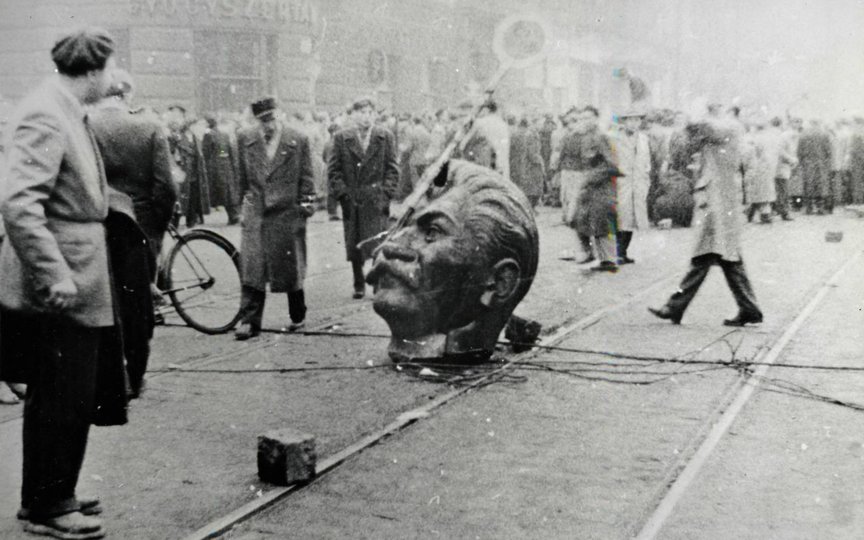
Seventy years on, commentary on the year 1956 tends to focus on the Suez crisis that disrupted international relations from the end of July, and on the Hungarian uprising that began at the end of October. Both were certainly noteworthy international developments, but they were neither isolated nor unconnected. For 1956 was a year in which the apparently firm ground, solidified in the decade that followed the end of the Second World War and assumed to underpin the edifice of global power, began to develop destabilising cracks with profound implications for the future. These cracks did not appear suddenly: some were present even as the postwar foundations were laid; but 1956 revealed their depth and dynamic potential. Decision-makers in 1956 did not have the benefit of hindsight in detecting these shifts; but if they had been willing to recognise them as they appeared beneath their feet, they might have learned better to deal with them as the cracks widened still further.
Four areas of shifting sands from 1956 remain particularly relevant in 2026. The basis of Soviet power and influence showed signs of crumbling, not just in the Eastern bloc but globally. Certainly, the Hungarian uprising was suppressed brutally; but Khrushchev’s speech of 25 February repudiating Stalinism reverberated round the communist world, disturbing stones if not yet starting an avalanche. As Foreign Office official Thomas Brimelow noted, for the first time in a decade the Russians were confronted by the reality of a popular discontent they had underestimated consistently. The doctrine of ‘different roads to socialism’ led inevitably to a slackening of Soviet control. That slackening was noticed elsewhere: in China, in Yugoslavia, and in areas such as the Middle East and Africa where the USSR lobbied (and spied) hard and spent freely to extend its influence.
Leaders like Nasser in Egypt saw the potential of playing East and West off against each other, and the nascent non-aligned movement attracted new followers. The Suez Crisis, while serving Soviet purposes in creating divisions within NATO and disturbing Anglo-American solidarity briefly, also indicated to some Arab states that if Israel attacked them they could not look to Moscow for help, while Soviet actions in Hungary alienated many in the Afro-Asian bloc. Although the Cold War did not end for another 30 years or so, and Soviet/Russian troops would invade elsewhere on various pretexts, the cracks in the bloc in 1956 were prophetic.
Cracks had been opening under the feet of the British government ever since it emerged victorious, but bankrupt, from the Second World War. Britain remained a great power, a close ally of the United States, and a member of the UN Security Council, playing a major role in the creation of the Western security establishment including NATO. It was also a nuclear power with genuine global ‘reach’. But economically and militarily British power was on a downward trajectory that the events of 1956 accelerated. It was never a realistic proposition to reverse Nasser’s nationalisation of the Suez Canal with British forces alone, nor would Nasser’s removal solve the problem (as both the Joint Intelligence Committee and Eisenhower predicted).
The scheme for Israel to invade Egypt so that Anglo-French forces could ‘enforce a ceasefire’ was ill-conceived, and the way it was brought to an end by the Americans was seen in London as humiliating, though the episode did not cause a major breach in the Anglo-US relationship (as Eisenhower assured Eden, telephoning him on the day of the US presidential election). But the widening gulf between available resources and what Britain wanted and believed it should be able to achieve was exposed brutally; and, like the shifting base of Soviet power, was watched closely by others across the world.
In addition, the Suez Crisis revealed – or should have done – to the CIA that the wartime days of death-or-glory exploits when American agents could achieve anything had gone; despite much discussion and excited planning with MI6, which had its share of nostalgic carpetbaggers, neither could offer a practical solution to dealing with Nasser (which was one reason for Eden’s exasperated adoption of the French/Israeli scheme).
A related area of shifting sands was decolonisation, and trends in the developing world. The movement towards independence of territories hitherto ruled by colonial powers such as Britain, France and the Netherlands was well underway by 1956 and would accelerate in the next decade. Two aspects of this shift became clearer in 1956: the foreign policies of the colonial powers were affected profoundly by their anxieties over future relations with those territories that had become, or wished to become, independent.
For the British, relations with Singapore, Cyprus and Malta all caused political difficulties in 1956, while anti-British sentiment in the Middle East increased under the influence of Nasser (whose disruptive activities extended across the globe). For the French, the real anxiety was about Algeria, a prime reason for their enthusiasm for the plan to unseat Nasser. In 1956, the idea of Algerian independence was unthinkable in Paris, just as the idea that Britain was losing its ‘special position’ in the Gulf States was unacceptable in London, despite increasing American dominance and support for Saudi interests. The US government, loud in its condemnation of ‘imperialism’, nevertheless valued a British global presence for its own purposes: as the CIA’s Frank Wisner had once told Kim Philby that ‘whenever we want to subvert any place, we find that the British own an island within easy reach’.
Meanwhile, newly independent or emerging countries drew their own conclusions from the events of 1956, on the one hand rejecting the idea that major powers could invade and impose their will, while on the other refusing to let largesse from Moscow or Washington buy their allegiance. All this produced a shifting landscape, with cracks opening in 1956 that would extend to Vietnam, and beyond.
Chinese developments also caused disturbances to the foundations of the global system in 1956. While the US administration still insisted on recognising the Nationalists, exiled in Formosa (Taiwan), as the legitimate government, by 1956 even Washington accepted in practice that the communist regime was in control of the mainland (as British foreign secretary Selwyn Lloyd observed, the Americans did not seem to know what sort of relationship they wanted with China). The leaders of the People’s Republic, ruling a vast land area with multiple borders, kept a close eye on Moscow and observed that Soviet methods of dealing with opposition in the territories under its control were crude and not wholly effective; alternative models might be adopted, but absolute control was essential.
In policies pursued towards two territories perceived as Chinese but not yet under Beijing’s direct control, Hong Kong and Taiwan, Beijing also learned from Soviet strategies that it would deploy in the decades that followed: subverting Western influence through stimulating unrest that it blamed on ‘foreign agents’; using espionage; and offering financial inducements, particularly in infrastructure – methods that in the longer term would achieve results without direct military action. The ‘rise of China’ has not been without setbacks, but events in 1956 helped set the course.
Despite the major moves towards European integration that took place in 1956, as the Six moved towards the creation of the European Economic Community, they did not mark a dramatic shift in status. While the Community has expanded greatly since then, the innate tensions between its members, the competing leadership roles of France and Germany, and the ambivalent attitude of successive British governments (in 1956 they did not want to join the EEC but did not want it to succeed without them), remain remarkably constant.
And there are other sands that did not shift in 1956: Arab hostility to Israel and Israel’s conviction that only aggressive self-defence assures its survival as a state; the unresolved issue of a Palestine settlement, pursued throughout 1956 and beyond by many different players; Russia’s self-confidence in its identity as a great power despite its economic weakness, its resentment of a supposed Western conspiracy to deny that identity and its aggressive use of espionage and subversion in response; Britain’s attempt to balance the roles of close American ally and European partner; the importance, in dangerous times, of being a power with its own nuclear arsenal; debates within NATO about the scale of relative contributions; and – a marked feature of US policy throughout 1956 – the determination of American administrations to act as they see fit in their own interests without consultation (or even communication) with their allies.
Sadly, these trends and attitudes remain hard to shift or resolve; but the changes in train during 1956 remain instructive.


