The long battle with Russia for the Black Sea
- November 23, 2026
- Dimitar Bechev
- Themes: Eastern Europe, Europe, Geopolitics, Turkey, Ukraine
Russia’s war in Ukraine has returned the Black Sea to the heart of European geopolitics.
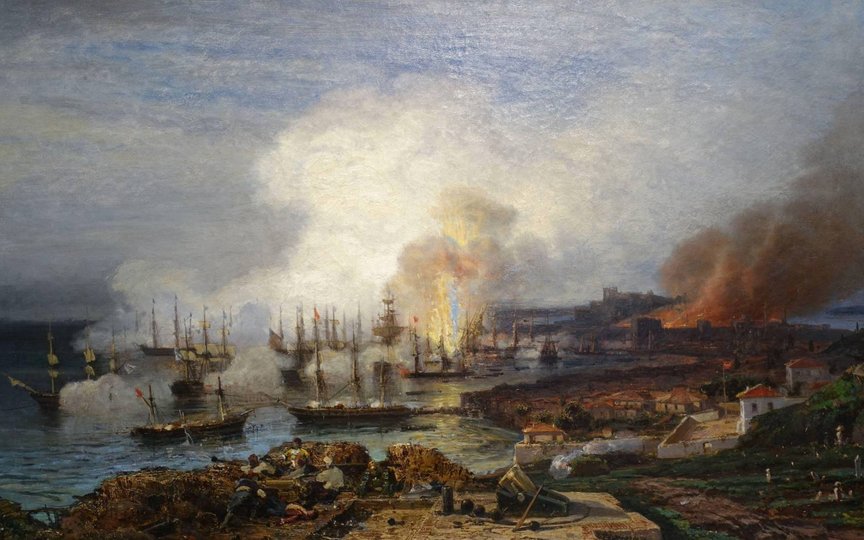
Among the countless anniversaries we are marking this year – the American Declaration of Independence, the Suez Crisis and the Brexit Referendum, to name three – one certainly does not get the attention it deserves. Though it was to be overshadowed by subsequent conflicts and diplomatic milestones, the 1856 Treaty of Paris ending the Crimean War left a lasting imprint on European affairs. Not only that, but it resonates with the present moment. As it was 170 years ago, the Black Sea is again at the centre of the continent’s geopolitics. Should they rise from the grave by a miracle, Lord Clarendon and Count Walewski, the British and French signatories at Paris (the latter of whom was also Napoleon’s illegitimate son in addition to serving as Napoleon III’s foreign minister) would probably see it as a case of plus ça change, plus c’est la même chose. The dual challenge of containing Russia while crafting a reasonably functional relationship with Turkey continues to weigh on European decision-makers’ shoulders as it did in the 1850s.
One can stretch analogies with past eras only so far. The Europe of today has plenty more strategic headaches, including how to handle a mercurial United States, while ensuring Ukraine’s survival as a state and future integration into the European Union-led political, economic and institutional order. But again, the Black Sea is at the crux of these dilemmas. History does rhyme.
The Black Sea is certainly on the radar of those who have been following Russia’s war in Ukraine. Armed with a new, jet-propelled modification of the Geran drone system, Russian forces have been inflicting severe damage on Ukrainian port infrastructure. Russia’s goal is clear: strangle the Ukrainian economy in order to squeeze Kyiv further. In turn, Ukrainians have been targeting tankers from Russia’s so-called shadow fleet to disrupt the export of crude oil.
What’s new is Russia’s decision to bring naval warfare to the western shore of the Black Sea. Gerans and surface drones are wreaking havoc on commercial shipping off the coasts of Romania and Bulgaria. Since early October, 13 vessels bound for, leaving or located close to Romanian and Moldovan ports have been hit. Most incidents have taken place in either Romania or Bulgaria’s exclusive economic zones (EEZs). Of those, five have sunk (as of 17 November) and at least 34 sailors are either missing or confirmed dead.
The Russian campaign has also had a considerable economic impact, diverting traffic away from the Black Sea and inflating shipping costs. As far as insurers are concerned, risks are higher than in the Strait of Hormuz. The war-risk premium on some routes to Ukrainian and Russian ports reached 20 per cent of the vessel’s value compared to five or six per cent for the Gulf. Along the Romanian/Bulgarian route, insurance charges have risen fivefold since September, from 0.1 per cent to 0.5 per cent.
Yet it is the Black Sea crisis’ effect on security in Europe that matters most. The strikes are taking place on the edge of NATO and EU members’ territorial waters. On 14 October, the Comoros-flagged chemical and oil tanker Yara J was struck inside Romania’s 12-nautical-mile sovereign zone. The risk of further deterioration is very real. Soon after the 14 October attack, Romanian F-16s downed Russian UAVs entering the country’s airspace. Both NATO and the EU have raised alarm, with the US and France deploying patrol aircraft in Varna and Constanța respectively. Romania and even Bulgaria, the latter of which has taken a pro-Russian turn under the leadership of Prime Minister Rumen Radev, are looking for options to upgrade anti-drone defences. Both are doubling down on three-way naval cooperation with Turkey, too, in order to dissuade Russia from behaving recklessly.
In the meantime, Ukraine is not staying idle. Attacks by drones and missiles on 16-17 November brought down one of the arches in the middle of the 19-kilometre bridge connecting Crimea to the Russian mainland. One of the road spans has been severely damaged, with another assault following on 19 November. The access to the Sea of Azov, effectively a Russian lake since 2022, has been blocked. Russian grain exports are bound to suffer as a result. Unfortunately, that is not likely to persuade the Kremlin that the time is ripe for a moratorium on strikes against merchant vessels.
All in all, the Black Sea is currently the flashpoint where the Western bloc and Russia are facing off. Dreading the spillover from the conflict in Ukraine, European policy-makers have long kept a wary eye on the Baltic states. Now they are looking south as well.
That the Black Sea has become such a major preoccupation is a novel development. Neither during the 2008 Russia-Georgia War, nor even in 2014, when Putin’s ‘little green men’ seized Crimea in a special military operation, did the region move centre stage. In the first instance, French President Nicolas Sarkozy brokered a ceasefire. The EU deployed a civilian monitoring mission between Georgia and the breakaway regions of South Ossetia and Abkhazia, de facto Russian protectorates, but did not really claim a greater security role. The following year, the Obama administration in the US launched its reset with Russia, one focused almost exclusively on strategic nuclear stability.
By taking Crimea in 2014, Moscow asserted its primacy in the Black Sea, but the Kremlin’s actions did not really trigger any pushback. Turkey, meanwhile, went along with the fait accompli. Following a period of tensions with Russia in 2015-16, President Recep Tayyip Erdoğan sought conciliation with Putin with a view to possibly co-manage Syria. The Minsk Accords championed by France and Germany in 2014-15 focused on the Donbas, in effect accepting Russia’s control over Crimea. NATO upped its support for allies but, unlike in the Baltic, its ‘tailored forward presence’ did not entail the deployment of troops in the Black Sea littoral. A Western containment strategy focusing on the Black Sea was at best rudimentary, at worst absent.
Much has changed since. There is a realisation that access to the Black Sea is a fundamental precondition for Ukraine’s survival as an independent state. In fact, the Ukrainians’ early success in forestalling a Russian takeover of Odesa and Mykolaiv, along with the subsequent liberation of Kherson in the autumn of 2022, turned out to be nothing short of a strategic coup.
Securing the navigation routes in the western third of the sea will remain an imperative for Western policy. Together with building up defences along the shores of Romania and Bulgaria and protecting critical infrastructure – e.g. the offshore gas fields in the Romanian EEZ – this task elevates the south-eastern flank’s status in the emerging strategy. To put it another way, the maritime domain is just as critical in terms of managing the confrontation with Russia as policing the future demarcation line between the Russian-occupied areas of Ukraine and the territory remaining under Kyiv’s remit.
The Black Sea testifies to Turkey’s enduring importance for European security, another crucial issue that policymakers have been grappling with for decades. Under Erdoğan, Ankara recast itself from a perennial candidate for EU membership into a regional powerhouse in its own right. The shift is manifest, among other things, in Turkish foreign policy turning to the Middle East and Muslim-majority countries more broadly. But Russia’s full-scale invasion has demonstrated the extent to which Turkey remains anchored in the wider European scene. It has been backing Ukraine by keeping the Turkish Straits closed to warships and sending aid while serving as an intermediary with the Russians.
At the same time, European leaders have made a clear effort to keep Turkey and Erdoğan personally onside, through initiatives such as the European Political Community. The recent clampdown on Turkish opposition has not led to a breakdown of the relationship, as it might have done in former times. The Turks, in turn, have been trying to insert their country into EU-led platforms geared towards rearmament, such as the SAFE programme. They have also emphasised their country’s weight in NATO, most recently by hosting a summit for the alliance in the summer. Turkish involvement also extends to infrastructure and connectivity projects supported by Brussels.
Turkey has been busy of late. In September, it floated a plan for de-escalation in the Black Sea, mindful of the risks for commercial traffic. Equally, Turkey is committing to security cooperation with Romania and Bulgaria via a mine-clearance operation in the Black Sea, which has now been extended to intelligence sharing. Though it is reluctant to call out Russia for the strikes, Ankara is strongly signalling its concern for freedom of navigation. For this reason, Turkey is also leading on the naval dimension of the ‘coalition of the willing’. Any future ceasefire deal in Ukraine is likely to bear some Turkish imprint.
One cannot miss the irony here. Since NATO came to the region in 2004, with Romania and Bulgaria’s accession to the transatlantic alliance, Turkey has jealously guarded the Black Sea, viewing it primarily as a Russian-Turkish condominium. Ankara enforced scrupulously the 1936 Montreux Convention limiting the presence of non-littoral navies in peacetime and excluding them during war. Now, conflict has transformed the Black Sea into Turkey’s ticket to Europe. Turkey is leveraging its geographical position and power status to claim a stake in European politics writ large. But the most effective means to do that is through NATO, an organisation that, thanks to Russian aggression, is more firmly anchored in the Black Sea than ever. Though it still pays lip service to ‘regional ownership’, Turkey, in its particular way, is complicit in the NATO-isation and EU-isation of the area, something Ukraine appreciates.
A word to be said about another European power: the United Kingdom. The Royal Navy left the Black Sea in the summer of 2021 upon the conclusion of the annual Sea Breeze drill. But the UK is present nonetheless. Together with Norway, Britain is in the lead when it comes to developing Ukraine’s navy. It funds the acquisition of new capabilities by Kyiv, including reconnaissance drones and uncrewed surface platforms. The UK shares intelligence, enabling Ukraine to strike Russian targets at sea and onshore, too. The RAF has been contributing to NATO air policing over Romania and Bulgaria since 2014. In short, the Black Sea furnishes endless examples of how the post-Brexit UK remains deeply embedded in continental security.
The Crimean War of the 1850s might be a faded memory. Looking at some of the same dramatis personae locked in a power struggle in the Black Sea, however, it is hard to resist the temptation to draw analogies. Optimists would suggest that now, as then, Russia could be checked, brought to its senses and forced to settle. Pessimists would probably retort that several circumstances have altered the nature of the game. These include advances in fields of technology, such as AI, in which Europe is falling behind, and the destabilisation of the continent’s overall security architecture, caused by the transformation of the United States from a cornerstone of European stability into a wildcard.
Under these conditions, the best hope for Europe is to contain Russia over the long haul through an imperfect coalition of states, notably with a swing actor such as Turkey playing an important role. Either way, the Black Sea is no longer a sideshow in Europe. It is once again at the heart of the continent’s geopolitics.