A debrief with Ukraine’s soldiers
- October 20, 2026
- Peter Caddick-Adams
- Themes: Defence, Geopolitics, History, Ukraine, War
Ukrainian soldiers returning from the frontline reveal that it is now a vast space policed by drones, in which death is a constant presence.
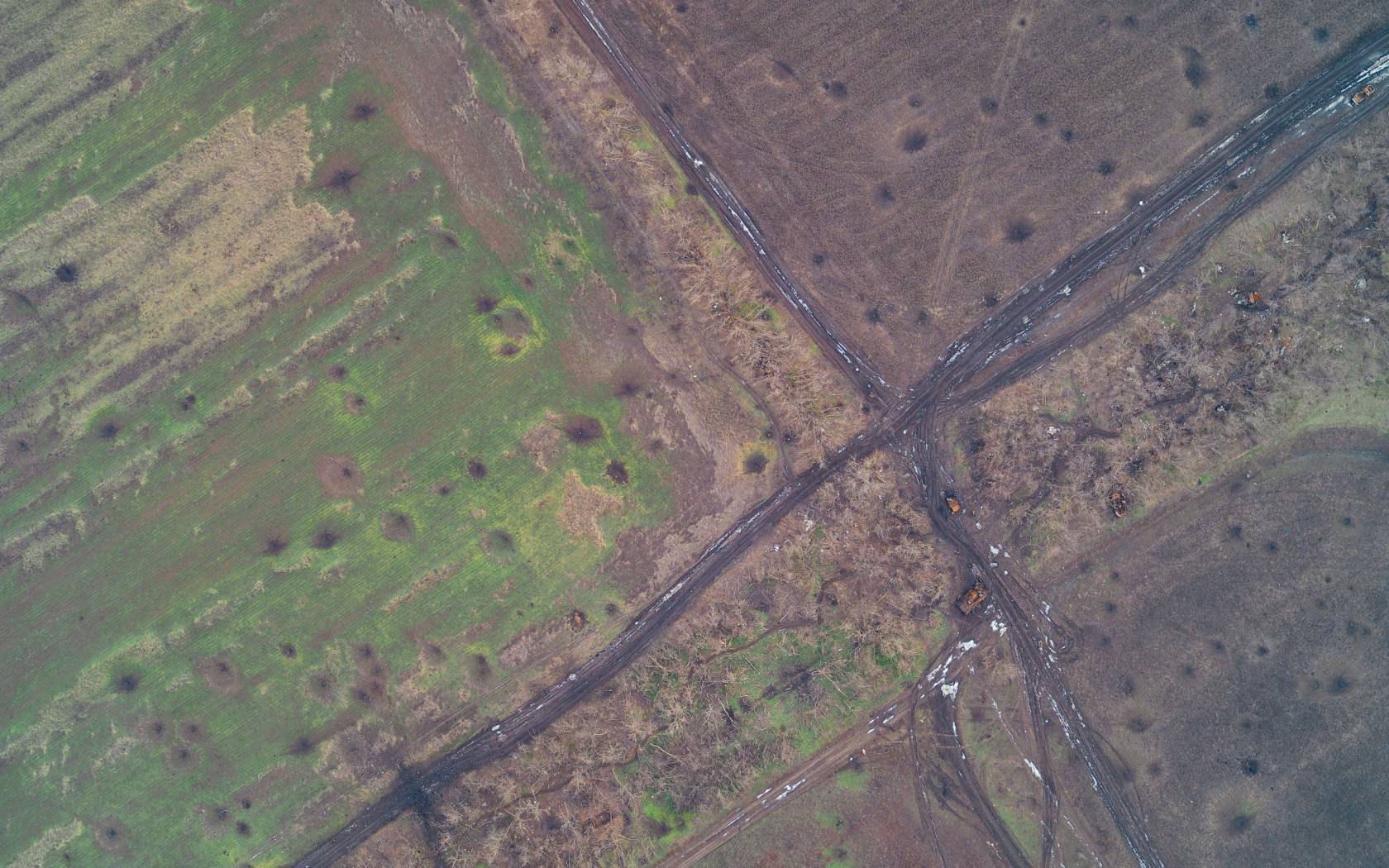
Last week, I was briefed by military colleagues just back from Ukraine. Every few months, officials and outside observers visit the countries supporting Kyiv, especially those mentoring its troops. Before the 2022 invasion, training took place at the International Peacekeeping and Security Center at Yavoriv, west of Lviv near the Polish border, with the aim of aligning Ukrainian soldiers with NATO standards so that Ukraine might eventually join the alliance. When Russian missiles struck Yavoriv early in the war, mentoring moved to the UK, supported by hundreds of experts from partner nations: the Nordic and Baltic states, and countries as diverse as Australia, Canada, the Netherlands, New Zealand and Romania. Some 100,000 recruits, mostly conscripts with little or no military experience, have since passed through five-week courses covering everything from marksmanship and urban combat to mine clearance, first aid and the laws of war.
My briefers, who requested anonymity and used noms de guerre, deferred to Oleksandr, a general, who began by observing that there is no longer such a thing as a frontline. Outside offensives, both sides hold their forward edges very lightly. Few sectors have any density of troops, and nothing to compare with either world war.
This is because of the sheer density of unmanned systems, optical devices and other sensors, some concealed on the ground, which watch forward areas around the clock. Dozens of kilometres can now be held by a few hundred well-equipped defenders, who can call on precision-guided artillery and drones. Small raiding parties, often armed with quadcopters, occasionally slip on foot through minefields and anti-tank obstacles, but achieve little and do not linger. The days of banning anti-personnel mines appear to be over. To save manpower, both sides cover terrain by fire rather than with troops dug into the earth. Outside urban areas, Oleksandr added, combat zones routinely stretch 20km deep or more, so front and rear have also disappeared.
Artem, an unmanned munitions specialist, said that when Russia claims a new settlement, its troops can rarely move above ground by day. Moscow’s new gains are often cellars and tunnels; footage of nervous soldiers waving flags from basements seems to confirm it. My new-found friend suggested: ‘That is not holding ground in a military sense. It is merely infecting it, temporarily. It’s like claiming control of an ocean from the seabed.’
The depth of these zones is covered by first-person view (FPV) drones, many now fibre-optic guided, which attack anything that moves. The latest figures from Ukraine are suggesting 85 per cent of Moscow’s human and equipment casualties are caused by unmanned aerial vehicles (UAVs), or artillery and mortars directed by them. Including long-range strikes and air defence, Kyiv is routinely expending between 9,000 and 10,000 UAVs per day, Oleksandr insisted. Any NATO partner that boasts of being drone-ready for the next war needs at least 3.5 million cutting-edge drones (a year’s supply) and the capacity to replace them.
Regimental commander Andrey thought every soldier should be trained to fly small drones. ‘It should be a skill as basic as operating a rifle,’ he suggested. The most important figure troops now report to, he said, is not the infantry officer but the networks engineer or coder. They track how the unmanned systems perform, adjust them on the spot and report up the chain. All have a price on their heads, and ‘their workshops are better protected than my headquarters’, he exclaimed, ‘as their signature across the electromagnetic spectrum is huge’. Future developments might include drones taking prisoners (Russians already surrender to machines) and unmanned ground vehicles (UGVs) that bring up supplies and return with casualties.
Despite protective cages (‘turtles’) and welded-on spikes to trigger incoming warheads (‘hedgehogs’), armour and UGVs remain vulnerable to drones. In recent weeks, Andrey said, new scouting and escort drones have been devised to protect them. Artem showed footage of escort drones swarming around a Challenger 2 tank and an M2 Bradley of the 475th Assault Regiment as they attacked Russian positions and returned to base intact, if not unmolested, while above, drone fought drone. Other drones dropped grenades to suppress the enemy and clear mines.
The debrief turned to President Trump’s current obsession, artificial intelligence. ‘AI didn’t feature at all in the 475th’s [tank-drone] mission,’ said Artem. ‘In fact, AI’s contribution to our war is so far massively exaggerated. It’s still in its early stages and I’d say it features maybe one per cent of the time, mainly in navigating alternative routes for long-range strikes.’ Analysts had expected AI to accelerate the OODA loop (observe, orient, decide, act), the USAF pilot John Boyd’s model in which the side that acts faster on accurate information prevails. Boyd saw it as the key to the Wehrmacht’s defeat of France in 1940. ‘It was anticipated that AI would be used to speed up our decision-making, our OODA loop, but we are still cautious,’ thought Artem.
Both sides’ targeting of data centres is the latest escalation, with each trying to cripple the other’s digital infrastructure. In recent weeks, Ukraine has struck several Yandex data centres in retaliation for similar Russian attacks. This was a tactic copied from recent conflicts in the Middle East, and one for which the West currently has no answer, as such targets have few defences from air or ground attack, and none that are coordinated or tested.
Deadly innovations are routine. For about a year, Oleksandr noted, Russia has coated some Geran-2 drones with chemicals that linger on the wreckage, endangering anyone who touches it. Last year, Russian drones were also seen dropping yellow phosphorus on Ukrainian trenches. In May this year, Ukraine’s SBU (internal intelligence service) found depleted uranium in a missile mounted on a modified Russian Geran-2 drone. ‘Elevated radiation levels were detected on the debris,’ Oleksandr recounted. That posed risks to civilians and emergency workers. ‘It provided proof that Russia is prepared to deploy depleted uranium weapons.’
In this game of tit-for-tat, Kyiv has had no qualms about experimenting with a fleet of fire-spewing ‘dragon drones’ against its foes. The aerial devices were recorded releasing a white-hot mixture of thermite (aluminium powder and iron oxide, which burns at very high temperatures). Weapons as much psychological as physical, they can strip tree cover and kill the troops beneath, but have been used sparingly so far.
Development time for new kit, Artem said, was about seven months in 2022, halved within a year and is now measured in weeks. In extremis, a minor tweak can be requested by an operator in the morning and be in service the same afternoon. This agility should inspire Western armies, which still think in months and years. ‘We know the Russians minutely examine every single piece of our drones and copy everything,’ Artem noted. But a matched opponent innovates just as fast, and every introduction will be noticed and countered, sometimes within a week.
Zlata, a trained nurse, then revealed that the ‘days of the trained combat medic have ended’. The ‘golden hour’ for getting the wounded to treatment has gone. Instead, she thought, ‘every soldier has to be his or her own medic, capable of far more than basic first aid on themselves or each other’. Drones often stop medics reaching the wounded, and there is now ‘routine disrespect by Russia of the Red Cross symbol’. The implications for medical training and kit, well beyond bandages and morphine, need serious thought.
Her colleagues routinely carry tools for extractions, amputations, tourniquets and transfusions, and can video-call surgeons to be talked through complex procedures under fire. Her limits, she said, are getting the right blood and medications forward. Often the task is less to bring the wounded back than to bring sophisticated care forward.
My American colleague, Harry, wisely observed that while Ukraine pointed to a direction of future war, its lessons might not be applicable in all cases: ‘We must be careful not to slavishly apply all the conclusions coming out of Ukraine. Poor weather, including high winds or fog, can erode the effectiveness of drones. We cannot trust that one side in the future could virtually eliminate its opponent’s naval forces in the way Kyiv has destroyed Russia’s Black Sea Fleet. We see relatively few manned sorties of aircraft, other than the Russians releasing missiles from the safety of their own territory. Russia’s lack of air dominance, and its timidity in the skies, is truly puzzling.’
In anything but a Putin-led dictatorship, the Kremlin’s cost-benefit ratios are disastrous. Little has been gained for huge cost, with virtually no end in sight. Moscow’s forces remain poor, owing to extensive recruitment from Russia’s poorer regions, widespread corruption at every level, and the lack of an NCO class. Initiative is crushed; top-down Kremlin-inspired diktats from distant generals remain the only permissible methodology of command.
My briefers were unanimous in seeing the conflict as Putin’s war, and as deeply unpopular with most Russians. The participants remained inspired by Volodymyr Zelensky’s leadership, attributing hostility towards him to Russian disinformation, Trumpian interference and war-weariness. The collective view, after four and a half years of intense fighting, the bitterest since 1945, was that the end would not be decided soon by Trump or anyone else outside Russia. To announce a ceasefire doesn’t necessarily mean that it exists. Above all, Ukraine still possesses an unshakable belief that its fight for freedom will continue until Putin dies.
Since then, President Trump has drifted further towards Moscow, briefly pausing intelligence on Kyiv’s distant targets and incoming threats. In parallel, Ukraine’s access to Starshield was throttled and then suspended, with Musk insisting the decision lies with Washington. The encrypted military version of Starlink’s network of more than 10,000 low-orbit satellites, Starshield had become the backbone of Ukraine’s military communications. Suddenly, Kyiv found missions disrupted and drones lost, while Moscow’s missiles were raining down virtually unchecked. More generally, communications resilience is an issue taxing many countries, with the result that a military satellite race has begun, which is why Space Commands are sprouting across the globe like mushrooms.
The good news is that there are currently six European commercial alternatives to Starlink/Starshield, including two focused on maritime traffic, with two further ventures planned, plus ten in America. one are yet as fully developed. NATO also maintains its own satellite communications (SATCOM) services, yet all require exactly those elusive qualities of resilience and back-up. Coverage may resume, but today’s controversy over access to Starshield should be a wake-up call to the dangers of a single defence system or technology failing.
In the final analysis, this amounts to Washington pushing Ukraine and the wider West away from America’s domestic defence industries. Europe and Canada are scrambling to vastly expand their own military manufacturing and procurement systems. Once developed, there will be no return to Washington, which will be left facing the possibility of a G3 with Moscow and Beijing. Strong medicine indeed from the world we knew only a couple of years ago.
Peter Caddick-Adams
More from Defence

Moscow is watching Latvia. Is Washington?

Britain needs to rediscover a more resilient statecraft

Australia needs a tragic statesman

Bevin’s alternative European order

Locked arms: looming threats to the Romania-NATO partnership
More from Geopolitics

Nord Stream: another Ukrainian deep strike

Gdynia and the dream of a maritime Poland

Is Latin America’s pink tide ebbing in Brazil?

Hezbollah’s Venezuelan money machine

Japan and South Korea must master transactional diplomacy
More from History

The unknown painter behind Manhattan’s Gilded Age interiors

The Christian genesis of North Korea’s personality cult

Shakespeare’s riot of humanity
Gdynia and the dream of a maritime Poland

Joshua Wong, heir to the Cold War dissidents



More from War
Nord Stream: another Ukrainian deep strike
Gdynia and the dream of a maritime Poland

Vasily Grossman’s account of humanity’s darkest hours

Britain’s information war against Nazi Germany

