Russia’s war has its novel
- November 2, 2026
- Tom Parfitt
Dmitry Glukhovsky’s ‘Registration’, released free on Telegram, is a rare Russian novel that confronts the moral rot of the invasion of Ukraine.
Tolstoy’s War and Peace chronicles Napoleon’s ill-fated invasion of Russia in 1812 – while his lesser-known but brilliant novella, Hadji Murad, skewers the imperial conquest of the Caucasus a few decades later.
Doctor Zhivago, the masterpiece of Nobel laureate Boris Pasternak, follows its heroes through the vicissitudes of the Civil War and its aftermath in the early 20th century.
And Life and Fate, Vasily Grossman’s sprawling epic, covers the Soviet struggle against the Nazis in the Great Patriotic War, as the Second World War is known in Russia.
Granted, all of these books were published decades after the conflicts they described, but in the hyper-scrutinised years of Vladimir Putin’s assault on Ukraine, surely something should have appeared by now?
‘Hurrah-patriots’ in Moscow will point to the writer Zakhar Prilepin, a former Kremlin critic turned zealous war supporter who has fought on the side of pro-Russian separatists in eastern Ukraine.
Yet Prilepin’s war novel, Some Won’t Go to Hell – which, in any case, dates from the phase of violence against Ukraine prior to the full-scale invasion in 2022 – shoulders no guilt, being chiefly a vehicle for self-puffery, and evades true inquiry into the consequences of the conflict.
Where is the Russian literature that dissects the rot – the internal corrosion of waging the deadliest war in Europe since 1945? A contender has just arrived.
In mid-September, the émigré Russian writer Dmitry Glukhovsky released his latest novel, Registratsiya (Registration), for free on his Telegram channel, thus evading the censors. It tells the story of a young woman who tries to marry her boyfriend Sasha as he lies in his hospital bed in Moscow, gravely wounded from fighting in Ukraine. Her aim: to receive the generous payments due to the relatives of injured or dead soldiers.
Registration is being read with greedy interest among the large diaspora of anti-war Russians – as well as people within the country who access banned social media like Telegram using VPNs.
Glukhovsky, who lives on the move in Europe and was best known previously for his science fiction, may not be on a par with the giants of Russian literature, but he has acted: he has written a novel that genuinely confronts the current horror.
He was a marked man, even before this latest venture. Russia’s justice ministry designated him a ‘foreign agent’ in 2022, and the following year he was sentenced in absentia by a court in Moscow to eight years in jail for ‘discrediting’ the Russian army by posting anti-war comments online.
His decision to make Registration available without charge online seems a bold if pragmatic one: the book would never have got anywhere near the printed page in Russia, where hundreds of people have been jailed for the slightest infraction of laws that effectively ban criticism of the euphemistically named ‘special military operation’ in Ukraine.
Registration is, after all, an indictment of the moral corruption wrought on Russian society by the war. The protagonist, Ulyana, is not just an opportunist; she is in a tight spot. She is pregnant with Sasha’s baby and she has just lost her job as a receptionist in a beauty salon in the provincial city of Vologda, north of Moscow, after standing up for a colleague who refused a local official’s demand for a massage with ‘intimate services’.
Sasha has gone missing at the front and not been heard of for weeks. When Ulyana goes to visit his mother Tatyana to seek solidarity, all she receives is shouted abuse and a hint that she should have an abortion.
Finally, the news comes through: Sasha is badly hurt and is waiting for an operation at a hospital outside Moscow.
Ulyana sets out for the capital. Without being married, she realises, she will officially be ‘nobody’, with no right to the payments for families of wounded soldiers or, if Sasha dies, the groboviye (‘coffin money’) due to widows and relatives, including her baby.
What is more, she has competition. Tatyana has taken out a mortgage on a new apartment, relying on her son to send chunks of his decent army salary, chunks that have now disappeared. She is growing desperate and will want the lion’s share of any hand-out.
But Ulyana has learned of Sasha’s condition first and reaches her boyfriend’s bedside before his mother. Faced with the intransigence of hospital staff (warning: spoilers), Ulyana blackmails a corrupt doctor into allowing the couple to get married. In order to sign the documents, Sasha – who has lost his legs – is woken up early from sedation after his op, but the interruption to his care proves fatal.
Ulyana’s compromise with evil carries something of the degradations enacted upon Viktor Shtrum in Grossman’s Life and Fate. Shtrum, a nuclear physicist, falls victim to antisemitic prejudice, but his woes evaporate when he receives a benevolent phone call from Stalin. In gratitude, he goes against his principles and signs a letter denouncing two innocent doctors.
At the end of Registration, Ulyana returns to Vologda and, heavily pregnant, opens her own beauty salon, employing the same young woman, her friend, whom she once defended from sexual advances. One day, the official who made those demands turns up once more, requesting the same relief.
Ulyana tries to fend him off again by saying she is a soldier’s widow. But the man is indifferent: satisfy me, or I’ll close you down.
Angered by her colleague’s refusal to accept the inevitable and give the man what he wants (something she will not contemplate herself), Ulyana goes out for a smoke, leaving the friend little choice but to resolve the predicament.
Glukhovsky’s book has prompted spiky debate on the Russian-language internet. Does he have the right to snipe from abroad at the nasty behaviour of those who remain in the country? Has he been unduly harsh on the women the soldiers have left behind?
The latter criticism, at least, seems out of place. Ksenia Sobchak, the socialite and journalist, has documented the phenomenon of young women speedily marrying soldiers before they go to war in Ukraine, in the hope of receiving groboviye. It is a known fact.
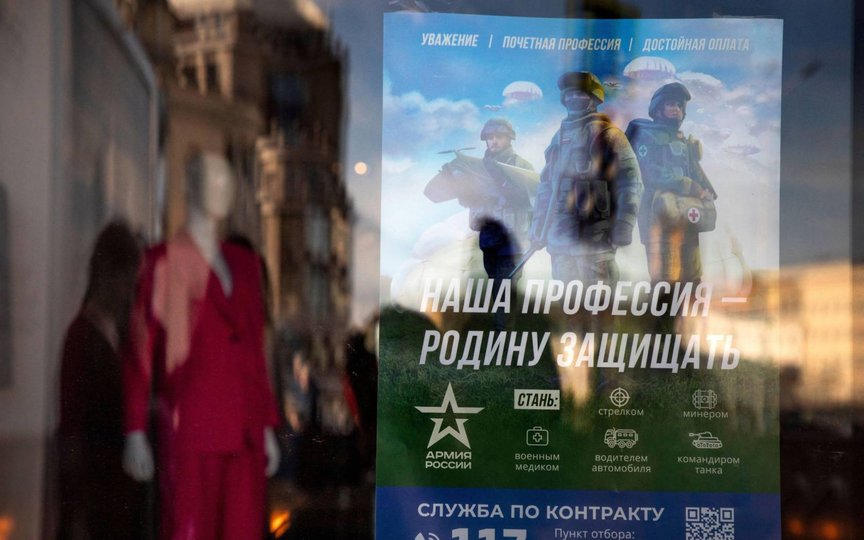
Besides, men in Registration also choose ugly compromises: when she goes to visit Sasha in Moscow, Ulyana stays with her mother’s cousin and her husband. Maksim, the husband, is a pro-democracy type who has stayed in Russia despite opposing the war. He runs a bookshop that still sells the work of some ‘foreign agents’, and likes to lecture Ulyana for having a baby with an invader of Ukraine. Yet Maksim is a hypocrite. He enjoys the rewards of his wife’s work producing billboards of soldiers, and as soon as the threat of a call-up looms over their playboy son, he abandons his moral stance.
As the émigré critic Anna Narinskaya has said, the significance of Glukhovsky’s novel is that it grapples with a lived reality in a way no other author has dared. The writer himself insists that he judges neither those who fled Russia after the invasion, nor those who stayed behind. In Registration, he gives no one a free pass, but neither are any of the principal characters utterly condemned. What is clear is the crippling force of circumstance in a state built on lies, repression and hate. Absolute power corrupts absolutely but absolute powerlessness can corrupt absolutely too.


