Johann Peter Hebel’s little treasure chest
- November 11, 2026
- Malcolm Forbes
Two hundred years after his death, the German storyteller admired by Goethe, Kafka and Sebald deserves a wider readership.
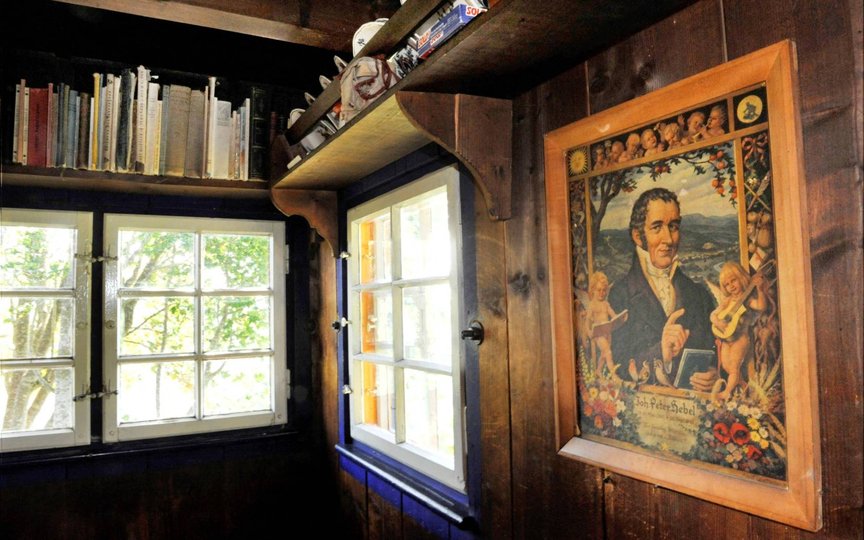
A man enters the Lion Inn and asks the landlord for the best meal and glass of wine his money will buy. When the time comes to settle up, he gives the landlord a paltry six-kreuzer piece. The landlord tells him the meal costs a thaler. The customer replies, ‘I didn’t ask for a meal for a thaler, but for my money. Here it is. It’s all I have. If you gave me too much for it then that’s your fault!’ Incensed by his guest’s brazenness, and frustrated by his own powerlessness, the landlord sends the man packing, but not before buying his silence with a 24-kreuzer piece and urging him to play the same trick on his neighbour and rival, the landlord of the Bear. ‘I went to the Bear first’, the man says with a smile; ‘it was the landlord there who sent me over here!’
So unfolds a tale from 1804 called ‘The Cheap Meal’ by the German writer and poet Johann Peter Hebel (1760–1826). It is one of many stories from Hebel’s most popular work, The Little Treasure Chest (1811), a compendium of prose pieces. This tale has much in common with the other contents of the collection. It is short, in John Hibberd’s English translation, amounting to only four brief paragraphs. It is simple yet effective, infused with homespun charm and light wit. It features a rogue who outsmarts a pompous individual. It has a straightforward set-up and a slick pay-off. And it contains words of wisdom, opening and closing with instructive Sprichwörter (‘The biter is sometimes bit’ and ‘For peace pays, whereas quarrels have to be paid for’).
‘Dinner Outside’ (1805), another story of similar length about a meal, contains the same components plus a welcome dash of absurdity. A servant finds his demanding master in an even more foul and critical mood than usual. The food he brings to the dinner table is either too hot or too cold. When the master throws a bowl of soup out the window in a rage, the quick-witted servant takes the opportunity to chuck the meat, bread, wine and tablecloth out after it. The master explodes: ‘What the devil do you think you’re doing?’ The servant’s response comes quietly and calmly. He thought this was his master’s way of telling him he wanted to eat outside today. ‘The air’s warm, the sky’s blue, and look how lovely the apple blossom is and how happy the bees are sipping at the flowers!’ The master sees the error of his ways and is grateful for being taught a lesson. Hebel clarifies that lesson by informing us that people who lose their tempers ‘over trifles’ can be ‘brought to their senses’ if we deal with them in the right way, ‘neither too wilfully nor too indulgently’.
Hebel isn’t as well known among Anglophone readers as he should be. It is a different story in the German-speaking world. Goethe and Kafka were admirers, the former describing his verse as ‘raising the presentation of art to a higher level’, the latter carrying a copy of The Little Treasure Chest around with him and regarding one of its tales as ‘the most wonderful story in the world’. In Germany there is a literary prize in Hebel’s honour. Each year, there are celebrations to honour him and his work in the village of Hausen im Wiesental in the southern Black Forest, where he spent much of his childhood. This year, the 200th anniversary of Hebel’s death, the village hosted a particularly special Hebelfest comprising song and dance and readings and exhibitions. There were also commemorative events further north in the town of Schwetzingen, where Hebel died while en route between Mannheim and Heidelberg. As Hebel wrote in Kafka’s favourite story when adding a sting to the tale: ‘Death paid a call.’ Two centuries on from his death, his short-form fiction is still vividly compelling.
Hebel was born in Basel to parents in the service of a well-to-do family. He grew up in both Switzerland and Baden, where he was exposed to the local dialect of Alemannic. He studied theology and went on to work as a teacher and headmaster. In 1819, he was made Prelate of the Lutheran Church in Baden. As a writer, he first made his mark in 1803 with the publication of a collection of poems written in Alemannic. In the same year he started writing short prose contributions for an almanac which came to be known as Der Rheinländische Hausfreund (The Rhineland Family Friend). Hebel’s Kalendergeschichten, or calendar stories, were designed to be edifying, entertaining, and, perhaps most important of all, accessible to all readers.
The Schatzkästlein des rheinischen Hausfreundes – The Little Treasure Chest – constituted a kind of greatest hits, a best-of compilation of the most popular stories that had appeared in the almanac between 1803 and 1811. Those stories are wonderfully diverse. There are historical narratives, picaresque adventures, embellished news reports, folk tales, tall tales, fables, parables and anecdotes. Unlike the Brothers Grimm and Hans Christian Andersen, Hebel didn’t go in for fairy tales, and his ghost stories, while spooky, turn out to contain not malevolent spirits but cunning fraudsters – or, in one case, forgers. We also encounter swindlers, loafers, beggars, farmers, thieves, travellers, soldiers, princes and emperors. Underdogs get the upper hand, often through impudence or ingenuity. Scoundrels get their just deserts or, in some cases, lucky last-minute reprieves. Wily, enterprising opportunists make a quick buck by trading in riddles (‘Who gets paid for pulling wool over people’s eyes?’ asks one man to a dumbfounded audience. ‘A wigmaker’). Freddy Tinder, a loveable knave who doesn’t steal for the sake of profit or out of wickedness but rather ‘for the love of his craft and to sharpen his wits’, makes welcome returns in several stories.
Common subject matter involves mistaken identities, mixed fortunes and, in various shapes, sizes and styles, marital relations. In ‘The Last Word’ (1810), a skinflint husband and a spendthrift wife wear each other down in a bitter war of attrition. In ‘A Strange Divorce’ (1811), we are told that ‘in Spanish households the wife is the master, a lover plays the husband, and the husband is the maid.’ Elsewhere, in a farcical vignette, a husband comes home late from the pub and finds himself locked out by his wife and forced to sleep under the beehive in the garden. To prevent a repeat performance, the next time he plans a drinking session he removes the front door from its hinges and takes it out with him.
A few famous stories have proved endearing to generations of German readers. ‘Kannitverstan’, from 1808, revolves around a young German tradesman visiting Amsterdam and learning the ways of the world through a series of misunderstandings. ‘Unexpected Reunion’ (1811), Kafka’s beloved tale – one which couldn’t be more different from any of his own – is a touching yarn about a bride-to-be afflicted by tragedy and then setting eyes on her long-lost lover after 50 years of mourning.
A handful of Hebel’s stories could never be classed as endearing. In the brilliantly named ‘How a Ghastly Story Was Brought to Light by a Common or Garden Butcher’s Dog’, written in 1810, a husband and wife kill a man for his money and then their own child for witnessing the murder. The grisliness is almost comic (‘while the child was being boiled and then popped into the bread oven’) but we still hold out for the relief of retribution at the end. In Hebel’s bleakest story, ‘A Secret Beheading’, there is no such cathartic release. There isn’t even much of a story. A mysterious account of a woman’s execution is rendered all the more disturbing by the pile-up of negatives in the conclusion: ‘No, nobody found out who she was, what sin she had committed, and nobody knows where she is buried.’
Uniting these disparate tales with their range of tones, themes and voices is Hebel himself in his persona as the Family Friend. He narrates the stories and routinely breaks off to address the reader directly and chattily. He dispenses moral judgements without resorting to preaching. He highlights trickery and treachery but also underscores good deeds and happy outcomes. He justifies the inclusion of those darker stories: ‘Things sometimes have to get pretty violent and bloody before you can recognise a noble frame of mind where you don’t expect it.’ And finally, he reminds us of who he is and what his role is: ‘An honest calendar man, Your Family Friend for instance, has been given an important and enjoyable task by the Lord God, that is to show how eternal providence provides help before the need is too great, and to proclaim the praise of excellent men wherever they may be.’
Another of Hebel’s admirers, the German writer W. G. Sebald, wrote in an essay of his ‘unwavering affection’ for the author of The Little Treasure Chest. He singled out ‘the ethereal or ephemeral nature of Hebel’s prose which every few weeks makes me want to check whether the Barber of Segringen and the Tailor of Penza are still there’. Both characters are still there in their respective stories, ready to enchant new readers. These gem-like tales and others like them haven’t lost their lustre.
Malcolm Forbes


More from Europe

Putin loses his Balkan Trojan horse

The consumer-voter is killing German politics

Moscow is watching Latvia. Is Washington?

Britain and Germany: Europe’s original special relationship


