Who has heard of Gustave Fayet?
- November 27, 2026
- Cath Pound
A new exhibition in Paris does belated justice to Gustave Fayet, one of France’s most voracious collectors of modern art – who was a gifted artist and designer in his own right.
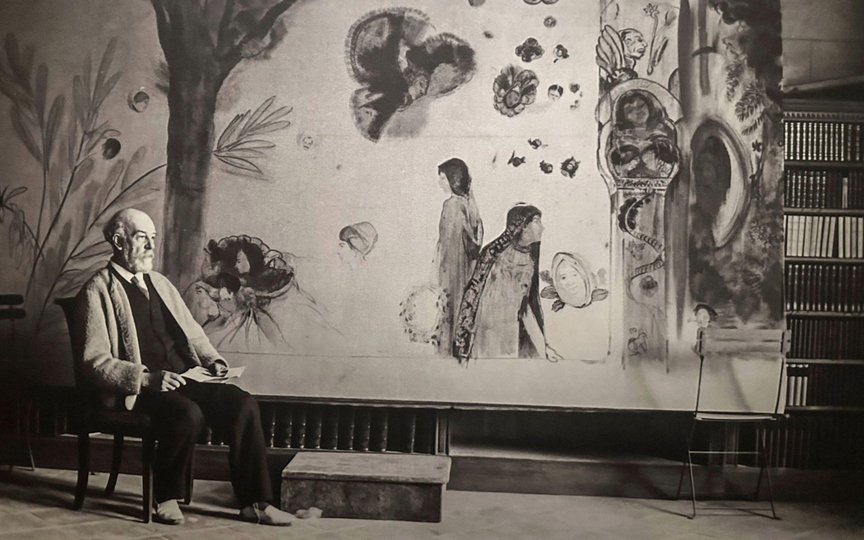
That question opens a new exhibition at the Fondation Louis Vuitton in Paris, dedicated to a figure who, despite his significant role in shaping French painting at the turn of the 20th century, has all but disappeared from public consciousness.
During the later years of the Belle Époque, from around 1899 to 1908, Fayet (1865-1925) was one of France’s most voracious collectors of modern art and one of its most enthusiastic advocates. His primary focus was Post-Impressionism – the Fauves, the Nabis and the Symbolists. An early champion of Gauguin, van Gogh and Odilon Redon, he turned his Paris home into a museum devoted to the first of these. Hung floor-to-ceiling with around 200 of Gauguin’s works, it attracted prominent artists, writers and collectors, including Bonnard, Vuillard, Gertrude and Leo Stein, Colette and André Gide. He lent works from his collection to numerous exhibitions, boosting the reputations of the artists he loved, and also organised annual salons of modern art in his hometown of Béziers, at which (in 1901) he became one of the first people in France to exhibit the young Picasso, then only 19 years old. It’s a testament to his connoisseurial eye that many of the works he owned now reside in the world’s major art galleries.
But that is only part of the story. Fayet was also a gifted artist and designer in his own right. Like William Morris or his beloved Gauguin, he made little distinction between the fine and applied arts, turning his hand to painting, ceramics, book illustration, textiles and wallpaper design. Working at the intersection of art and industry, he founded a stoneware workshop and a glassworks and served as artistic director of both an interior design and fashion house, Maison Della, and an avant-garde carpet workshop, Atelier de la Dauphine. The carpets he designed brought him fleeting fame towards the end of his life, but after his death in 1925, his collection was sold off, his work passed into the hands of private collectors, and his name was largely forgotten.
The exhibition’s scope is enormous. It is very much a show of two halves (each accompanied by its own monumental catalogue). The first is devoted to Fayet’s collection, and it is here that viewers are likely to be most richly rewarded. Bringing together more than 200 paintings, along with ceramics, sculpture, prints and drawings, it is an embarrassment of riches. Eighty works by Gauguin alone are spread across several rooms, including some of his most celebrated creations. Paintings like The Yellow Christ or In the Waves (both 1889) still leap from the wall with their radically stylised modernism, but we also see the artist’s calmer side in a selection of stunning still lives and landscapes. There are also key examples of his stoneware vases, wood carvings and graphic work, including a complete set of the groundbreaking print series, Noa Noa (1893-94), which almost single-handedly dragged the woodcut into the modern era.
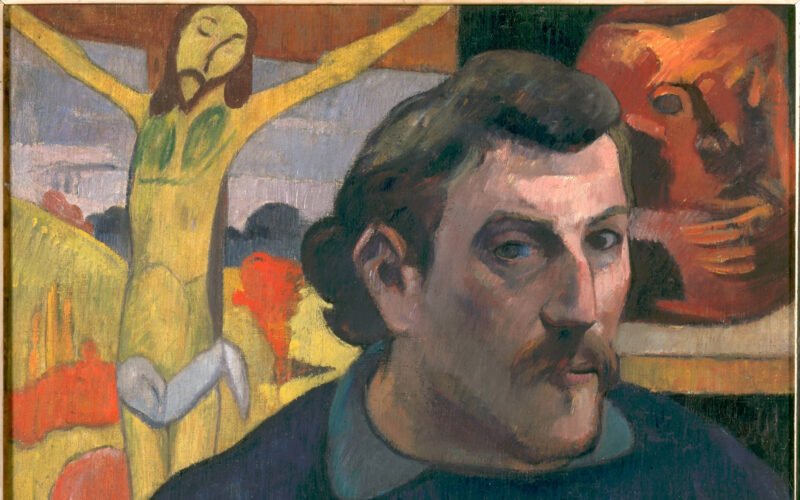
The selection of work by van Gogh is smaller, but no less impressive. Fayet shared the painter’s affinity with the south of France and clearly identified with the sun-dappled pathways in Public Garden in Arles (1888) or the vibrant yellow cornfield and swirling clouds seen in The Cypress Trees and the Flowering Tree (1889). But the undoubted star of the exhibition is Self-Portrait with Bandaged Ear and Pipe (1889), a painting that hasn’t been on public display for almost 40 years. One of two self-portraits painted shortly after he severed his own ear, it is among the most central to the myth of van Gogh, already emergent when Fayet acquired it in 1902. Tightly framed against a vibrant orange-and-red background, the artist’s enigmatic visage gazes out from a canvas that (unlike the more famous version in the Courtauld Collection) is free of incidental details, concentrating its emotional and psychological intensity. It would remain one of Fayet’s most treasured possessions, proudly displayed in his bedroom until the end of his life.
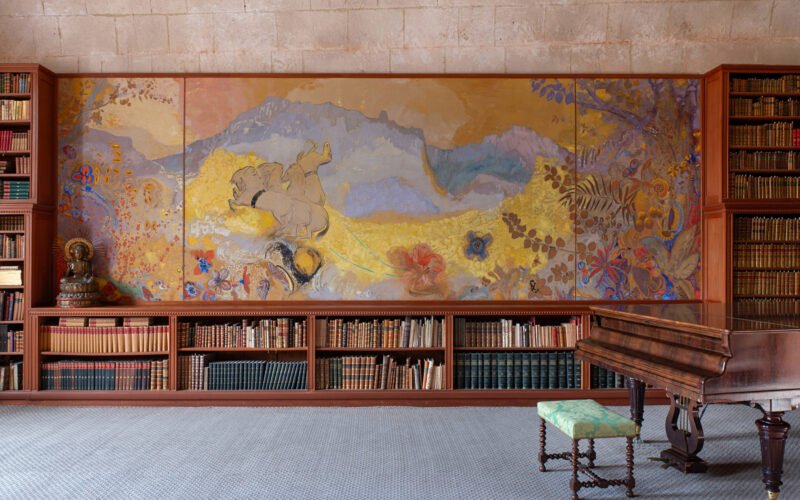
As Fayet was a devotee of Symbolist writers such as Mallarmé, Huysmans and Baudelaire, his lifelong attraction to the dreamlike, surreal visions of Odilon Redon comes as no surprise. But there was also a personal connection. The two met in 1900 and would remain friends until Redon’s death in 1916, by which time he had become the primary focus of Fayet’s collection. The four galleries devoted to his work offer an impressive overview of his oeuvre, from the enigmatic lithographs and charcoal drawings that initially brought him fame to the vividly coloured pastels and oil paintings of his later years. The latter, with their hazy backgrounds and flashes of red and gold, suggest an uncanny cross between Turner and Klimt, although their mythological subjects can seem a little undercooked at times. More beguiling in their weirdness are chimerical nature studies like Flowers (1909) or Undersea Visions (1909-10), in which bizarre plants and aquatic forms dance against abstract, nebulous backgrounds.
There are many other highlights. Early morning light shimmers across the lagoon in a group of stunning views of Venice by Signac, while a late afternoon haze saturates Vuillard’s The Painter Ker-Xavier Roussel and his Daughter (1903). Look one way, and the eye is caught by Redhead (Toilette) (1889), a masterpiece by Toulouse-Lautrec; look the other, and it’s captivated by La Baie de l’Estaque (1879–83), one of Cézanne’s most sublime landscapes. Vibrant red banners burst from the canvas in Albert Marquet’s Bastille Day in Le Havre (1906), while in Bonnard’s Paris Boulevard at Night (1900), the light from a single window shines out on the eerie silence of the sleeping city. Beyond that, viewers can take their pick among Matisse, Morisot, Renoir, Degas, Pissarro, van Dongen and more, all testifying to the keenness of the collector’s eye.
However, Fayet’s acquisitive urges diminished after 1908, following his purchase of the ancient Cistercian Abbey of Fontfroide, which he transformed into a ‘total work of art’, filling its halls with medieval sculptures, Japanese ceramics and Moorish furniture, along with specially commissioned stained glass by Richard Burgsthal and monumental paintings by Redon. The second half of the show examines the expansive decorative projects at Fontfroide and his other residences, but its primary focus is Fayet himself as artist, designer and entrepreneur. Equally engaging, it reveals a man who, while not always a natural innovator, was certainly an apt pupil and could turn what he learnt to original ends. His early ceramics, from the 1890s, reflect the era’s prevailing taste for Art Nouveau and Japonisme, but are the least interesting of his creative endeavours. His paintings, however, are more impressive. The striking vertical composition of Blue Cypresses (1902) is enhanced by intense contrasts of light and shadow that draw the eye into the far distance, while a seascape like Marine (n.d.) echoes Signac’s Divisionism and hovers tantalisingly on the edge of abstraction.
He was also a skilled draughtsman with a keen eye for nature and a gift for transforming it in imaginative ways. In a group of drawings made in Mallorca in 1924, the gnarled and twisting limbs of ancient olive trees metamorphose into what he described as ‘monsters’. His illustrations for Fleurs (1925), an imaginary herbarium produced for his grandchildren, fancifully subvert the conventions of botanical drawing, with strange, flowing forms, part floral, part aquatic, hovering ominously against a blank void, oddly foreshadowing the work of more contemporary artists such as Ann Churchill.
This reimagining of nature had its apotheosis in a remarkable series of works made from 1912 onwards. Working in watercolour on blotting paper, Fayet used the paper’s absorbent qualities to conjure swirling, interlacing floral motifs of surprising grace and delicacy. Like much of Redon’s work (surely an influence), they walk a fine line between dream, reality, and abstraction, capturing the zeitgeist at a pivotal moment on the cusp of Art Nouveau and Art Deco. When transformed into carpets by Atelier de la Dauphine in the 1920s, they were an immediate hit with the Parisian fashionistas, bringing their designer great acclaim. Displayed en masse in the exhibition – one room of watercolours, another of the carpets they inspired – they close the show with an explosion of colour.
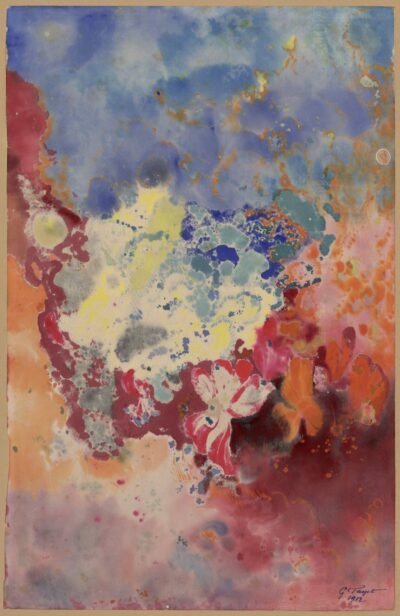
Undoubtedly, these carpets were his greatest achievement in interior design and would be the subject of a posthumous exhibition at the Louvre in 1926, where they hung on the wall like paintings alongside work by his friend Redon.
The fact that Fayet has had to wait a century for a second retrospective seems somewhat unfair, but this exhaustive, rigorously researched and hugely enjoyable show does belated justice to every aspect of his life’s work.
Gustave Fayet: Collector, Designer is at the Fondation Louis Vuitton from 9 October 2026 until 8 March 2027.


