Is France heading for a new 1789?
- October 21, 2026
- Basile Marin and Léo Marin
The Fifth Republic’s deteriorating fiscal situation offers the strongest parallel with the waning years of the Ancien Régime.
Behind the urban disorder in France lies an equally serious fiscal predicament. France ended 2025 with public debt at 115.6 per cent of GDP and a deficit of 5.1 per cent. Moody’s downgraded French sovereign debt in December 2024; by October 2026, the rating carried a negative outlook. French ten-year borrowing costs have approached five per cent.
Since the fragmentation of the National Assembly in 2024, no government has possessed a dependable majority for an ordinary budget vote; the 2026 budget was forced through parliament with the use of Article 49.3. With the presidential election approaching in 2027, fiscal adjustment remains both urgent and politically explosive.
The parallel with the waning years of the Ancien Régime is not that revolution is inevitable, but that a fiscal crisis can quickly transform into a crisis of political legitimacy.
In the early 1780s, as in the late 2010s, France appeared to be a firmly established European state. Since the vicious civil conflict of the 17th century, the heart of the kingdom had been largely spared major domestic upheavals. Wars had certainly been numerous, but their principal theatres were far away. This distance sustained among France’s elites the illusion of an immutable domestic order, captured in Talleyrand’s remark: ‘Those who did not live in the years preceding 1789 did not know the pleasure of living.’
Warning signs of an impending crisis were everywhere. The cost of the American war had compounded already longstanding debts, and the monarchy proved unable to extend taxation to the privileged classes to pay for it. Reform was blocked first by the Assembly of Notables and then by the parlements. In August 1788, the Treasury suspended a portion of its payments. Louis XVI then summoned the Estates-General: within months, the budgetary crisis had turned into a debate over who possessed the right to distribute resources on behalf of the nation. During the following decade, France passed through successive constitutional regimes, civil war and the Terror, before the Directory was overthrown by Bonaparte in 1799. The civil war in western France alone probably cost several hundred thousand lives. These warning signs are once again emerging in contemporary France.
In 1785, the public deficit was approximately three per cent of GDP and public revenue approximately 15 per cent of GDP; in 2025, they were approximately five per cent and 52 per cent. In 1785, the deficit was large relative to the state’s limited resources (approximately 20 per cent of annual revenue), but small relative to the national economy. In 2025, the deficit was smaller relative to public revenue (approximately 9.8 per cent) but larger relative to GDP, because the state taxes and spends a very substantial share of national wealth.
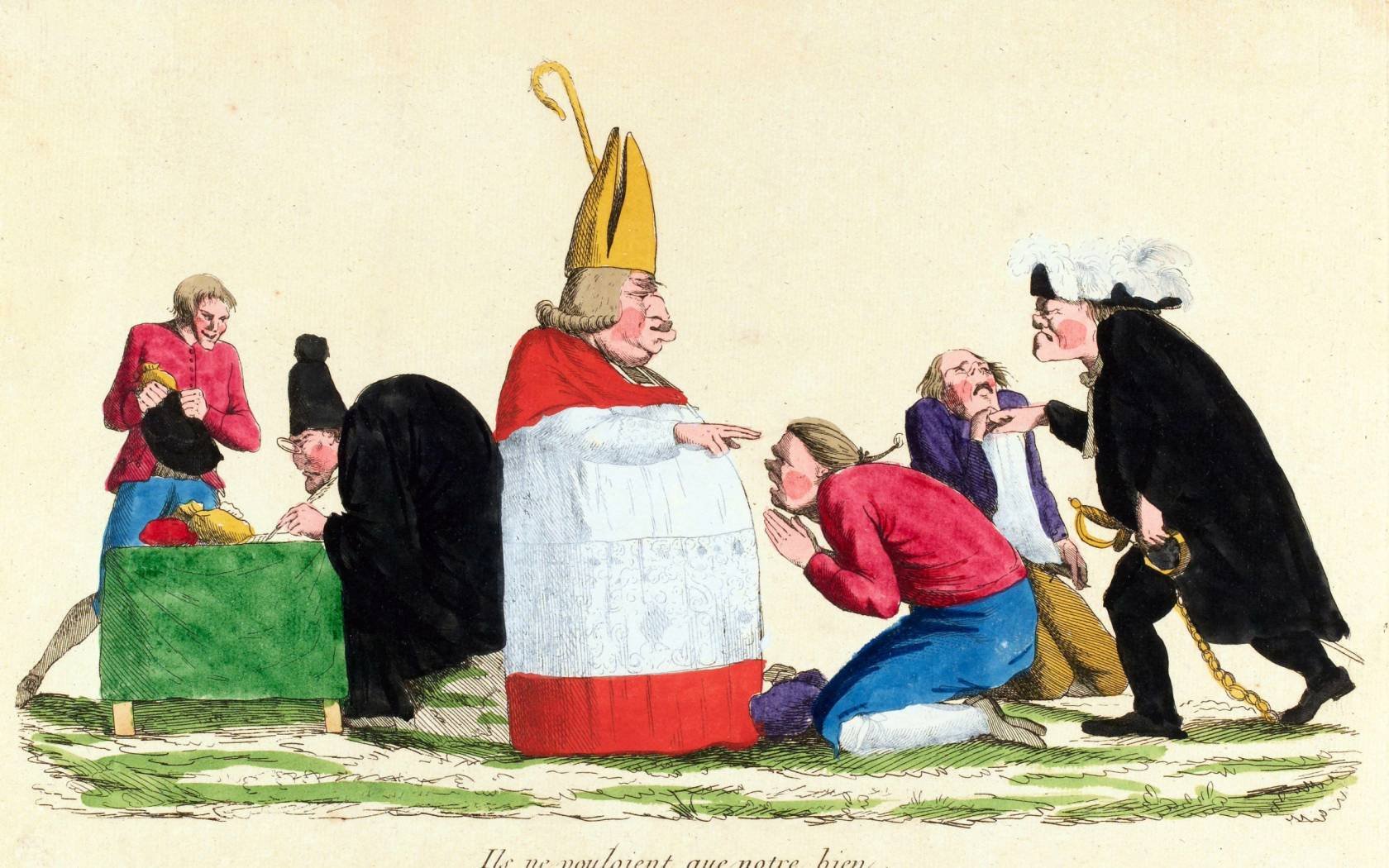
The kingdom could theoretically have raised taxes. But the nobility and clergy would not countenance taxation, while the Third Estate refused to bear any further burden unless the privileges of the other orders were abolished.
In 2025, with levies already amounting to 43.6 per cent of GDP, the room for raising additional revenue is far narrower, leaving any substantial fiscal adjustment dependent on drastic spending cuts.
The debt of the Ancien Régime, at 56-70 per cent of GDP, was lower than that of the Fifth Republic, at 115.6 per cent, but its interest rate between five and six per cent was astronomical; the ten-year OAT stood at approximately 3.9 per cent in 2025. While Versailles courtiers, rebellious parlements and recalcitrant nobles fought among themselves, financial markets punished the absence of any effective mechanism to produce real reform.
The monarchy thus faced pressure on two fronts. On the one hand, more than half of the state budget went towards servicing its debts, increasing the pressure on the government to raise taxes. On the other hand, an inflexible society refused to countenance fiscal reform.
The situation recalls some of the structural deadlocks confronting contemporary France. In 2025, interest payments approached €64.7 billion, up 11.2 per cent from 2024, while the fragmentation of the National Assembly has made lasting reforms to pensions and social spending particularly difficult to deliver.
In 1781, Necker estimated royal pensions – distributed by the king to servants of the state, military personnel, widows and nobles – at 28 million livres. Although transfer spending represented only six per cent of the state’s annual revenues – far less than debt service – and approximately 0.1 per cent of the population was a net recipient of state support, the pensions question crystallised a sense of injustice over how the burden of adjustment was being distributed.
In 2025, 45 per cent of public expenditure consisted of transfer spending, while 56 per cent of French people received more than they contribute under a broad measure of redistribution. In October 2025, 72 per cent of French people believed that restoring the public finances should rely more on spending cuts than on tax increases. Only 29 per cent supported freezing pensions, while just 21 per cent supported doubling medical deductibles. The divide is also generational: 84 per cent of retirees oppose a pension freeze, while nearly half of 18-to-34-year-olds support one.
As in the 1780s, polarisation emerges over who exactly should take the pain of reducing the deficit: reforming social expenditure risks provoking a major political crisis; failing to reform it condemns the country to a worsening deficit and, ultimately, to an even more brutal adjustment in the future.
Under the Ancien Régime, society was functionally divided into three orders. The clergy retained spiritual and intellectual authority. It contributed to the nation by running schools, providing social welfare and participating in scholarship and research. The nobility monopolised senior positions in public service, particularly in the military and diplomacy (noblesse d’épée), as well as in the judicial, policing and administrative systems (noblesse de robe). The Third Estate was divided between the bourgeoisie and the poorer working and peasant classes. The bourgeoisie of the Ancien Régime controlled much of the country’s industry, including banking, textiles and construction.
These three orders broadly overlapped with three competing conceptions of society: a hierarchical Christian society, in which each order performs a distinct function under the authority of the king and God; a constitutional monarchy of corporate bodies, in which the king’s power should be constrained by the nobility, the parlements, the provinces and the fundamental laws of the kingdom; and a society of individuals and citizens, in which rights belong to individuals or to the nation, rather than to orders and privileged corporate bodies. The Revolution erupted when the third conception – championed by the elites of the Third Estate, but also by certain reformist nobles and clergymen – demanded that the Third Estate be incorporated into a legally homogeneous nation.
In contemporary France, the functional divisions of the New Regime are less pronounced than those of the Ancien Régime, but they are becoming increasingly visible. Modern French society can, schematically, be divided into three classes, each associated with a dominant ideology. The governing class, comprising senior executives, high-ranking civil servants and economic elites, supports a modern liberalism centred on mobility, expertise and European integration. The normative class, comprising teachers, journalists and cultural professionals, supports a progressive egalitarianism committed to public services and the reduction of inequalities. The productive class, comprising workers, farmers and small independent business owners, increasingly favours a form of protectionism combining sovereignty, security and the defence of purchasing power.
In the 1780s, as in the 2020s, these distinctions are deeply embedded in the structure of society. With high levels of social reproduction and low social mobility, contemporary France increasingly resembles a society of orders, in which the son of a worker or employee tends to inherit his father’s social position, while the son of an executive tends, in turn, to become an executive.
In the 1780s, as in the 2020s, social status is a strong predictor of political beliefs: working-class voters have moved strongly towards the National Rally, while higher professional groups remain substantially more centrist or liberal and several public-sector and cultural professions lean towards the Left. Each bloc attributes a moral failing to the others. For the Left, voting for the RN is an expression of xenophobia. For national-populist voters, the governing and cultural elites look down on the people and erode their identity. For the liberal bloc, the other two camps represent extremes against which society must guard itself.
Thus, under both the Ancien and the New Regime, the French inhabit social strata that interact relatively little with one another and remain ideologically fairly homogeneous. In fact, the modern conflict still revolves around the same fundamental questions as it did in 1780. On one side stands the creed of universalism, according to which the same principles should apply to all individuals regardless of their culture or nation. On the other stands the thought of the Counter-Enlightenment, which regards society as a living organism rooted in history and tradition. Any ‘Counter-Revolution’ in the 21st century could therefore constitute a historical rupture as fundamental as that of 1789.
It is impossible to predict whether the point of no return will be crossed. We should nevertheless remember that Louis XVI’s contemporaries believed until the very last moment that the system could endure unchanged into the next generation. The 2027 elections will probably constitute another test for French institutions, particularly if they produce a National Assembly without a stable majority, or if the outcome of the election is not respected by the political parties. History cannot predict the date or the form the crisis might take; but in France a crisis of the regime is rarely a comfortable event.


