Pericles the eccentric
- November 11, 2026
- Paul Cartledge
Born into the Athenian elite, Pericles was a committed democrat. His eccentricities, political and personal, set him apart.
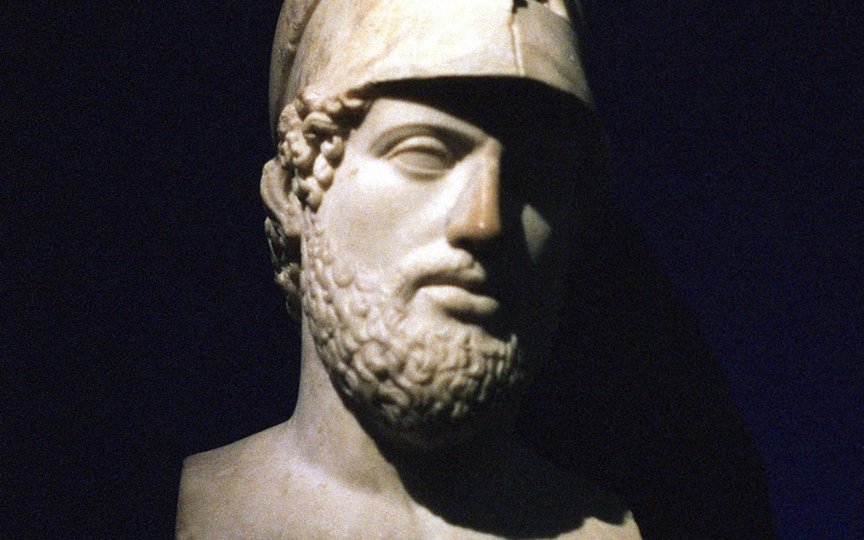
A character in Shakespeare’s Twelfth Night states that some are born great, some achieve greatness, and some have greatness thrust upon them. Pericles – my Pericles – qualified for ‘greatness’ on all three counts. One of the most important contemporary witnesses, the historian Thucydides, wrote that Pericles was adōrotatos, literally not at all susceptible to bribes. In ancient Greek a dōron meant both a gift – and a bribe: so closely were the two then intertwined in both fact and appearance. Pericles, to put it differently, was famously incorruptible in a world of democratic politics that was anything but.
Many years, indeed, centuries later, Plutarch, from a small town in central Greece, wrote a series of biographies of ‘great’ Greeks and Romans, writing the biographies in parallel and in pairs to bring out more sharply the distinctive qualities of each. His Pericles biography is by general agreement one of his best, and one of the most useful to us because it preserves much evidence, including evidence contemporary with Pericles, that would otherwise have been lost. But it is not what we today would demand of a critical, especially a complete, biography, that is, an account of both his subject’s inner and outer lives. Besides, Plutarch was not primarily interested in Pericles’ political career as a democratic leader. He was interested mainly in character, in the mere foibles of his subjects as well as deeper moral characteristics, and in telling anecdotes that illuminated them.
Pericles (meaning something like ‘all-round famous’) was born in about 495 – we don’t know the exact year – and died, of the plague, in 429, aged about 65 or 66. Just over a decade before his birth, in 507, an aristocratic reformer called Cleisthenes had given his name to a set of profoundly radical political reforms at Athens that ushered in a system of governance hitherto unknown anywhere in the world and which was later given the name dēmokratia, or ‘power of the People’. That Cleisthenes just happened to be Pericles’ maternal great-uncle. His father Xanthippus was not of such illustrious aristocratic ancestry, but the (h)ippus part of his name, meaning ‘horse’, indicated that he too came from an elite, wealthy, horsey family.
Cleisthenes’ reforms probably included the new, democratic procedure of ostracism – a procedure for dissipating the tensions between leading political figures that could foment political instability. In 484 Xanthippus was among the first victims of this form of reverse election and banished into exile – to be recalled after only four years of his ten-year sentence because of an imminent invasion by the mighty Persian empire. Such were the excitements of Pericles’ first 15 or so years. We shall return below to consider Pericles’ major contributions to the progress of democracy and the flowering of the arts at Athens.
Pericles belonged by birth and inheritance to the top five or 10 per cent of elite Athenian families. Most of those were by upbringing, inclination or out of plain self-interest normally disposed to be oligarchic, not democratic, to favour the rule of the elite Few as against that of the democratic Many. For whatever reason, possibly because of who his maternal great-uncle was, Pericles was an outright democrat through and through from the very first moment he entered the political stage.
Literally as well as figuratively: in 472, when performing a public legal obligation imposed on super-rich citizens, he funded a series of plays by Aeschylus, one of which (the tragedy Persians) survives to this day. Aeschylus, then about 50, who had fought at the historic Battle of Marathon in 490, was then the great man of Athenian tragic drama (a genre the Athenians had invented). Play performance was a competition, democratically judged, and Aeschylus’ four plays were adjudged the winners. Whether Pericles, then aged only about 23, could be counted as a ‘friend’ of Aeschylus is another matter. Certainly they were on the same page ideologically. His relationship with the non-Athenian astronomer and philosopher Anaxagoras is different again. They certainly can be considered intellectual friends, and from Anaxagoras Pericles learned, for example, that the solar eclipse of 3 August 431 BCE was not an awful divine portent presaging disaster but merely a natural planetary phenomenon. And then there’s master sculptor Pheidias, Athenian-born and bred and generally credited as the overall designer of the sculptural programme of the Parthenon temple as well as creator of the gold-and-ivory cult statue of Athena the Virgin herself. The evidence – though mostly late and circumstantial – does suggest that Pericles and he were personal friends. Certainly, when Pheidias was accused of embezzling publicly owned gold, that was used as a weapon to attack Pericles. Life at the top of the Athenian democratic tree was precarious.
Pericles was eccentric by birth and upbringing, and eccentric by political-ideological inclination. But his greatest eccentricity was manifested in his late adult private life. He fell in love with and chose to spend his final decade and a half living with a woman, Aspasia of Miletus, to whom he probably could not be formally, legally married, and with whom he had a child, a boy they named ‘Pericles’, who therefore laboured under the stigma of being a bastard (nothos) until the Athenians legitimised him after Pericles’ legitimate sons died of the plague. Irony of ironies: the imposed nature of his relationship with Aspasia (technically, concubinage) was due to a law he had himself proposed, just a few years before, aimed at reinforcing the Athenian-ness of the citizen population. Thereafter to be an Athenian citizen one had to have both an Athenian father and – new requirement – an Athenian citizen mother. That Aspasia was from Miletus eased the formation of the relationship, since Athens and Miletus (a major Greek city in western Asia Minor) were not just allies (against Persia) but also on ‘special relationship’ terms.
FDR is an excellent parallel or analogy to Pericles in this respect. Pericles too was considered a class-traitor – but unlike the US President he did not hold an office of comparable power. He was a democratically elected General, but elected annually, and the office was corporate not individual, there was no political party to support him, and in any year he might be subject to ostracism, and on almost any day subject to impeachment and de-selection (as actually happened in 430). As such, he was eccentric. Most rich and elite Athenians thought oligarchically, not democratically. Democracy was not only the rule of the Many but also, as Aristotle best analysed it, the rule of the poor masses or majority of citizens. To be ruled by the Many was – for most of the Few – the world turned upside down.
As for the origins of dēmokratia at Athens, let’s start with an irony and a paradox. The founding principle of the first Athenian democracy was anti-tyranny, principled opposition to one-man autocracy, and yet the adopted founding heroes of the Athenian democracy, the ‘Tyrannicides’, were two aristocrats, a lover and his younger beloved, who were not democrats (neither the system nor the word had been invented when they were killed in 514) and had not killed a tyrant. Go figure. It gets worse. The acknowledged founding father of the democracy, Cleisthenes, was on his mother’s side grandson of a tyrant, and a non-Athenian one at that. Pericles, a famous democrat, was maternal great-nephew of that Cleisthenes.
Both Cleisthenes and Pericles were of course exceptions. Cleisthenes held a personal grudge against the tyrant Hippias, who ruled Athens, following his father Peisistratus, between 527 and 510. But he also had the Athenian People backing the reform package of 508/7 that saw power begin to shift decisively from the Few to the Many via the introduction of a new People’s Council chosen by lot and the introduction of popular election for the top executive office of General. Popular jurisdiction followed, especially in the reform package championed by Ephialtes, the second democratic ‘hero’, after Cleisthenes, with the support of Pericles, the third.
Direct democracy meant that the final decisions of policymaking or lawmaking were taken by the Athenian People collectively and not by elected representatives on its behalf – and instead of it. Of course the democracy required officials to make it work, and most of those were chosen by the democratic, egalitarian method of the lottery and most were collective boards of ten members. There were two kinds of exception only: the top military office and the top financial offices. Those were elected – but also rigorously accountable, subject to recall. The organ of governance that made the whole thing workable was the Council of 500, selected by lot annually, with places apportioned regionally and in accordance with demographics. The biggest demos (ward) contributed 22 members, the smallest one per annum, and one could be a Councillor only twice in one’s lifetime and not in two successive years. As a result, almost every Athenian citizen in good standing aged over 30 would serve at least one term. As such, especially when his tribe’s turn came to serve as prytaneis (‘Presidents’) for a tenth of the year, and if he happened to be chosen by lot to chair the Council and Assembly for a day, he really could make a difference. For it was the Council that filtered all the Assembly’s business, and the Council that managed the city’s day-to-day finances and annually oversaw the audits of all office-holders.
How was this democratic culture recorded? Athens-made red-figure ceramic fine wares such as those by the Achilles Painter (or, a generation later, the Meidias Painter) dominated Mediterranean export markets, as well as all domestic outlets, both sacred and secular. In literature, pride of place must be given to the groundbreaking poet-playwrights, Aeschylus, Sophocles, Euripides, and Aristophanes, whose pioneering works still astonish and delight today. But not far behind comes historian Thucydides, whose boast that he had composed a ‘possession for all time’ still has legs. The written genre of philosophy, and the sense the word ‘philosophy’ has carried ever since, are creations owed to Plato, who was born a year or so after Pericles’ death. Xenophon was a near coeval.
Both their mentor and model, Socrates, although (or perhaps because) he never wrote a word, taught his willing or unwilling interlocutors that a life that wasn’t critically examined just wasn’t worth living. In science, one thinks at once of Hippocrates in medicine, but he had no known direct connection with Athens. However, Thucydides’ meticulous account of the symptoms of the plague, which he contracted but survived and Pericles contracted but died from, smacks of Hippocratic outlook and jargon. Anaxagoras too was not an Athenian by birth but he was a long-time resident, and, as a friend of Pericles, helped inculcate in the politician a thoroughly rational outlook towards such natural phenomena as eclipses of the sun. Damon, a political adviser of Pericles but also a specialist musicologist, doubtless encouraged the musical interest that Pericles showed most conspicuously in his patronage of the new Odeion/Odeum.
To call Athens ‘Periclean’ could be just a way of referring in shorthand to ‘Athens in the time of Pericles’ or, more judgmentally, ‘under the guidance/control of Pericles’. But it is often intended to mean more than that: that Athens was the way it was, thanks, uniquely, to Pericles; that, if you take Pericles out of the picture, you are left with a significantly or totally different ‘Athens’. Against that my instinct was – and still is – to emphasise that Athens politically was a dēmokratia, not a Perikleokratia, a democracy not a henocracy! Yes, Pericles was influential, often dominantly so, but still it was the Athenian People that decided whatever it did, and the Athenian People that ruled in the Courts as well as in the Assembly. One possible exception – it seemed to me before I embarked on writing my Pericles book – was the extraordinary Athenian public building programme that took off in the 440s BCE when Pericles was indeed in his ascendancy and resulted in, most conspicuously, the Parthenon (built between 447 and 432) on the Acropolis.
Yet when I looked more closely into all the original ancient sources a rather different picture seemed to me to emerge. Yes, Pericles was – of course – a major proponent and supporter and advocate for the programme, but his definite personal involvements can be boiled down to just three: the gold-and-ivory cult-statue of Athena the Virgin fashioned by his friend Pheidias within the Parthenon; the third of the three ‘Long Walls’ strategically linking the city of Athens to its port of Peiraieus; and the brand-new Odeion/Odeum (Singing/Concert Hall) built below the Acropolis. All three are massively important, indeed, but they are far from being the whole of the programme. (Consider only the wondrously well-preserved Hephaesteion temple overlooking the Agora.)
As for the ‘spirit of place’, and the Parthenon’s role today, it can’t be exaggerated just how much the unique temple’s still most imposing remains mean both to the average visitor on the sacred spot and to the world of architecture and to world culture in general. The shadow that the Parthenon casts is immense – hence for instance the long-running cultural dispute over the proper location of all extant Parthenon marble sculptures, a dispute if anything magnified by the opening in 2009 of the magnificent new Acropolis Museum.
There’s yet another major, significantly but not only semantic, controversy. Pretty much everyone now agrees that at least by the time the Parthenon was started Athens was running something that deserves to be labelled an ‘empire’, the benefits of which, especially financial but also symbolic, accrued differentially to the Athenians at the expense of their (subordinate) allies. Just how much of the money required for the massive building programme described above came from the tribute remains controversial also, but all are agreed that the stored-up reserve of enforced allied tribute money contributions helped make the programme even more spectacularly massive than it would or could have been otherwise.
There is, however, a distinction to be drawn between quantity and quality: take the Parthenon. It was not because Athens was running an empire that the extraordinarily beautiful aesthetics, the feats of engineering, the acutely nuanced mathematical proportions all happened simultaneously and harmoniously within the space of this single grand building. On the other hand, it was because of Athenian public and private wealth, a good deal of it empire-related or empire-derived, that the city had produced or attracted top-notch craftsmen and architects, and could draw on enslaved, mainly non-Greek, manual workers, alongside free ones, for the dirty business of marble-extraction and haulage, and earth-removal, and column-elevation. But above all else it was the will and organisation of the Athenian People that made it all happen.
Such was Pericles’ lasting influence and fame that the comic poet Eupolis, who flourished after Pericles’ lifetime, like his rival Aristophanes, made several references to him as a great if controversial figure of the Athenian past. It was a natural outcome of a technology-free, direct style of face-to-face democracy that the ability to make a persuasive public political speech was an indispensable requirement for any would-be ‘demagogue’ (leader of the People). But it was equally critical that even the most articulate and persuasive speaker should have something useful to propose or defend. Otherwise a politeuomenos (professional politician) would be nothing more than a rhētōr, public orator. How one took advantage of Athenian democratic parrhēsia, freedom of speech, and isēgoria, absolute equality of public political speech, made the difference between a leading or great politician such as Pericles and an also-ran (or also-spoke).
There were no political parties in Athens, but a Pericles had his intimate circle of ‘friends’, both advisers and a focus group. Damon was one of its members. In the absence of parties, and manifestos, and general elections, every politician was only as good as his last performance in Council, or on the rostrum on the Pnyx addressing 6,000 plus in the open air, or prosecuting or defending in a People’s law court. No one else in Pericles’ time achieved his continuity of influence over more than two decades, between, say, 451, when he proposed a new law redefining eligibility for citizenship, and his death in 429.
But what of Pericles’ responsibility for the outbreak of the Atheno-Peloponnesian War in 431, which meant the breakdown of the peace treaty sworn between Athens and Sparta and their allies in 445? Our principal contemporary source, Thucydides, is – according to taste – either clear that Sparta was, legally, in the wrong, and that therefore Pericles was completely right to tell the Athenians that, or is so wildly biased in favour of Pericles that he both misrepresented the facts of the case (Athens was the guilty party) and exonerated Pericles of the blame for persuading the Athenians to enter upon a war that did not go anything like as well for the Athenians as Pericles had confidently predicted. My taste favours seeing Thucydides – and Pericles – as objectively in the right, Sparta in the wrong. But the jury is still out, and it’s very complicated.
Not one whole speech that Pericles himself certainly either wrote or delivered has come down to us via papyrus, parchment or print. What we do have are isolated phrases that caught the imagination of contemporaries or later critics, such as ‘the spring has gone out of the year’, or that the fallen had become ‘immortal, like the gods’. As it happens, both probably come from the officially commissioned Funeral Oration Pericles delivered after the Samian War in 439. And they are pretty certain to be authentic. But what of the 431 Funeral Speech, a text which we owe wholly to Thucydides, who – we know, because he tells us his practice himself – allowed himself the licence to make his chosen speakers say what Thucydides believed they had to say, given the situation they found themselves in? That’s very far from a guarantee of literal, word-perfect authenticity from start to finish. And it doesn’t help that by the time Thucydides was writing, canons of rhetoric were being enshrined in textbooks that Thucydides surely knew very well. I think the most one can safely say is that Thucydides’ version of the Funeral Speech of 431 is the closest we can ever get to the ipsissima verba of Pericles himself. It is far closer anyhow than the version, or parody, of a supposedly Periclean Funeral Speech provided by Plato in his imaginary dialogue called Menexenus.
Why did Athens and Sparta get on each other’s nerves? Who bears the responsibility for the protracted internecine Peloponnesian War? Here we are back to the ‘Thucydides question’ or ‘problem’ so far as the 440s and 430s BCE are concerned. Evidence for official public relations between the two ‘great powers’ of Classical Greece goes back less than a century before that. Sparta had been the first of the two to ‘rise’ to eminence outside its own local sphere of the southern Peloponnese. Historian Herodotus – who knew both Sparta and Athens firsthand and was composing his Histories mostly in the third quarter of the 5th century – began his account of the Graeco-Persian conflicts that were his main subject in around 550 BCE, because by then, he says, the two Greek states that would be Greece’s champions in 480–479, Sparta and Athens, had already emerged into exceptional prominence. It was in the last two decades of the 6th century that they first directly clashed, and that Athens or its territory was invaded or threatened by Spartan or Spartan-led military forces. Not a great start.
The next two decades, however, the 490s and 480s, saw first a rapprochement and then an actual military alliance between them, despite their very different political trajectories and regional interests. The latter was caused by the prospective then actual massive Persian invasion, against which the Spartans and the Athenians and nearly 30 other Greek allies swore jointly to resist by land and sea. Although Sparta had barely any sort of war fleet, the Athenians conceded that the Spartans should lead ‘the Greeks’ by both land and sea. The result was an unpredictable triumph for the resisters. But it was not long before a crack, or rather a giant fissure, opened up between the two allies – precisely over what should now be done to ensure that the defeated Persians did not attempt a repeat performance. Out of that disagreement, as Sparta largely confined its attention to matters within or near its own state territory, emerged an Athenian empire.
It was the growth of that empire, as it impinged upon Sparta’s alliance and interests, that – as Thucydides succinctly put it – caused the Spartans to fear for their security and gave them, they thought, no viable alternative but to go to war with Athens in 431, claiming as they did so propagandistically that their war-aim was to ‘free’ any Greeks who were being ‘enslaved’ by the Athenians. Eventually after many a ‘slip’ the Spartans won, but only with massive outside financial assistance from – of all sources – Persia.
Again, inevitably, we are drawn back to the testimony and judgement of Thucydides, for it is to him and him alone that we owe our understanding, such as it is, of the strategy which Pericles propounded for the Athenian People to debate and either accept, modify or reject. Thucydides is unambiguous that at the outset, whatever exactly it was, it was accepted and enacted. As Thucydides portrays it, it was a massively defensive strategy with some few offensive elements. Pericles himself as elected General put his money where his mouth was: he both commanded a fleet of 100 triremes (three-banker oared warships) around the Peloponnese and led an infantry offensive into the territory of the neighbouring city of Megara, which was an ally of Sparta. And that, although he was in his mid-60s, beyond the upper military age-limit for even a Spartan soldier. But for most of the campaigning season (March to September), he, like most Athenian citizens, withdrew within the circuit walls of Athens town and sat tight as the Spartans invaded in full force and ravaged Athens’ territory and citizens’ private property under his and their eyes. That proved demoralising enough, but worse, far worse, was to come in the war’s second year, when plague (probably typhus) began its devastation, both moral and physical.
Notwithstanding the respect in which Pericles was generally held, the People voted to send an official embassy to the Spartans to talk terms. The Spartans sent the ambassadors away empty-handed. The plague took hold, both Pericles and Thucydides caught it, and though Thucydides survived, Pericles was among its perhaps as many as 75,000 or even 100,000 victims.
Hobbes (1588–1679) was England’s most powerful post-Renaissance and pre-Enlightenment political thinker, a man of Classical learning but sceptical of the benefits of a Classical education, who chose as his first published work in 1629 to translate Thucydides directly from the Greek into English – the first direct translation: the only earlier English version (1550) had been made from a French translation of the Latin, the universal scholarly language of the day (and later – consider Newton’s Principia Mathematica published after Hobbes’ death). In late life, Hobbes published an autobiography – in Latin. In this, he praised Thucydides for demonstrating the superiority of one-man rule over the rule of the masses, not only in 5th-century BCE Athens but also in 17th-century England (so long as that one man was not Oliver Cromwell). Actually, as many others have done before and since, Hobbes misinterpreted what Thucydides had said about Pericles’ ‘arkhē’ (rule) in 2.65.
In the sharpest possible contrast to Hobbes, Thomas Paine (1737–1809) was a proto-democrat, and, though English-born, an active supporter of and participant in both the American and the French Revolutions. Not being Classically educated, he did not share the then upper class’s adulation of the ‘great’ ancient Greeks (such as Pericles) and Romans biographised by Plutarch. He did admire Pericles as being both an Athenian patriot and a sort of (non-monarchical) ‘republican’, as he himself was. But he strongly favoured representative – not direct – democracy. In that he was at one with both the US Founders and most of the French revolutionaries.


