How France’s Jacobin state paved the way for the riots
- October 27, 2026
- Marc Le Chevallier
The current unrest is a symptom of a two-century project to strip out the bodies between citizen and state.
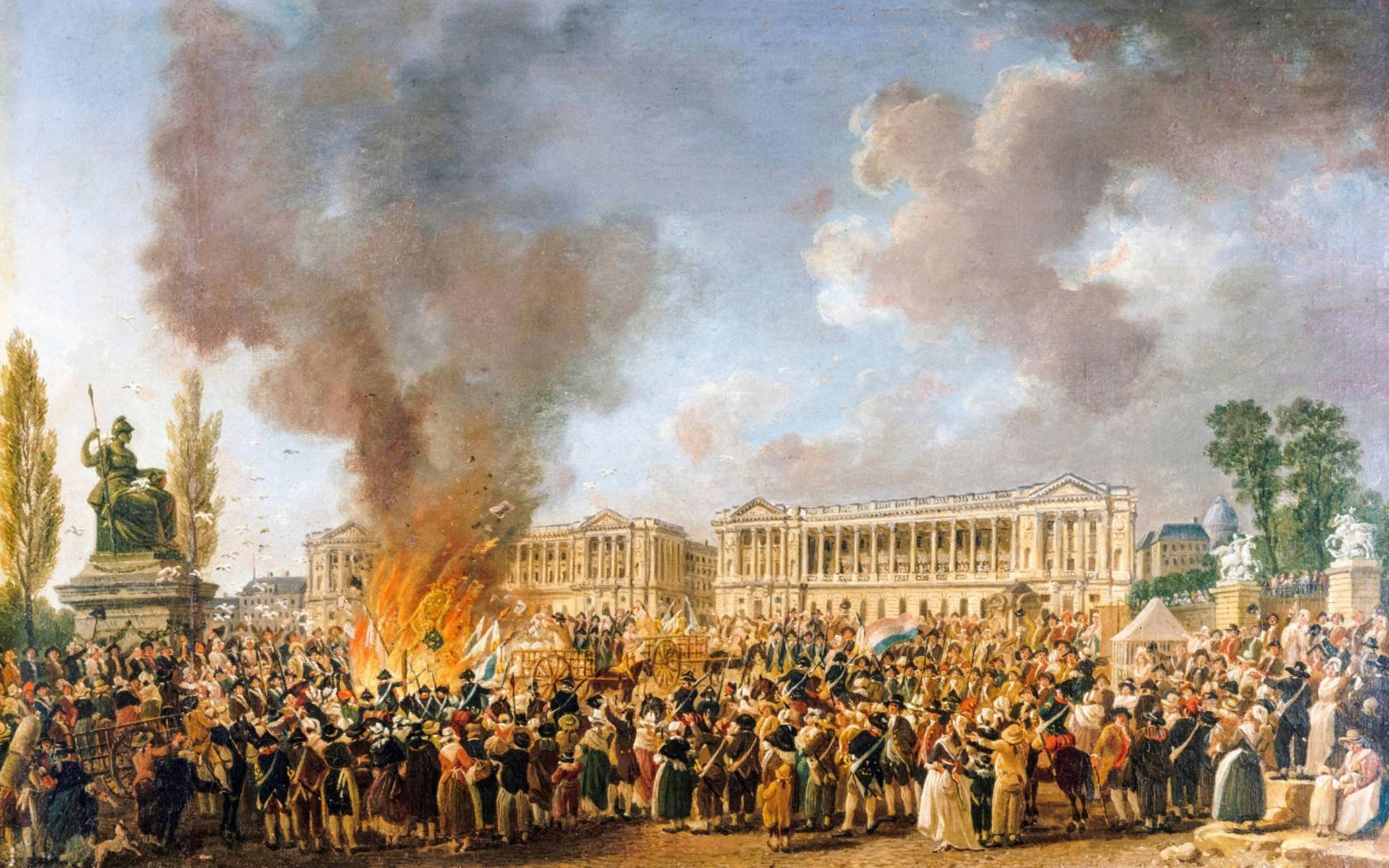
Whether it be the current protests and riots, PSG’s Champions League victories, or the 2023 riots (when over 2,500 buildings were burned or damaged, while rioters rammed a burning car into a mayor’s family home with his wife and two children inside), France has become accustomed to moments of unrestrained violence. This state of permanent chaos is made worse by the internal implosion of the traditional French political system, long dominated by a Jacobin state.
In place of a strong Leviathan, France has a Jacobin state that, after years of centralisation, is obese, indebted and weak, incapable of pacifying the atomised society it helped to create. As with most stories about France, the tale begins in 1789. Influenced by Enlightenment thinkers, the revolutionaries sought to create a society of free individuals, emancipated from subjugating customs and intermediary bodies. Among the Jacobins especially, democracy was conceived as an unmediated relationship between the individual citizen and the nation-state. Sovereignty could be neither divided nor mediated: it belonged to the undivided will of the people.
Yet France was a plural society, divided by region, language and culture. Unity could not emerge from society itself; it had to be embodied and enforced from above, and only the administrative, vertical state could uphold the principle of a Republic ‘one and indivisible’. The Republic became, in effect, an indivisible bond between the state and its citizens, promoting an abstract and impersonal identity freed from parochial attachments. As the French historian Pierre Rosanvallon states, there are in this society only two poles, the ‘individual’ and the ‘big Whole’, with intermediary bodies ‘being suspected from the outset of obstructing or corrupting the expression and formation of the general interest’.
In June 1791, the Le Chapelier Law banned all associations of workers and employers. Its author, Isaac Le Chapelier, justified it in terms that summed up the revolutionary conception of the Republic: ‘there is nothing but the particular interest of each individual and the general interest. No one is permitted to inspire in citizens an intermediary interest, to separate them from the public good through a corporate spirit’. The revolutionaries’ hostility towards intermediary bodies was particularly acute in the case of the Catholic Church, which threatened the country’s state-imposed civic unity. The Catholic Church was subordinated to the state in 1790 and strongly suppressed in 1793 and 1794.
The political dismantling of France’s social fabric continued throughout the 19th century, in the service both of France’s centralising ideals and of its growing industrial economy. The visible hand of the state and the invisible hand of the market effectively worked in tandem to impose a new modern order. This settlement partly explains France’s repeated revolutionary outbursts throughout that century: 1830, 1848, 1871.
Thinkers as various as Constant, Tocqueville and Durkheim came to recognise that, for all their sins, the Ancien Régime’s intermediary bodies had morally regulated French society and given citizens regular channels to voice their concerns to local and national leaders. Their absence explains France’s tradition of public unrest: a state that imposes order through top-down methods of coercion and violence (bureaucratic control and riot police), and citizens who oppose it through bottom-up methods of violence and resistance (strikes and barricades).
Faced with society’s resistance to state-led atomisation, and with their own inability to govern France without intermediary bodies, the French political elite made a series of attempts to legalise them again: trade unions in 1884 and associations in 1901. But the 1901 law that freed associations also subjected religious congregations to a far stricter regime, under which many were dissolved. The 1905 law then consecrated the separation of church and state, and in the Jacobin reading that prevailed, religion became a private matter rather than a public one. The message was clear: the public sphere belonged first and foremost to the Republic.
Throughout the 20th century, then, French society underwent a stop-start process of re-socialisation. A plethora of new social institutions emerged and in 1925 they even gained institutional representation with the creation of the National Economic Council, the ancestor of today’s Economic, Social and Environmental Council. The always tense relationship between the Republic and corporate bodies finally reached a precarious equilibrium under Charles de Gaulle’s presidency. De Gaulle led the creation of the Fifth Republic – seen as far more centralising than its two predecessors – but also proposed to merge the Senate with the Economic and Social Council so that socio-professional bodies (unions, employers, farmers, family associations) would sit in a chamber of parliament (a proposal he lost in a referendum, which led to his resignation). He also always upheld republican secular principles while still being devoutly and openly Catholic.
His presidency could therefore be characterised by a strong state and a strong civil society, working hand in hand for a peaceful society (especially by French standards). If need be, the state was then powerful enough to restore order through coercion.
This arrangement would unravel with a revolution that swept across the West from the late 1960s. In France, the student protests of 1968 announced the collapse of moral codes and social taboos through slogans such as ‘it is forbidden to forbid’ and ‘enjoy without hindrance’. They heralded a cultural revolution that progressively broke down the emotionally restrictive codes and social institutions that had regulated French society. Gone was a society regulated by complex prohibitions and, in its place, the celebration of immediate and limitless jouissance. This still ongoing revolution was not purely cultural. It was fuelled by rapid economic and technological change, from an abundance of consumer goods to, more recently, social media.
The effect of this massive and well-studied sociological process of social atomisation has been to sap civil society of its strength. ‘Thick’ institutions, such as the trade unions, the Church and national parties (in particular the Communist Party), have massively dwindled.
All Western societies have been affected. But France, marked by a revolutionary tradition that already viewed intermediary bodies as suspect, had no political or institutional antibodies to resist, or even slow, their decline. Citizens themselves, increasingly alienated from thick social institutions, have grown accustomed to seeing the state as a kind of saviour: ask (through elections or, if need be, protests) and you shall receive (from the state). The Jacobin dream, in fact: individual citizens, untethered from social institutions, brought together in a single, indivisible will: a large state. The Republic finally reigns supreme.
Emmanuel Macron’s presidency represents the pinnacle of this toxic arrangement. Before his election, Macron compared France’s situation to the period before the Le Chapelier law, arguing that ‘parts of society have organised themselves to defend their interests’ and lamenting a widespread sense that ‘corporatism blocks everything’. Macron dismantled traditional parties, imposed policies of limited engagement with trade unions, and massively eroded the autonomy of local government. His answers to social crises almost always meant more state, if not a more effective one: ‘whatever it costs’ during the pandemic, the energy price shield, 10,000 additional police and gendarmes since 2017.
With the gilets jaunes and the pension protests, France has returned to the traditional methods of protest that were a feature of the 19th century. But the scenes of pillaging expose something much more troubling and profound. In both the 1830 and 1848 revolutions, pillaging was constrained and often severely repressed. There were even instances in which workers were killed by fellow insurgents for theft amid the fighting, indicating that parts of the revolutionary crowd treated personal looting as a violation of the movement’s norms.
France’s tradition of unrest is therefore not new, but its culture of rioting is. What is striking about these riots is that they usually have no political dimension at all. They break out on Bastille Day, New Year’s Eve, Halloween, or whenever PSG wins big. A 2024 cross-party Senate report concluded that the 2023 riots carried no ‘identifiable demands’, and pointed instead to the role of ‘collective euphoria’. As one sociologist told the inquiry, the riots also had ‘a playful dimension’, amplified by social networks.
The streets have become a form of outlet; rioting has become a pleasurable and wholly transgressive experience. Temporarily seizing public space and showing their feats on social media gives participants a sense of exhilaration and omnipotence, the pleasure of taking control of the city. Understanding the demographic behind these riots is crucial to explaining why they are occurring with such acuteness in France. Most rioters came from the banlieues, where much of France’s population of North and sub-Saharan African origin is concentrated. These young men stand at the sharpest end of the atomisation described above. Immigration is by definition an uprooting process, and many of their families ended up torn between identities. France’s Jacobin model compounds this, since it asks immigrant communities to shed or privatise the intermediary bodies they bring with them, above all religion, as most come from Muslim-majority countries. The abstract civic identity offered in exchange, sustained by a distant state, therefore has little appeal.
It is probably no coincidence that mosques in France appear to exert limited moral and regulatory force on younger generations. In 2023, calls for calm by imams reportedly had little effect. In some cases, peace was instead said to have been restored by local gangs, for whom riots were bad for business.
With comparable immigration rates, Britain offers an instructive contrast. Its established church, along with its multicultural model, has preserved a public role for religion that extends to minority faiths. Officials cooperate closely with religious authorities to anticipate and de-escalate disorder. In Bradford in 2007, a collaboration between the police and local mosques led to a 30 per cent fall in criminal damage during Ramadan.
To be clear, the British integration model is itself in crisis, beset by communities living ‘parallel lives’ (to borrow the language of the 2016 Casey Review), ethnic tensions and a crisis of loneliness. But its willingness to work with non-state institutions has meant that it has, for now, largely avoided the regular and intense bouts of anarchic, apolitical rioting that France experiences, despite higher levels of inequality.
France’s political future is bleak. Most parties, from the RN to LFI, sit squarely in the Jacobin tradition. While all acknowledge current riots as a failure of the state, few point to the deeper problem of atomism and to the need to rebuild a strong and autonomous social fabric. Their solutions always involve expanding the state: more tax on the left or more repressive powers on the right.
Émile Durkheim, the founding father of French sociology, described this future more than a century ago: ‘[since the state] is far from them, it can exert only a distant, discontinuous influence over them; […] while the state becomes inflated and hypertrophied in order to obtain a firm enough grip upon individuals, but without succeeding, the latter, without mutual relationships, tumble over one another like so many liquid molecules, encountering no central energy to retain, fix and organise them’.
What France is living through is the simultaneous realisation and breakdown of a political project that began more than two centuries ago. The Revolution brought France a powerful dynamic of emancipation, but it also bequeathed a political culture in which intermediary bodies are illegitimate by default. Here lie the uniquely French sources of the country’s chaos. In attempting to create Hobbes’s Leviathan, France has ended up in his state of nature.


