The dawn of the post-Trump era
- November 5, 2026
- Luke A. Nichter
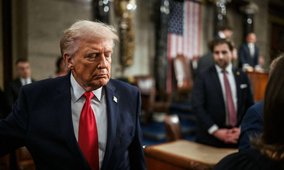
Donald Trump remains in the White House, but the midterms have made him a lame duck.

On election day I flew from Los Angeles to Washington. Ahead of what history suggested would be a change, it seemed the place to be. The approach into Reagan National follows the Potomac, and the monuments slide past the window, as they always do. Soon the city’s institutions will change hands. History is a useful guide to what could come next.
By Wednesday morning, Democrats had won control of both the House and the Senate. They flipped Senate seats in Texas and Kansas, which had not sent a Democrat to the Senate since 1988 and 1932 respectively. Donald Trump has become what nearly every second-term president becomes sooner or later: a lame duck. When the Democrats lost 47 House seats in 1966, Lyndon Johnson insisted he was no ‘crippled waterfowl’. Within 18 months, he was out.
In the American system, re-election is the greatest political prize, yet it is rare that anything much good follows. Second terms gave us Watergate, Iran-Contra, an impeachment and the long war in Iraq. In the final midterm of a two-term presidency, the president’s party has lost ground every time since 1938, with one exception: 1998, when Republicans overplayed their hand on impeachment. Trump’s terms are not consecutive, and he won’t face the voters at the ballot box again. He has now lost the House in both of his midterms, eight years apart.
If the lessons of history held, 2026 was always going to be a magical year for Democrats. There will be no shortage of explanations for their success. On election day, petrol averaged $4.15 a gallon. There is also the war with Iran, along with inflation and tariffs, but the result would probably have looked much the same without any of them. The midterm penalty is virtually a law of American politics.
As the results came in, Trump posted: ‘I wasn’t on the Ballot and if I was, we would have won IN A LANDSLIDE!’ Perhaps. But midterms are a referendum on the president. The electorate is also notoriously fickle. Millions of the same Americans voted for Obama, then Trump, then Biden, then Trump again, and on Tuesday against him.
The best guide to what comes next is 1958. Voters were shaken by a recession and uneasy about the Middle East. American marines landed in Lebanon that July. The Democrats romped home. Their House seats grew from 234 to 283, and they gained 15 Senate seats and six governorships.
Eisenhower, therefore, spent his last two years holding the line with his veto against a Congress led by Sam Rayburn and Lyndon Johnson. On election night, Trump posted an image of a red cap reading ‘VETO’. Eisenhower’s personal popularity survived his lame-duck years, but his vision for ‘Modern Republicanism’ did not. Nixon, his heir, lost in 1960, and four years later the party’s soul had been captured by Barry Goldwater. Trump may be a lame duck; the question is whether MAGA is, too.
For Republicans, the blame game is in full swing. Trump has already named culprits, including Fox News and Greg Abbott, the defeated Texas governor, whom he accused of becoming a ‘RINO’ (Republican in name only). In 1958, Vice President Nixon was less concerned with the facts of the Sherman Adams affair than with the party’s chances in the coming midterms, and Adams was forced out on that basis. In 1974, Nixon’s own party turned on him, arguably less over the facts of Watergate than out of self-preservation. Trump could also betray the Republicans. Within hours, he told the New York Times, ‘We’ll work with the Democrats.’ A president with no election left to win may prefer self-interested deals over loyalty to a party that he believes has failed him.
Republicans do keep the White House and the Supreme Court. The period of unified government had curious effects: the justices and some Republican legislators found themselves restraining Trump, on tariffs and elsewhere. With Democrats now in control of Congress, the Court can return to something closer to its six to three conservative majority, and congressional Republicans are relieved of an unwelcome role.
The obvious path forward for the Republicans is JD Vance, although he is in a tricky position. A vice president must be the administration’s chief defender and have ideas of his own, complicating his pitch for the presidency. Since the Second World War, only George H.W. Bush, in 1988, has pulled off the transition. Nixon in 1960, Humphrey in 1968, Gore in 2000 and Kamala Harris in 2024 did not. Nor did Hillary Clinton, who had run Obama’s foreign policy as secretary of state – now the brief of Marco Rubio, the other name in Republican conversation. Vance has one advantage that Nixon also enjoyed: time. Nixon lost in 1960 at 47 and won in 1968. Vance is just 42.
Democrats must answer the other side of the equation: who deserves the credit? One answer is Barack Obama, who opened his campaigning in Cleveland. Ohio duly sent Sherrod Brown back to the Senate and elected Amy Acton governor. But credit is really a question of identity, and here the Democrats have a problem. Many of Tuesday’s gains came in states Trump carried easily, by candidates such as Brown, Adam Hamilton and James Talarico. Will the party at large act accordingly and move back to the centre? Or will the heartland get a taste for the politics of the Democratic Socialists of America, the movement that made Zohran Mamdani mayor of New York? After a narrow defeat in 1968, the Democrats shifted disastrously to the left and were trounced in 1972. They then had to learn from the mistakes of 1972 before enjoying the spoils of victory in 1976, when they united behind the centrist former Georgia governor, Jimmy Carter.
The first test is whether Democrats choose the path of revenge on Trump. House investigations will begin at once, but removing a president takes 67 senators. Only Nixon has ever had enough of his own party turn against him for removal to be a possibility, although he resigned before a formal vote was taken.
The class of 1974 used its majority to rein in the presidency, while the Republicans of 1998 overreached. Moderates in both parties, meanwhile, may find that their stature grows by working across the aisle.
Both parties now begin auditioning for 2028, and the next two years will preview what each has to offer. Trump’s final act could resemble Bill Clinton’s deal-making after 1994 or George W. Bush’s defiance after 2006, but Clinton still had an election to win, so the more revealing question may be who betrays whom first: Trump the Republicans, or the Republicans Trump.
A reset is also an occasion for grace, across the aisle and among ordinary Americans, although Washington rarely grasps the opportunity. Meanwhile, the clock is running on the 2028 campaign. Jimmy Carter announced his candidacy a month after the Watergate midterms, and Obama three months after the blue wave of 2006. The campaign begins, unofficially, when the first ambitious senator or governor starts behaving like a candidate. Somewhere in Washington this morning, that day may already have come.