Pavel Fischl began keeping a diary in the Theresienstadt ghetto at 19, entrusting his notebooks to a friend before his deportation to Auschwitz. They now appear in English for the first time.
Essential reading, viewing, and listening from the EI editors.
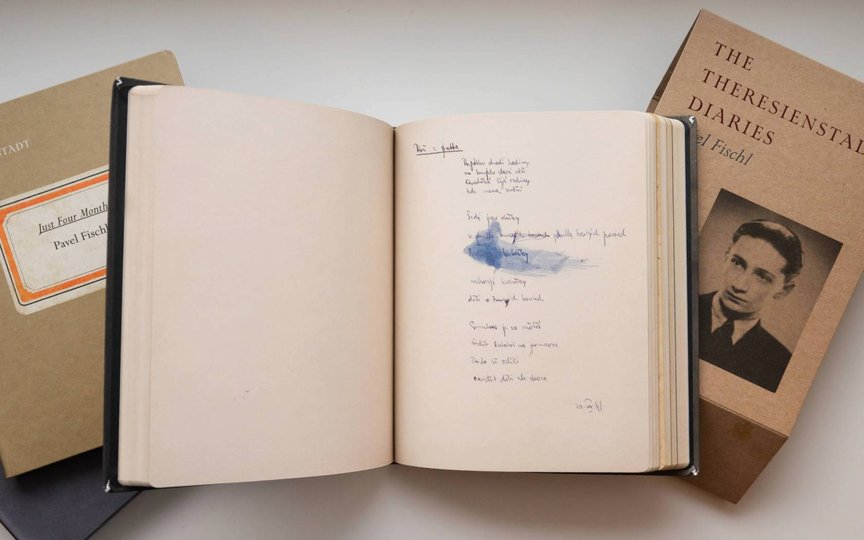
In the wake of the Second World War, Pavel Fischl, then resident in Prague, was greeted on his doorstep by a woman with a package. It contained the diaries he had kept while a prisoner in the Theresienstadt ghetto between 1941 and 1943. He was just 19 when he arrived. Before he was deported to Auschwitz, he asked a friend to keep them safe as best they could. Miraculously, they survived via a circuitous route to end up in the hands of his visitor. Later, Fischl’s son, Michael, found them among his late father’s belongings (he had died in Israel in 2008). The Theresienstadt Diaries is a boxed set of three volumes, containing a facsimile of the handwritten diaries, an English translation and a copy of Fischl’s autobiographical novel, Just Four Months. ‘I really wanted to write nothing more than to truthfully write down everything that drove so many of us to ask ourselves: “Are we still alive?”’ He succeeds heroically in a work that now takes its place among the great testimonials of humanity’s most terrible moral abyss.
Mozart’s tonic
Mozart’s Requiem, completed by Franz Xaver Süssmayr in 1792, a year after the composer’s death, is among the most beloved and profound works in the western canon. But, if you thought you’ve heard it all before, and already have your favourite version, then think again and give the recording by Pygmalion under conductor Raphaël Pichon a go. It places the standard Süssmayr edition amid interpolations of sacred pieces attributed to Mozart, as well as the delightful canon ‘Ach, zu kurz’ – ironically a meditation on the brevity of life. The account opens and closes with a plainchant ‘In paradisum’ sung with striking beauty by the treble Chadi Lazreq. In a world in desperate need of sacred beauty, this is a tonic.
The bawdy joys of 42nd Street
And now for something completely different. 42nd Street, one of the great Warner musicals, gathered a roster of top talent – producer Darryl Zanuck, the sassy star Ruby Keeler, the choreographer Busby Berkeley, and Ginger Rogers making a claim for greatness – that turns popular entertainment into fine art. And it’s bawdy with it. Bradford Ropes’ story is all girls and gangsters set in the cut-throat world of Manhattan showbiz. The film came out a year before strict enforcement of the puritanical Hays Code put a dampener on Hollywood excess. Cinema has rarely been so life-enhancing, so joyous – and the title song still stuns.


