Churchill’s gift to diplomacy
- November 20, 2026
- Peter Caddick-Adams
The British statesman believed that regular personal contact between world leaders was the best way to avoid a catastrophic great-power conflict. Shenzhen was a pale imitation of his vision.
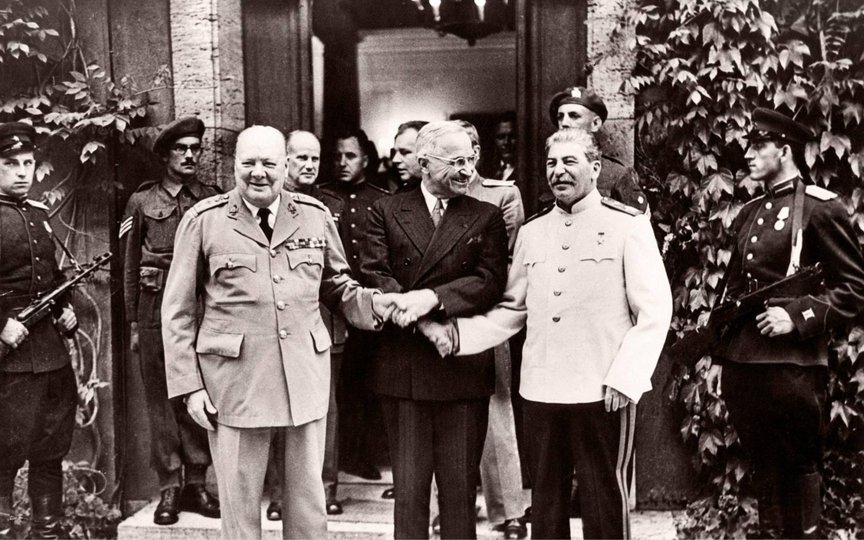
Two months after the death of Stalin on 5 March 1953, Winston Churchill stood up to address the House of Commons. He was back in office as prime minister, and deputising for his foreign secretary, Anthony Eden, who was in hospital. The occasion was a foreign affairs debate of 11–12 May, when the Cold War was warming up, negotiations to finalise the Korean War were ongoing, and the USSR was known to be testing nuclear weapons in Kazakhstan.
Soviet leadership was uncertain, with the troika of Malenkov, Beria and Molotov, who had succeeded Stalin, soon to be ousted by Khrushchev. Building on his wartime meetings with other world leaders, Churchill boldly announced: ‘A conference on the highest level should take place between the leading powers without long delay… at the summit of the nations… At worst, the participants would have established more intimate contacts. At best, we might have a generation of peace.’ Shortly afterwards, he suffered a stroke, but it never dampened his hope of ending the Cold War, which daily threatened to blow hot.
It is remarkable that, in his long career, Churchill never held the position of foreign secretary, a post that would have suited him far better than Stanley Baldwin’s curious choice of Churchill as Chancellor of the Exchequer during 1924–29. Domestic affairs never interested him in the same way as defence and what we now call geopolitics. It is in these spheres that he left his mark. One of his footnotes to history was to bequeath to us the concept of the ‘summit meeting’ as a gathering of influential world leaders. It originated in his speeches in the early 1950s, including his 1953 speech to the House of Commons.
Churchill had grown up in the days when such gatherings had few precedents. Before the days of long-distance air travel, attendance meant a long journey and residence for many months. One precedent that would have come to Churchill’s mind was the Napoleonic-era series of international diplomatic meetings during September 1814 to June 1815 known as the Congress of Vienna. Another was the January to June 1919 Paris Peace Conference that concluded with the Treaty of Versailles on 28 June, which he attended for four days in February. The value of face-to-face meetings with his opposite numbers never left him. However, there were also warnings from the recent past, including the disastrous encounters between his predecessor Neville Chamberlain and Adolf Hitler at Berchtesgaden and Munich in September 1938.
Accordingly, Churchill spent much valuable time during the Second World War shuttling to and from international conferences forming relationships with allies and discussing strategy. We often think of the ‘Big Three’ who met at Tehran, Yalta and Potsdam in 1943 and 1945. Yet Churchill set up and attended 17 such gatherings with other world leaders between 1941 and 1945, excluding his deliberations with the French in May 1940. Each had a strategic objective, cloaked by elaborate codewords. The various leaders brought with them huge entourages of politicians, generals, other experts and even family members. Documents were signed and brandished in front of the world’s media at the end, while the minions communed with their opposite numbers.
Since the wartime years, Churchill’s legacy of summits in word and deed has become commonplace, enabled by the convenience of long-distance air travel. There were 28 major American–Soviet conferences held during 1955–91, often about arms control, and 52 encounters of the G6–G7–G8 leaders between 1975 and 2026. The G20 nations have assembled 21 times for summits from 2008 to 2026, while the Europeans have gathered on 20 significant occasions to thrash out defence, economic and political matters, from 1969 to 2026. Malta in 1989 saw the first meaningful gathering of East and West after the fall of the Berlin Wall, while there have been a further 29 important musters of heads of state since Geneva in 1955 to discuss spheres of influence, ceasefires, peace in the Middle East and other matters of world import.
All of these conclaves have acted as conduits for the diplomatists and generals of nations in conflict or in tension with one another (think of India and Pakistan, for example) to keep talking. On visiting his old friend Dwight D. Eisenhower at the White House in 1954, Churchill confirmed his belief in the value of structured dialogues: ‘Meeting jaw to jaw is better than war.’ Four years later, during a visit to Australia, Harold Macmillan borrowed and adapted the words to out-Churchill Churchill with the more memorable and rhythmic ‘Jaw, jaw is better than war, war.’
Another series of international assemblages revolves around the Asia-Pacific Economic Cooperation (APEC), an inter-governmental trade forum for the 21 member economies around the Pacific Rim, whose meetings commenced in 1989. All members, including Australia, Japan, New Zealand and Singapore, take turns to host summits; the United States has hosted three times, while 2026 also marked China’s third time as host of the APEC forum, this time in the city of Shenzhen.
However, it was only on 19 October this year that The Wall Street Journal reported a Putin–Trump phone call of ten days earlier when the Russian leader proposed, in the margins of the forthcoming APEC meeting, a trilateral summit between him, Trump and Chinese leader Xi Jinping to discuss Ukraine, with Trump reportedly receptive to the idea. Subsequently, on 13 November the White House confirmed the encounter would take place. Three days later China’s Ministry of Foreign Affairs confirmed the trilateral summit in Shenzhen was on for 19 November.
The three leaders met for 90 minutes and apparently chatted about international and energy security. President Xi rather vacuously intoned, ‘every effort must be made to prevent nuclear war via positive interaction’, and they ‘should set an example by cooperating to address global challenges and safeguarding world peace and stability’. His Russian opposite number observed that the three nations ‘shared responsibility for maintaining international peace and security and had many converging interests, including ending the war in Ukraine’. Trump, who at one stage appeared to fall asleep, thought they ‘were uniquely positioned to discuss reduction of nuclear stockpile, but that it was not an easy thing to do – give them up.’ There was much talk from the American side about the three leaders ‘making history’. The US again emphasised that the three nations were ‘uniquely positioned to discuss nuclear weapons’, while omitting the fact that the world’s other declared nuclear powers who are permanent members of the UN Security Council, Britain and France, were not present.
What was achieved? The trio issued a ‘Declaration toward Peace’, agreed to promote reform of the United Nations and increase supplies of refined petroleum products. They also stated that the International Criminal Court (‘out of control’, said Trump) and similar bodies ‘must not abuse their jurisdiction’, that ‘a nuclear war cannot be won and must never be fought’, and that they ‘would conduct negotiations on reducing nuclear risks and stop the proliferation of nuclear weapons’. This was more a list of views already held on nukes and oil, and common grievances held by the three.
Ominously, a sentence concealed within the text of the Declaration reaffirmed that ‘the principle of state consent and respect for immunities of state officials are of paramount importance.’ This is an attempt to establish an ‘immunity’ category for those engaged in murderous skulduggery against others – the Russian leader is wanted by the ICC under an arrest warrant for war crimes in Ukraine. Benjamin Netanyahu is likewise wanted on charges relating to his government’s prosecution of the war in Gaza. The pressing issues of Ukraine, Iran or Taiwan, of climate change, human rights, transnational policing, crime and immigration, were barely even mentioned. The irony that the likelihood of nuclear proliferation had been increased by Kyiv’s surrendering of its nukes under the December 1994 Budapest Memorandum, on the understanding that Russia would never invade, was conveniently overlooked.
This was not a meeting of equals. President Xi positioned himself as ‘the adult in the room’, presiding over a power that doesn’t get involved in reckless foreign wars. Trump thought their gathering was ‘really making history, that a lot of wonderful things can come out of this, or at least start.’ In reality, after a disastrous domestic showing in the US midterm elections, amid rising inflation at home and the ongoing conflict with Iran abroad, the event was a form of distraction therapy for the American president. As for Putin, he framed the summit in Shenzhen by referring to the three nations being ‘united not only by our status as victors in the Second World War, but, most importantly, by our shared responsibility for maintaining international peace and security.’ He didn’t seem to reflect on the fact that his government has done more to shatter that peace and security than any other since 1945.
Shenzhen was a wasted opportunity. It achieved nothing apart from permitting three ageing rulers, sharing some commonly held prejudices, to rail against much of the rest of the world. Churchillian, in terms of Tehran, Yalta or Potsdam, it was not. Indeed, the real summit of the moment took place 5,000 miles away, where 40 European leaders and their staff met Ukraine’s Volodymyr Zelenskyy in Berlin to reassure him of their support, a meeting at which two of President Trump’s key diplomatic fixers, Jared Kushner and Steve Witkoff, were also present.
Peter Caddick-Adams
More from Diplomacy

Valentine Lawford, the hidden hand behind Britain’s wartime diplomacy

The BRICS+: rebels without a common cause

The price of Trump’s transactional diplomacy

Kissinger’s debt to Bismarck


