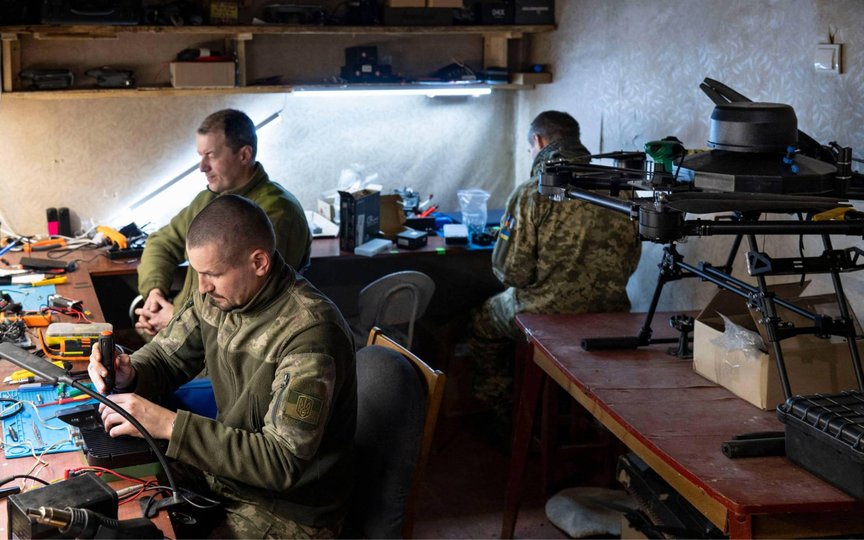
A war driven by algorithms has transformed the nature of conflict more than at any time since 1945.
Essential reading, viewing, and listening from the EI editors.
Ukraine’s struggle with its giant neighbour has now lasted longer than Russia’s Great Patriotic War against Germany. And Ukraine’s remarkable technological innovations have transformed the nature of warfare more than at any time since 1945. War of the Machines: How Ukraine Reinvented War, and the People and Systems Behind It explains this new form of conflict as a contest between systems of adaptation and integration, created by fast-moving networks of engineers, soldiers, intelligence agents, start-ups and politicians. This narrative of a war driven by algorithms is written by four authors who have witnessed these developments on the ground – the South African strategist Greg Mills, Estonian MP Eerik-Niiles Kross, the entrepreneur Basil Gavalas, and the former commander of the British Field Army, Ralph Wooddisse. It’s a fascinating, if troubling, guide to modern warfare – which is proving to be just as brutal as any in history.
Peter Sichel’s spy story
In Storyville: The Last Spy, 100-year-old Peter Sichel looks back on his long and dramatic life. He fled Nazi Germany as a child – he was Jewish – to move to France, where his family had interests in the wine industry: Sichel later became the brains behind the Blue Nun brand of wine. Having moved to the US after the Nazi invasion of France, he went on to become head of the CIA’s Berlin station, was transferred to its Washington headquarters, and ended up as the CIA’s station chief in Hong Kong. Despite his long and valuable service to America – perhaps because of it – he is deeply and perceptively critical of US foreign policy. ‘There’s no attempt to learn from the past. It is an institutional mistake of this country of not being able to associate what is happening today from what happened 70 years ago and what we did at that time.’ It is a beautifully made, moving and often funny lesson in the value of applied history – and the mistakes that can be made in its absence. Sichel died, aged 102, in 2025.
What did Ancient Rome sound like?
Those who’ve seen Ridley Scott’s Gladiator and HBO’s TV series Rome will be familiar, whether they know it or not, with the music of Synaulia. This project to restore the music of Ancient Rome, headed by the Italian musicologist Walter Maioli, takes its name from the Ancient Greek for an ensemble of wind instruments – such as the syrinx, or pan flute – the subject of volume one of their recordings; volume two is devoted to Roman string instruments, such as the lyra. It’s a heady sound, at once strange and vaguely familiar, with a repeated air of menace. The dance music, researched by Nathalie Van Ravenstein, the Spanish choreographer and anthropologist who died tragically young, is perhaps the most accessible to modern ears. In the absence of any system of musical notation, these sounds are the product of both deep research and empathetic imagination.
Paul Lay
More from Ukraine

Ukrainian literature is a European literature

A debrief with Ukraine’s soldiers

Nord Stream: another Ukrainian deep strike

Ukraine’s experiment with foreign reformers