The bankers of Christendom
- November 19, 2026
- Elise Morrison
Though sworn to poverty, the Knights Templar built the most powerful financial network of the medieval world.
Why do the Knights Templar occupy such a prominent position in our cultural imagination 700 years after they were disbanded? Theirs is a story shrouded in mystery and conspiracy: were they heroes or villains? Devil worshippers or keepers of the Holy Grail? Templars, or knights very much like them, crop up in pop culture, starring in Indiana Jones and the Last Crusade, in The Da Vinci Code and the video game Assassin’s Creed. But these knights left a much more important legacy – in the creation of modern banking.
Known as the Templars, these knights were officially named ‘the Poor Knights of Christ and the Temple of Solomon’. By the end of the 13th century they held property across Christendom, a fleet of ships in the Mediterranean, political sway with most of Europe’s monarchs and a permanent presence at the papal court. They also created the most trusted, stable and powerful financial structures in the world.
The story of the Templars began after the crusaders had captured Jerusalem in 1099. The city, now under Christian occupation, offered European Christians a chance to make the pilgrimage to see the holy places in and around Jerusalem and to be where Christ and his apostles had trod. The violent siege of Jerusalem had left much of the city heavily damaged, and while the Jerusalem itself was fortified by thick stone walls, the surrounding countryside was essentially a lawless war zone. The first generation of crusaders, busy trying to establish a military and ecclesiastical presence, allocated fewer resources to protecting pilgrims.
Twenty years after the siege of Jerusalem, the French knight Hugh of Payns gathered a group of eight other knights. These were not men who had devoted themselves to contemplation or silence, but had committed themselves to serving God by the sword: ‘heroically’ protecting the defenceless pilgrims, or at least, that is what they said. Their legitimacy was secured ten years later with the help of St Bernard in 1129 at the Council of Troyes, where they were made an official order of the Latin Church, charged with protecting the routes and roads to the Holy Land.
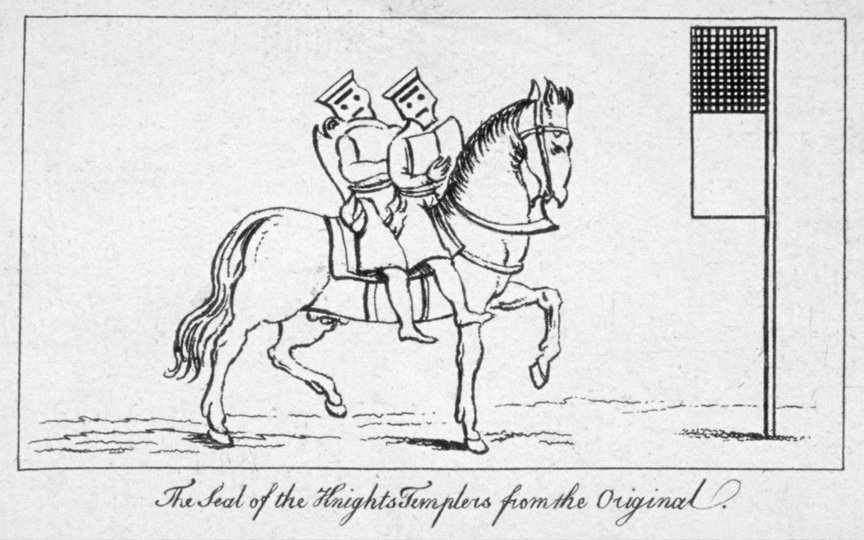
As historians have well documented, what we know about the early Templars suggests that they lived a very pious life. Though their service to God was active rather than contemplative, the Templars were nevertheless expected to live according to a monastic rule devised by St Bernard, based on the rule of St Benedict, requiring them to keep certain hours, commit themselves to certain principles and, following the Benedictine ideal of ora et labora, to work and pray. Poverty was a central part of this philosophy: even their seal, which depicted two knights sharing a single horse, was intended to illustrate this commitment.
There has been much written about their exploits in the East: their role as Christendom’s guardians, and their heroic and indeed problematic pursuits. Their commitment to violence, to fighting the enemy in the name of God, seemed to contradict the Christian’s duty to love his neighbour.
A tension less frequently addressed is how it is that the Poor Knights of Christ and the Temple of Solomon, who had sworn themselves to personal poverty, leveraged their religious immunity to become the most powerful and wealthy bankers in the world; how it is that a monastic order which embraced the anti-usury campaigns of the 12th and 13th centuries ended up providing financial services across the known world that relied on credit.
While projects of the Templars prior to 1129 were modest, and they were financially restricted in what they were able to do, the Council of Troyes marked a significant change in their status. With St Bernard’s support, the knights’ newly acquired legitimacy allowed them to begin operating more widely. In the early years, they relied for their survival on various patrons, including the king of Jerusalem, the Latin patriarch of Jerusalem and other religious orders.
However, according to a vague rule devised at the Council of Troyes, the Templars were permitted to acquire landed estates. This was fortified in the 1130s by the publication of St Bernard’s In Praise of the New Knighthood, which aided recruitment. It was bolstered again in 1139, when Pope Innocent II exempted the Templars from paying tithes and allowed them to take and keep the spoils of war, and in 1144, when Pope Celestine II awarded indulgences to those who donated to the Templars. They began to receive considerable donations from around Christendom, becoming the charity of choice for many wealthy congregants.
Around this time the Order had already established itself as a provider of financial services: first by offering pilgrims and crusaders safe travel to the Middle East with its fleet of ships, then by creating systems for transferring and transporting pilgrims’ wealth. These were letters of credit, perhaps modelled on the Islamic suftaja, which allowed pilgrims in England to deposit money with their local Templars at home and withdraw it in cash when they reached Jerusalem.
This escalated into the offering of loans. Many of the pilgrims travelling east did not have the money to finance the trip, and so temporarily handed over assets such as land to the Order, which collected the revenue from it in the meantime. This was an early example of a sophisticated financial operation based on credit.
There were other financial institutions offering loans at the time, but none of them as legitimate or powerful as the Templars. Jewish moneylenders were considered unreliable; not only did their exorbitant interest rates earn them the status of usurers, but prevalent attitudes against Jewish people meant that this money was often pillaged by states or mobs. Italian bankers, who later became the gold standard for financial services, were not well established in the 12th century as they had little jurisdiction outside of Italy. But the Templars, with the support of the Pope, who could threaten excommunication and interdict, established power throughout Christendom.
And so, not long after they had been set up, the Templars attained a global reach. Louis VII used them to finance his crusade in 1147-49; the Paris Temple later became the French royal treasury where funds were stored and taxes paid in; English kings made use of their services, with King John depositing money as well as the crown jewels and important records in the Temple. Because of these royal connections, the Templars grew in popularity and began to offer financial services to individuals independent of the crusaders.
But how did they justify their financial activity, when the popes of the time had prohibited lending at interest? This can, more broadly, tell us a little bit about how financial actors managed credit relations while negotiating the theological boundaries dictated by the Church.
The medieval campaign against usury intensified with the edicts of Pope Alexander III (1159-81) and Pope Urban III (1185-87). Alexander III expanded the definition of usury to include credit sales at a higher price than the cash price. Pope Urban III further solidified the Church’s stance against usury by citing Luke 6:35, interpreting Christ’s command to ‘lend, hoping for nothing thereby’ as a direct prohibition of usury. Urban ruled that a lender’s intention to gain from a loan, regardless of contractual stipulations, constituted usury. This interpretation became a cornerstone of the Church’s anti-usury doctrine for centuries.
We know that there is little explicit evidence in the historical sources that any interest was levied on loans provided by the Order. In other words, the Templars, on the surface, avoided making any charges visible or explicit which risked accusations of usury. As historians have pointed out, however, it would have been extremely rare for the terms of interest to be made explicit in any medieval contract, and such terms would typically have been agreed upon orally. Depositing money with a banker, where any return was entirely at the banker’s discretion, fell officially beyond the bounds of usury, since there was no contractual agreement for a specific return. Some historians have also suggested that the Order structured payment for loans through various administrative and service charges.
As the historian Eleanor Ferris conceded in her 1902 study of the Templars’ dealings with the English Crown, ‘the available records throw practically no light’ on how the Order was paid for its services. She suggested that one route for making credit relations profitable within the boundaries of the usury prohibition would have been the disguising of payment in the form of ‘gifts’ or ‘bonuses’, though she elaborated no further.
This practice, though not uncommon, was viewed very negatively. Powerful figures might compensate their bankers for invented damages through a series of so-called ‘gifts’, but despite the euphemism, these ‘gifts’ were understood as obligations and functioned as interest. What we do know is that the Templars often gave out loans to monarchs and other powerful figures to fund certain political projects, and that they were later rewarded for their services. But even from the early days of the Order, gifts to the Templars had been declared by the papacy a pious act of charity that promoted the spiritual welfare of the donor. They were enthusiastically encouraged, which helped disguise any financial wrongdoing.
Though it is not clear that the amount the Templars received in gifts from these monarchs rivalled the amount that they lent, it is clear that loans were a part of their financial services package, and most historians seem to think that some level of usury was involved. The use of concealed ‘gifts’ as repayment remains a topic of political relevance even today, and clearly, the line between gift and exchange for services is as uncertain now as it was back then.
Whatever romance the knights had, these technical arrangements, which facilitated interest on loans, demonstrate the complex systems of credit developed by the Order. Loans were based on projected revenues rather than money in hand, and allowed for a return, variously disguised, signalling a departure from the medieval idea that money could not make money. This shift set the stage for the banking developments of the later Middle Ages on which modern banking is based.


