Israel’s house divided
- November 4, 2026
- Michael Goldfarb
- Themes: Israel, Middle East, Politics
Israel’s first election since 7 October has left the Knesset deadlocked, continuing a long tradition of fractured parliaments under the country’s proportional system.
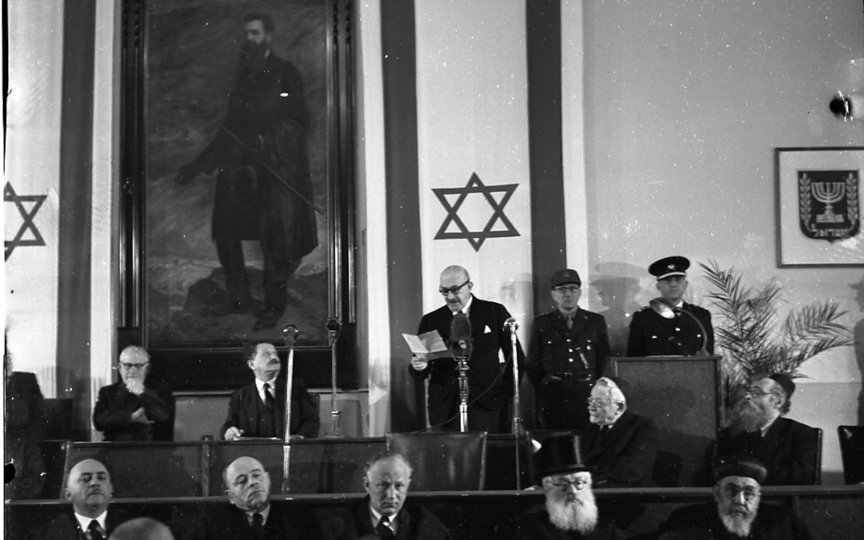
In strict political science terms, representative democracy means citizens elect a representative to a legislature to act on their behalf. When it comes to Israel the term takes on a wider meaning. Its democracy is ‘representative’ of the social-psychological structure of the society and its culture: fractious and inflexible.
The Israeli election system has, since the state’s foundation, tended to embed differences and factionalism. A parliamentary system was planned, and David Ben-Gurion, revered as father of the nation, wanted to model it on the British system of individual constituencies elected by first-past-the-post. He got stuck with a proportional representation system.
Parties form and disintegrate. Policy programmes come and go. Ben-Gurion later lamented: ‘With the strange electoral system of Israel the entire political system is not only undemocratic from the bottom up, but it endangers the development of the state as well as of a political consensus, and it undermines the state’s position both in its domestic life and in its foreign policy.’
It is a system that embeds the polarisation that has long existed in Israeli society and has dramatically deepened since the attack by Hamas on 7 October 2023.
The 27 October election was the first real chance for the Israeli electorate to articulate its feelings about the fallout from the terrorist atrocities of 7 October and the conduct of the war in Gaza. The result is a deadlock. Eleven parties – including two representing Israel’s Arab citizens, who make up about 20 per cent of Israel’s population – have been elected to the Knesset. Prime Minister Benjamin ‘Bibi’ Netanyahu’s Likud is the largest of them. But the anti-Bibi parties together, including the Arab parties, form a majority.
Those who pray at Bibi’s synagogue still wouldn’t cross the street to pray at the opposition’s place of worship. With 53 seats they fall well short of the 61 necessary to form a government. The ones who wouldn’t pray at Bibi’s shul are reluctant to cross the Arab parties’ threshold for discussions that would create a majority. So now what?
For all the focus on Netanyahu’s role over the last 30 years in shaping Israeli politics – he first became prime minister in 1996 and has held the office in three different stints for nearly two thirds of the time since – it is possible to lose sight of a deeper current that has shaped Israeli society during that period: a massive wave of migration from the Soviet Union as it collapsed beginning in 1989. In the ensuing decade around a million people from Russia and other Soviet republics, most of them Jews, made aliyah to Israel. This wave of people represented an increase of more than 20 per cent in Israel’s population.
The impact of this aliyah – the word means ‘ascent’, and is used both for being called up to the Torah and for immigrating to the Land of Israel – was immediate, not just because of the high-tech skills many of these people brought with them, but also their world view. Many brought with them a Soviet, or Russian, mindset about how to use power; their families had survived Hitler, Stalin and decades of discrimination inside a failing totalitarian state. The immigrants’ impact on Israeli society was outlined in a 2013 book, The Million That Changed the Middle East, by Lily Galili and Roman Bronfman. Sadly, the book has never been published in English.
The Soviet arrivals coincided with the negotiations that led to the Oslo Peace Accords. Although most of them helped elect Yitzhak Rabin’s Labour in 1992, Galili and Bronfman note that a large number went on to support Netanyahu’s Likud and other right-wing parties that opposed the Accords.
Eventually, inevitably, they formed their own political parties or lists, the most successful of which is Yisrael Beiteinu, Israel Our Home. The party was founded by Avigdor Lieberman, whose point of origin was the Moldovan Soviet Republic. Lieberman, who made it to Israel before the great post-Soviet aliyah, is a former close associate of Netanyahu. The men had a very public break over Bibi’s concessions to the Palestinians, which went on to culminate in the 1998 Wye River Agreement, a long-forgotten attempt to revive the peace process that had been badly damaged by the assassination of Rabin in 1995. Lieberman started his party in 1999 and drew on the ‘Million’ to make it an electoral force.
In the labyrinthine world of Israeli politics, Lieberman and Netanyahu would make up and become allies again. He would eventually serve as Deputy Prime Minister under Netanyahu in 2009, then merge his party with Likud for the 2013 election, then un-merge it the following year.
Lieberman still acts like a kingmaker in Israeli politics, even though Yisrael Beiteinu’s Knesset representation has shrunk since its 2009 peak. Characteristically blunt, before the election he had already ruled out sitting with Arab-majority parties and, as the shape of the post-election landscape became clear, he repeated that a coalition could be formed without them.
The reality is that Lieberman’s party only got seven seats in the election. The two Arab lists got 19 seats between them, an unprecedented achievement. In 2022, 53.2 per cent of Israel’s Arab citizens voted. In last month’s election the figure jumped to about 80 per cent.
Self-preservation was the reason for the high turnout, according to a poll in the Arabic-language newspaper Kul al-Arab, published in Nazareth and read throughout Israel and the West Bank. Nearly 92 per cent of Arab voters polled said their primary motivation for voting was fear of the continued presence in government of Bezalel Smotrich and Itamar Ben-Gvir, Netanyahu’s Finance Minister and National Security Minister, respectively.
If the other Zionist parties want to replace Netanyahu and have a government committed to a full investigation into the security failure that led to the 7 October atrocity then, unless the ultra-Orthodox parties change sides, there is very little choice but to work with the Arab parties.
Squaring the circle is not impossible. If bringing parties into government destroys any chance of the anti-Netanyahu forces forming a coalition, a confidence and supply arrangement can prop up a minority parliamentary government. It might happen.
Then again, it might not.
The convoluted process for forming a government continues. The leaders of each party or list elected to the Knesset, from smallest to largest, are holding an individual meeting with Israel’s President, Isaac Herzog. They will recommend to him who should be given the mandate to form a government. Herzog will then make a decision. The leader of the anti-Netanyahu opposition, former army chief of staff Gadi Eisenkot, is expected to be given that honour, though his allies have already pledged a ‘Zionist government’.
It remains open to question whether the newly elected representatives of Israeli society can accept the reality that they need to work with their Arab fellow citizens to form a new government.
Michael Goldfarb
More from Middle East

The Middle East’s coalitions of convenience

How the Middle East boiled over

Mourning the old Israel: Fauda after 7 October

The Cold War blind spots behind Iran’s rift with the West


