Spain’s spectres of civil strife
- November 27, 2026
- Jason Webster
Not a single century in the country’s history has escaped civil conflict.
There’s an anecdote from Spain dating from the Civil War period which encapsulates, in a light-hearted way, much about recurring patterns in the country’s history. It goes like this: a man in the largely anti-clerical Republican zone was hauled before a judge for having used the customary, but then banned, form of wishing someone goodbye – adiós. The magistrate remonstrated with the man at length for uttering this religious term (it literally means ‘to God’), vehemently attacking the Church and everything it stood for, and insisting that the revolutionary alternative – salud – be strictly used henceforth.
After being found guilty and hearing his sentence, the culprit was led away. Stepping down from the dock, he nodded his farewell to the court, at which the judge, without thinking, called out: ‘¡Adiós!’
It is not known whether the magistrate saw the irony of the situation, or perhaps imposed a sentence on himself for his own transgression. Yet buried in the tale is not only a Quixotic humour about the roles that dogma and heavy handed authority have played in Spain’s past, but also a tendency that, when taking a long view of the country’s history, recurs no matter who is nominally in power: an ideologically driven suppression of condemned aspects of herself which later re-emerge, often in ironic and paradoxical form.
Here’s another example: in the fourth century, a bishop of the early Christian Church in northwestern Spain, Priscillian, preached a version of the faith that included unorthodox ideas, such as women and men praying together. In 385 he was tried and beheaded (in Trier), becoming the first Christian to be executed by other Christians for heresy. His followers took his remains back to today’s Galicia and buried them. Their movement later died out and Priscillian and his burial place were forgotten; the ‘suppression’ appeared complete.
About 450 years later, however, a hermit lost in the Galician countryside stumbled upon the ancient burial site of a holy man. When the religious authorities were informed, they quickly declared it to be the last resting place of none other than St James the Great, one of Jesus’ leading disciples. So it was that Santiago de Compostela, the most important pilgrimage site in Christendom (according to Dante), was born.
And yet, there are those who insist that this celebrated bastion of Catholic orthodoxy is built over Priscillian’s – not St James’ – tomb and that the ‘saint’ who worshippers pray to there is none other than a ‘heretic’ silenced centuries ago for his beliefs.
Attempts to eradicate ideas and the people who hold them has a very long pedigree in Spanish history, but are only ever, at best, a partial success. Something of this paradox can be seen in the image of St James – Santiago – himself, the country’s patron saint. Depictions of him come in one of three quite distinct forms: either as an Apostle, a solitary pilgrim, or a horse-riding swordsman lopping off the heads of his enemies. In the iconography of the Middle Ages and beyond, these are Muslims, from which Santiago gets his nickname Matamoros – ‘the Moor-Slayer’.
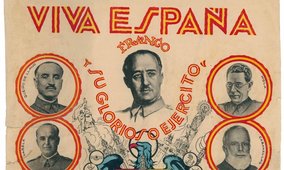
Yet the role of the ‘Moor’ here has been played by a host of other Spaniards who, over the centuries, have been violently repressed: Jews, liberals, Republicans, Freemasons, Protestants, intellectuals, artists, teachers and many others have suffered persecution at one time or another (in the Americas it was generally native populations, and Santiago Matamoros became Mataindios – ‘the Indian-Slayer’). Franco summed up this tendency well when he termed the elected government he was violently dismantling ‘the anti-Spain’.
Time and time again the country grasps for a national identity by turning on itself in a seemingly continuous war against its mirror image. Late 19th-century Spanish intellectuals referred to this as ‘the problem of Spain’, and in the early 20th century the poet Antonio Machado coined the phrase las dos Españas – ‘the two Spains’ – and warned that ‘one of them will freeze your heart’, a line often repeated as a byword for the pattern.
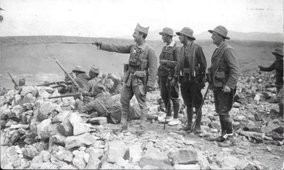
Spain’s civil war of 1936–39 is the most recognised example, usually referred to as the Spanish Civil War, as though there had only ever been one. Yet a longer and more holistic view of the country’s history (one which views Muslims, Jews and regional groups as Spaniards, not as ‘others’) reveals the war of 1936–39 merely to be the most recent of a long line of civil conflicts that have dogged and even defined Spain for a thousand years or more. In fact, every single century in Spanish history has seen at least one civil conflict. The 19th century had so many it is almost impossible to keep count; in 1873 alone there were effectively three different civil wars taking place simultaneously.
Part of the reason for this may be geographical: the Iberian peninsula has mountains along almost all of its coastline, while its land connection to the European mainland is restricted by the peaks of the Pyrenees. These natural formations have created what are effectively castle walls separating it from the rest of the world. Within this ‘castle’ are yet more mountain walls dividing the landmass into smaller areas, which have been historically quite cut off from one another and locked within their own fortresses, both literal and metaphorical. Hence the multiple and distinct regional identities within Spain, and the fact that a country with a population of only 50 million has five official languages, one of which – Basque – is not even Indo-European.
It is sometimes easier to understand Spain as a geographical reality, which has only occasionally managed to exist as a single political entity. Indeed, if we take the long view, it doesn’t even achieve that today: Portugal, which has been part of a greater Hispania, Al-Andalus, or Spain intermittently over its history, has been an independent country since the 17th century.
It is not surprising, then, that finding a single national identity to unify such disparate peoples – divided at various times by language, religion, customs and political ideology – has been a struggle. So much so that struggle against itself – as personified by the country’s Moor-Slayer patron saint – has in effect become that unifying principle, a cohesion around the violent suppression of whatever has been deemed undesirable at any given time. If we are not that then we must be this.
Obvious examples can be seen in the Spanish Inquisition, the Expulsion of the Jews in 1492, the Expulsion of the Moriscos in 1609–14, and the mass exodus of Republicans as Franco emerged victorious in 1939. Suppression, ejection and eradication.
Yet just as with Priscillian, these acts were never the ending of the story that they might have seemed at the time. Tens of thousands of Jews were driven out and many more forced to convert in 1492, but only months later in that same year one of Spain’s greatest triumphs, the discovery of the New World, was achieved thanks in large part to Jewish financing of an expedition led not by a Genoese sailor but – according to a recent DNA study – possibly a Spanish Jew from the Valencia area.
Similarly, Spanish Muslims left a mark so indelible on Spanish and Western civilisation that it would be impossible to do it justice here. Just one example can give us a sense: the origins of rationalist thought, a defining feature of several strands of Western philosophy, have been traced back to Ibn Rushd, a Spanish Muslim philosopher who lived in 12th-century Cordoba.
And what of the Republicans defeated by Franco in 1939? Many of them returned from exile once the dictator died in 1975 to build the kind of democratic state he had spent much of his life trying to destroy or prevent. Later, in the 2000s, many of those who had died in the ‘Moor’-slaying of the 20th century were found, not unlike Priscillian, buried in the countryside. Executed and thrown into unmarked mass graves, some have finally been exhumed and honoured.
The circle, however, never stops turning. Now it is Francoism, once viewed as dead and buried, that appears to be resuscitating in new form. Today, far-right politicians preaching fear of Muslim immigrants – and led by a man called Santiago – look set to enter national government for the first time since the dictatorship ended
The past, as ever, is alive in Spain’s present and appears keen to play a decisive part in her future.