London Museum’s emptiness
- November 26, 2026
- Mathew Lyons
Despite its spectacular new location, London Museum, uncertain of its own voice, has found a way to say nothing at all.
British readers of a certain age will recall how Gerald Ratner, chief executive of his family’s eponymous high-street chain of jewellers, destroyed the company’s value overnight by describing its products as ‘total crap’ in an after-dinner speech. If Ratner held his customers in low regard, what does it say about the newly re-launched London Museum (note the telling, modish absence of the definite article) that it has chosen a defecating pigeon – complete with a splatter of sparkly pigeon droppings – as its mascot? ‘The pigeon and splat speak to a historic place full of dualities, a place where the grit and the glitter have existed side by side for millennia’, Sharon Ament, the museum’s director, explained when the branding was unveiled in 2024. Tortured, portentous language will be a theme.
You might think grit and glitter are curiously impermanent, superficial phenomena for a museum to reify. Both scrub off, after all. But they obviously mean something to someone here because the phrase ‘All the Grit and Glitter’ is set in large letters high on the street-facing corner of its new premises, the former General Market at Smithfield, which has been converted for the museum’s use at a cost of £437 million. It left its former site, a purpose-built 1970s brutalist building by London Wall, in 2022, citing lack of space for its growing collection.
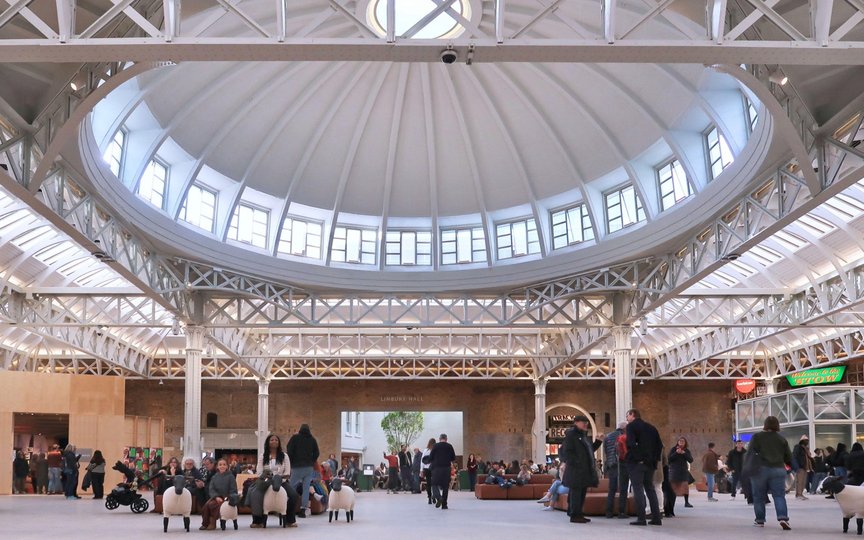
Space it certainly has now. You enter the new site through sliding glass doors leading you into a large characterless concourse called ‘Real Time’. No, I don’t know what that means either. Its walls are lined with digital screens informing you, for example, that Guinness is Londoners’ favourite drink and offering trivia about some of the city’s famous citizens, such as James Blunt and Maya Jama. This is not the museum proper. What it is, though, is harder to discern: there is so little in it. The last bell cast at the Whitechapel Foundry, commissioned by the museum in 2017 and called ‘We Are London’ – another clanging vapidity of which it is overly fond – hangs forlornly in a little green-tiled clock tower off to one side.
There’s no shortage of character – architectural character at least – in the museum’s vast central hall. Designed for the Corporation of London by Horace Jones, who also designed Tower Bridge and Leadenhall Market, and originally opened in 1883, it is flooded with natural light from a wide, shallow window-lined dome – a spectacular piece of civil engineering. If you come for no other reason, come for this: the whole building still positively sings with Victorian civic pride. It might be the best place in London to sip a coffee and scroll on your mobile phone. One day it will make a lovely space for a museum.
In the nomenclature this is actually a gallery named ‘Our Time’, intended to reflect life in the city over the last 80 years, a human lifespan. Again, its signature note is emptiness. If your attention is directed anywhere it is to the museum’s catering outlet opposite the entrance. A dozen or so ‘interventions’ hug the walls – the Lord Mayor’s coach, a mid-20th century switchboard from Buckingham Palace, a sound system from the Notting Hill Carnival – but they seem ornamental.
I was told that the curators tried not to ‘use their own voices’ in creating the gallery; the result is that it has nothing to say. A bank of items from the city’s former greyhound tracks has the tag line ‘London once upon a time went to the dogs’, seemingly unaware that in Romford they still do. In one corner, a life-size model of a recently departed giraffe at London Zoo named Molly stands in front of a Covid-era ‘Love the NHS’ banner. Molly can waggle her ears, so at least you know all those millions were well spent. A modest area memorialising the victims of the Grenfell Tower fire is tucked away, as if its seriousness strikes too discomforting a note. The theme of all this is ‘bringing London together’, but its effect is merely incoherent.
To find the museum’s third area, ‘Past Time’, you have to descend some stairs into the darkness of its basement area, down at the level of the Roman city. If the rest of the museum suffers from a dearth of exhibits, here you have the opposite problem. Cases are packed with artefacts, the space is packed with cases. The bulk of it is taken up with London’s story, from prehistory through to the 2012 Olympics (why the postwar displays aren’t in ‘Our Time’ upstairs isn’t clear). There are treasures galore here, of course: the museum’s holdings are extraordinarily rich. But they are poorly served by the lack of space accorded them. The displays are so dense that the experience of it is as much like a cabinet of curiosities as anything else. Puzzling, given that space constraints were the reason for the move in the first place.
Puzzling, too, because the museum clearly does know how to do this well. It is rightly proud to have the Cheapside Hoard in its collection, and it is beautifully displayed now in the Goldsmiths’ Gallery, a large side-room of its own, which also contains a range of exhibits exploring the goldsmith’s art, including a replica of a workshop. The jewellery, though, is the star, offering the proper rewards of a museum experience – a mix of wonder, insight and learning.
The challenges of navigating the ‘Past Time’ gallery aren’t helped by the museum’s decision to delegate the top-level narrative to a handful of poets and writers. Here, for instance, is the opening of ‘Long Before London’ by Jasbinder Bilan, one of the first texts you see:
What am I?
I am older than you can imagine – but I run fast!
As ribbed and ruffled as a newt’s back.
Adventuring for miles,
I bring everything in abundance.
And here is the last stanza of Inua Ellams’ poem on ‘The Changing Church’:
Rumour has it as Christians clashed
burning people at the stake
the frightened young watched, holding hands
and every hand would shake.
Obviously free verse is very much low-hanging fruit when it comes to mockery, but the primary sin here isn’t fatuity, it’s clarity. All these texts, and there are a lot of them, obscure more than they illuminate because they offer, at best, the vaguest traces of information wrapped up in the most insipid and trite of insights. Again, the museum, uncertain how to speak in its own voice, has found a way to say nothing at all.
Elsewhere, downstairs are two further exhibition areas, London Life and London Landscape. They are again packed with exhibits – the former really does include the proverbial kitchen sink – with very little sense of theme or meaning. London is indisputably one of the world’s great cities. It deserves one of the world’s great museums to celebrate that fact. But is this it? I’m not sure. One glass wall down here reveals Thameslink’s rolling stock rumbling past on its way to and from Blackfriars station. But when one of a museum’s highlights invites visitors to turn their backs on its exhibits and look out at the commuter trains they use in their millions every day, perhaps there is a problem.
The new London Museum has an extraordinary new home, but its very structure speaks to a profound sense of disconnection between the city’s past and present. Upstairs in the shop they are selling tote bags, mugs and other merch based on Charles Booth’s late 19th-century poverty maps. That word ‘poverty’ is erased, of course, but I don’t know how anyone with any respect for London’s deep and complex social history could authorise such a thing. ‘Over time people will come to recognise the pigeon and splat as signifiers of London Museum and everything it stands for,’ Josh Green, the museum’s head of design, said back in 2024. Unfortunately, he might be right.
Mathew Lyons
More from Britain

The balance of the British constitution

When the Mediterranean was a British lake

Britain and Germany: Europe’s original special relationship

Valentine Lawford, the hidden hand behind Britain’s wartime diplomacy


