The ‘madness’ of Valeriya Novodvorskaya
- October 23, 2026
- Erik W. Larsson
Locked away as insane by the Soviet state for her political beliefs, Valeriya Novodvorskaya later found that reputation turned against her by Putin’s Kremlin.
On 1 May 2004, a few dozen demonstrators gathered in front of the huge building that was once KGB headquarters in central Moscow. They were protesting in support of ‘civil society against a police state’ and against the authoritarianism of Vladimir Putin’s regime.
At the time, protests against the Russian government were small, low-key affairs. Most Russians liked their new president, who promised to restore order after the chaos of the 1990s. The rally in Lubyanka Square might have been forgotten if not for a famous photo taken that day of a dumpy woman with a pudding-bowl haircut and heavy glasses. Around her neck was a handwritten sign in black ink: ‘You’re all idiots and there’s no curing you! I’m the only clever one, all beautiful in my white coat.’
At first glance it was a photo of a crank, ranting in public. But the woman in the photo was none other than Valeriya Novodvorskaya, one of the most legendary dissidents in Russian history.
Novodvorskaya was born in 1950 in what is now Belarus and grew up in Moscow. She was a gifted child, but something of a loner. Rather than make friends her own age, she read voraciously, lost in a world of books.
When she was 15, Novodvorskaya walked into a military recruitment office and demanded to be sent to Vietnam to join the fight against the US. Even at such a young age, she was convinced it was her duty to stand up for the underdog – just like the heroes in the historical novels she loved.
Everything changed when her father gave her the book One Day in the Life of Ivan Denisovich by Alexander Solzhenitsyn. Reading about life in Stalin’s camps filled her with rage at the system that had destroyed her homeland. When Soviet tanks rolled into Prague in 1968, she decided to act.
A year later, hundreds of guests gathered in the Kremlin for a performance of the opera October, a glorification of Lenin and the Russian Revolution. Shortly before the curtain rose, pieces of paper began to flutter down onto the operagoers from the gallery. On them were handwritten copies of a poem dedicated to the Communist Party:
Thank you, Party, for all you have done and are doing to nurture the hatred we feel today. Thank you, Party!
Thank you, Party, for all you have betrayed and sold off, for the disgraced motherland. Thank you, Party!
The poem was more than an attack on the ruling elite and Stalin’s abuses; it took in the entire communist project, from Lenin’s Revolution to Brezhnev’s invasion of Czechoslovakia. To the guards’ surprise, the leaflets had been scattered by a teenage girl. Novodvorskaya made no attempt to escape, and calmly allowed herself to be arrested by KGB men.
Novodvorskaya was interrogated for days by the KGB. When she was shown the transcripts, she read them carefully, corrected a few spelling mistakes, and refused to sign them. While in KGB custody, she carried on scribbling attacks on the regime on scraps of paper, which she threw out of her cell window.
After a few days in the KGB’s hands, Novodvorskaya was sent for a forensic psychiatric evaluation. Like so many Soviet dissidents, she was declared of unsound mind and diagnosed with ‘sluggish schizophrenia’. Her medical records also referred to her ‘delusions of reformism’ and ‘philosophical intoxication’. She was sentenced to compulsory treatment and taken to a psychiatric prison hospital in Kazan.
Incarcerating political dissidents in mental hospitals had been standard practice in the Soviet Union since the late 1950s. Nikita Khrushchev openly spelt out the logic at a party conference: ‘People who fight against communism clearly have mental health problems,’ declared the First Secretary, to laughter and applause.
Psychiatry had several advantages for the regime. People who asked awkward questions could be locked away without trial, and stripped of their political credibility at the same time. Unlike a prison sentence, compulsory hospitalisation was indefinite. Patients could be detained for as long as the doctors – or their political commissars – deemed necessary.
The diagnosis of ‘sluggish schizophrenia’ was invented by the Soviet psychiatrist Andrei Snezhnevsky and his colleagues. In their model – in the tradition of the Moscow school of psychiatry – it was a subtle, slow-onset version of schizophrenia. Overt psychotic symptoms such as hallucinations or delusions were usually absent, and instead it manifested itself in poor social adjustment, conflict with the authorities, or an excessive fixation on philosophical or political ideas. Critics of the regime could easily be classified as mentally ill and in need of hospitalisation.
Novodvorskaya was imprisoned in the Kazan hospital for two years. In her memoirs, she described in detail the methods used on patients like her, including painful dental procedures and oxygen injected under the skin. Patients with sluggish schizophrenia were prescribed extremely high doses of the antipsychotic drug haloperidol, which was deeply unpleasant and sometimes had lifelong side effects. The aim was to break down patients’ resistance and force them into submission.
Novodvorskaya, though, proved hard to break. Soon after her release from the Kazan prison hospital, she returned to political activism. In the 1970s, she wrote a great many essays and joined the samizdat movement, which copied and distributed banned texts. She organised several underground anti-communist movements. The response from the authorities was to arrest and hospitalise her repeatedly. Sometimes she was placed in ordinary psychiatric wards, sometimes in special prison hospitals like the one in Kazan. She lost count of how many times she was imprisoned over the years.
When Mikhail Gorbachev came to power in the mid-1980s, things began to ease, and dissidents such as Novodvorskaya were allowed to emerge into the public eye. In 1988, she helped found an opposition party, the Democratic Union. It remained small, but its mere existence was provocative: the only political organisation permitted by the Soviet Constitution was the Communist Party. Novodvorskaya and her party colleagues demonstrated in the streets, handed out leaflets, and used the banned Russian tricolour.
Even among democracy activists, Novodvorskaya was known as a radical. Many of them imagined there would be change from within the system and pinned their hopes on Gorbachev. But Novodvorskaya refused to compromise with a criminal state apparatus she considered entirely illegitimate. In her essay ‘Heil Gorbachev’, she derided the regime’s sympathisers for their uncritical praise of the country’s new leader.
With the collapse of the Soviet Union came vindication for the dissidents who had been labelled mentally ill. Most famous among them was Vladimir Bukovsky, who returned from exile in Britain to help bring legal proceedings against the Communist Party. The new consensus viewed the likes of Bukovsky as persecuted victims of the regime, and in fact perfectly sane. But there were lingering doubts about Novodvorskaya. Perhaps she really was a bit unhinged?
Public scepticism about activists like Novodvorskaya coalesced in the term demshiza – a portmanteau of democrat and schizophrenia, used pejoratively to describe people who seemed fanatical in their reforming zeal. The group included the politician Sergei Kovalyov and Yelena Bonner, wife of the physicist Andrei Sakharov. But the person who best personified demshiza was Novodvorskaya.
Novodvorskaya was at home on the barricades. Her party, short on both voters and resources, never won a seat in the Duma. She remained something of a cult figure and a familiar face at demonstrations, wearing one of her trademark protest signs around her neck. She was a loyal supporter of Boris Yeltsin in the early years, even when the president ordered tanks to shell parliament in 1993. But the war in Chechnya was the last straw for Novodvorskaya. Uncompromising as ever, she likened the invasion to Hitler’s attack on Poland, and did not hide her hope for ‘the victory of the Chechen army’.
In time, the Russian economy was increasingly dominated by oligarchs, while key government posts went to former KGB officers. The moderates were sidelined by Gennady Zyuganov’s communists and Vladimir Zhirinovsky’s nationalists. Novodvorskaya found herself in opposition to everyone.
Novodvorskaya was often invited onto television in the hope that she would stun audiences by saying something controversial. She duly called Soviet heroes of the Second World War ‘fascists’ and dismissed Leo Tolstoy as a ‘talentless hack’. In her world, no one measured up and everyone was corrupt.
Over the years, Novodvorskaya’s image was cemented as a demshiza whose claims should be taken with a pinch of salt – in part because of several odd television appearances. In one, she taught a cartoon character how to fence with a broom; in another, she ate an enormous ice cream shaped like a brick. But her reputation was waning for political reasons too. She had adopted an Ayn Rand-inspired libertarianism that was profoundly alien to many Russians, and her habit of likening her opponents to Hitler only compounded her image as a volatile fanatic. Comedians made her a laughing stock, ridiculing her appearance and nasal voice.
When Putin first came to power in 2000, he enjoyed broad support among liberal politicians, but Novodvorskaya was not taken in. She warned in a radio interview that ‘the dictator’ Putin and his KGB henchmen were about to do away with democracy. Even among democracy activists, she was dismissed as alarmist, if not paranoid. After all, everyone knew that Putin was an ardent democrat who was simply trying to bring order to the country.
In the years that followed, Putin’s government tightened its grip on the media. By late 2003, all the major television stations were state-controlled, and they have been the regime’s propagandists ever since. Singing the president’s praises around the clock was not enough; voters had to be convinced that Putin was their only option. The answer was to make the other political parties and leaders seem unbalanced and irrational.
It suited the Kremlin to have Novodvorskaya serve as the face of Russia’s liberal movement. She may have been a sharp debater who was quick to see through Putin’s democratic pretence, but her eccentricity and reputation as a demshiza made it easy for those in power to dismiss her arguments as sheer madness.
This was carried to the limit in the political talk show K baryeru! (To the Barrier!), hosted by the propagandist Vladimir Solovyov. In one episode in 2003, Novodvorskaya was pitted against the incendiary ultranationalist, Vladimir Zhirinovsky. She began by likening her adversary to Hitler. He countered by accusing Novodvorskaya of peddling ‘the dictatorship of democratic fascism’.
It soon descended into a shouting match. Novodvorskaya called Russia ‘the empire of evil’, while Zhirinovsky screamed at her to leave the country. Solovyov held them apart, sighing. The official line was clear: neither the ultraliberals nor the ultranationalists were sane. Thank goodness for Putin.
In the 2000s, the political climate grew harsher, but Novodvorskaya did not back down one inch. She continued to write and give interviews, describing Putin as a ‘monster’ and a ‘thing of darkness’. She also accused the Federal Security Service (FSB) of staging terrorist attacks against Russians to clear the way for Putin to seize power. Many activists paid with their lives for speaking out, but Novodvorskaya survived unscathed. Apart from being arrested at a couple of demonstrations, she was largely left in peace to say whatever she wanted.
Was Novodvorskaya mad? It is difficult to say, even with the benefit of hindsight. It seems unlikely she would have met the criteria for a psychotic disorder, but no one could deny that she was extremely eccentric. The liberal writer Alfred Kokh, who knew Novodvorskaya well, described her as brilliant, deeply erudite, and ‘completely insane’. It is entirely possible the medical profession had come to the same conclusion and thought she was genuinely ill.
Not everything said about Novodvorskaya is true. The 2004 photo turned out to have been doctored. But Novodvorskaya’s contempt for her compatriots was very real. She often came to the same bitter conclusion: there was little demand in Russia for the freedoms she was fighting for. She once claimed in an essay that, at best, five per cent of Russians espoused democracy and individual freedom in the European tradition. She dismissed the rest as ‘reptiles, amoebas, and infusoria’.
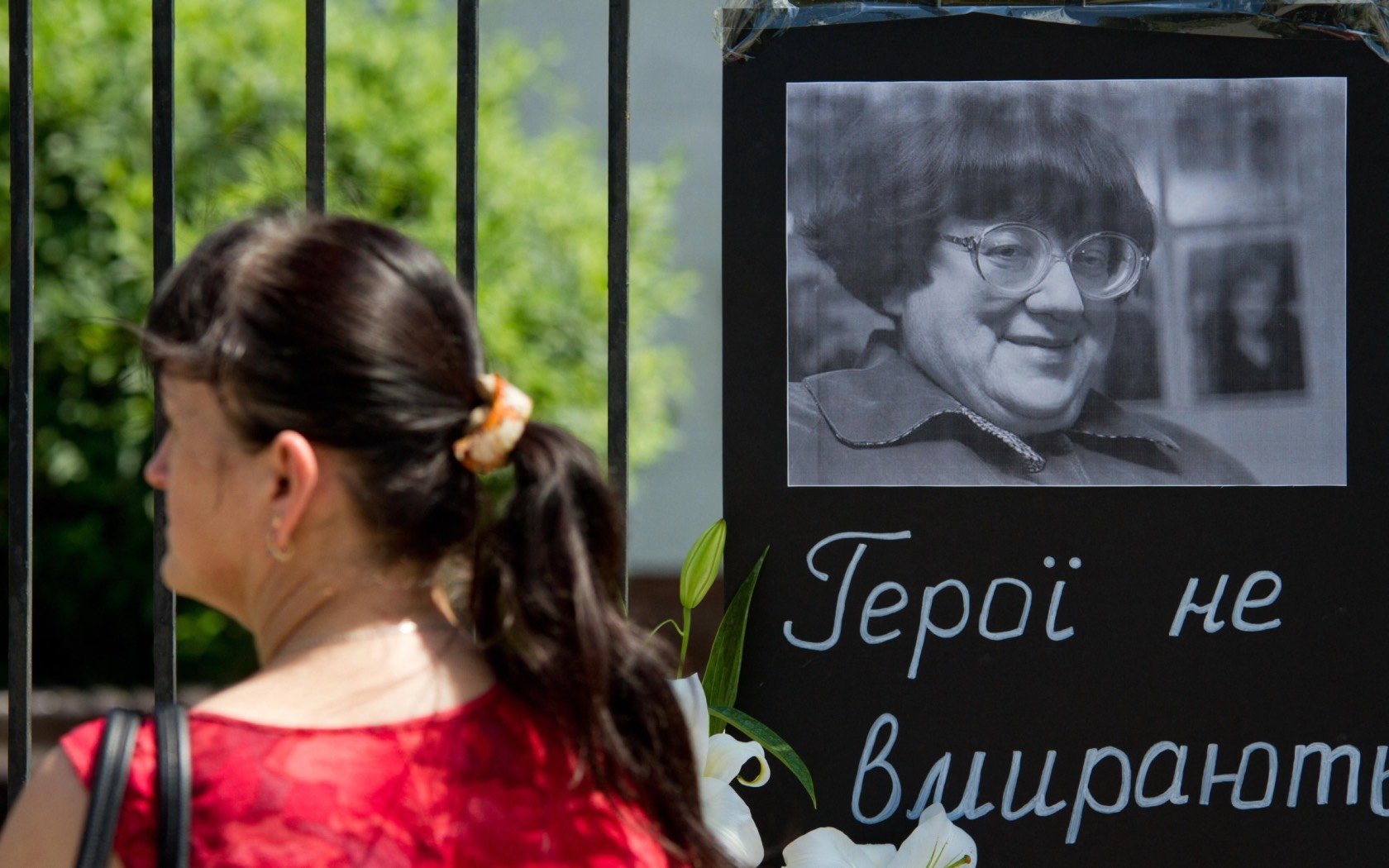
Novodvorskaya never married and lived all her life in her mother’s flat in Moscow. In the early 2010s, her health deteriorated, probably because she was overweight. She had a lifelong suspicion of the Russian health service and treated her diabetes with various home remedies. When she died in 2014, thousands of Russians attended her funeral.
Valeriya Novodvorskaya devoted her life to fighting for freedom and democracy. But toward the end, she often wondered aloud what the point was and whether her enemies had manipulated her into making mistakes. One can understand why. In the Soviet Union, she was locked away for being mad; under Putin, she was put on television for the very same reason.
This article was originally published in our sister publication, Axess Magasin. Translated by Charlotte Merton.
Erik W. Larsson
More from History

All of France was in Limoges’s town hall

Thomas Mann’s other fatherland

A debrief with Ukraine’s soldiers

The unknown painter behind Manhattan’s Gilded Age interiors


