America’s grand strategy for a multipolar world
- November 4, 2026
- Thomas Graham
- Themes: Geopolitics, History
The United States can neither dominate nor transform its rivals. It needs a strategy of competitive co-existence.
What grand strategy should guide American foreign policy as it faces an historically unprecedented challenge: how to engage in a multipolar world that it can neither abandon nor dominate as it competes against rivals it can neither transform nor decisively defeat? The two grand strategies it has pursued since the end of the Second World War – containment and integration – are inadequate. Both proceed from the premise that the United States can convince rival powers – by isolating them or reforming them – to become partners in a world order designed and led by the US.
The years since the end of the Cold War have shown that neither China nor Russia is about to submit. India, a rising power, has underscored its commitment to strategic autonomy, while Europe, caught between Russian aggression and fears of US abandonment, is rapidly developing the hard-power capabilities it needs to become an independent geopolitical actor. Even middle powers are increasingly manoeuvring among greater powers to expand their room for independent action.
These same years have also witnessed a significant narrowing of the United States’ margin of superiority. China has become a peer competitor capable of challenging the United States across all dimensions of power. The competition is especially fierce in cutting-edge technologies, such as artificial intelligence, quantum computing and bioengineering, which will reshape power in the decades ahead. Other countries are developing niche capabilities that challenge US leadership.
What then is the way forward? A grand strategy of competitive co-existence proceeds from the premise that rivalry is a permanent feature of global affairs that can at best be managed. It accepts the limits on US power, especially to transform or dominate other major powers. It recognises that the destructive power of modern weaponry creates a moral and strategic imperative to avoid great-power conflict. And it acknowledges the necessity of leaving space for great-power cooperation to deal with critical transnational issues, such as climate change and nuclear proliferation, even as the great powers compete aggressively on other matters.
This approach enjoys critical advantages over both integration and containment. The focus on managing rivalry reduces the risk of great-power war, whereas containment’s aim of defeating rival powers and integration’s focus on transforming them elevate it. Competitive co-existence also avoids the strategic overextension that is inherent in the other approaches’ drive for primacy or domination. And it preserves flexibility in dealing with a world marked by fluid geopolitics and disruptive technologies.
The adoption of competitive co-existence would see the United States base its foreign policy on two foundational principles, which challenge current thinking. First, acknowledge a world of diversity and competing value systems. That would entail accepting other major powers as they are, not challenging the legitimacy of their leaders, and eschewing efforts to transform them to conform to America’s democratic, free-market values. The United States has no choice but to engage those who hold power, no matter how unsavoury.
Second, accept that other major powers have legitimate interests, which will often run contrary to its own interests. The United States should be willing to accommodate the interests of major powers to the extent that does not jeopardise the achievement of its own goals.
In practice, that means three things. First, manage competition responsibly. The goal would not be victory in the traditional sense – something that is beyond US capabilities in a multipolar world. Instead, the United States would seek the gradual accumulation of incremental advantage.
Second, harness other states’ power and ambitions to American purpose, by manipulating interdependence to its advantage.
And third, leave space for broad-based co-operation on a narrow range of truly urgent transnational challenges, which it cannot manage on its own: climate change, pandemics, proliferation of weapons of mass destruction and international terrorism.
The United States should apply those principles in its relations with its major rivals today, China and Russia. Ideally, they would reciprocate. This is not a case in which it takes two to tango. The United States should pursue competitive co-existence to defend its interests, not to persuade other states to redefine the foundations of their foreign policy.
That said, even now conditions are moving in directions favourable to competitive co-existence. Russia may be the United States’ most implacable foe today, actively seeking to undermine its geopolitical positions in key strategic regions. Yet it is simultaneously seeking to normalise relations with the United States in part to avoid excessive reliance on China as a strategic partner. China, for its part, now describes its relations with the United States as constructive strategic stability, which bears undertones of competitive co-existence.
India’s abiding commitment to its strategic autonomy means there will always be an element of rivalry in relations with the United States. India’s flexible trilateral relationship with Russia, a longstanding strategic partner, and China, its primary strategic rival, bears elements of competitive co-existence. Meanwhile, Donald Trump’s transactional approach to Europe is surfacing the competition that has long lain suppressed in transatlantic relations, even as Europe seeks to maintain the United States as a strategic partner. Competitive co-existence may not yet describe the international system, but the building blocks are multiplying.
A world order grounded in competitive co-existence is coming into view. That approach would provide a framework for establishing and sustaining equilibria in critical regions of the world, which then would lay the foundation for an overarching global equilibrium.
The system would not be self-regulating. Stability is sustained when no power feels so threatened that it must resort to desperate measures and no power feels so dominant that it can ignore the interests of the others. Deterrence and diplomacy are both critical to success – deterrence to ensure that great powers are not tempted to resort to force to advance their interests vis-à-vis another great power; diplomacy to develop the codes of conduct and find the compromises required to reconcile competing interests.
A key task would be to keep the system genuinely multipolar, as a condition for sustaining balances through the shifting of coalitions. Balance-of-power systems have collapsed for two chief reasons in the past: the emergence of an aspiring revolutionary hegemon and the ossification of coalitions into blocs that transform a multipolar balance into a bipolar contest. The 18th-century European balance-of-power system was undone by the rise of a revolutionary France, which not only rejected the legitimating principle of the system, monarchical rule, but also redefined power through the creation of a national army based on mass mobilisation.
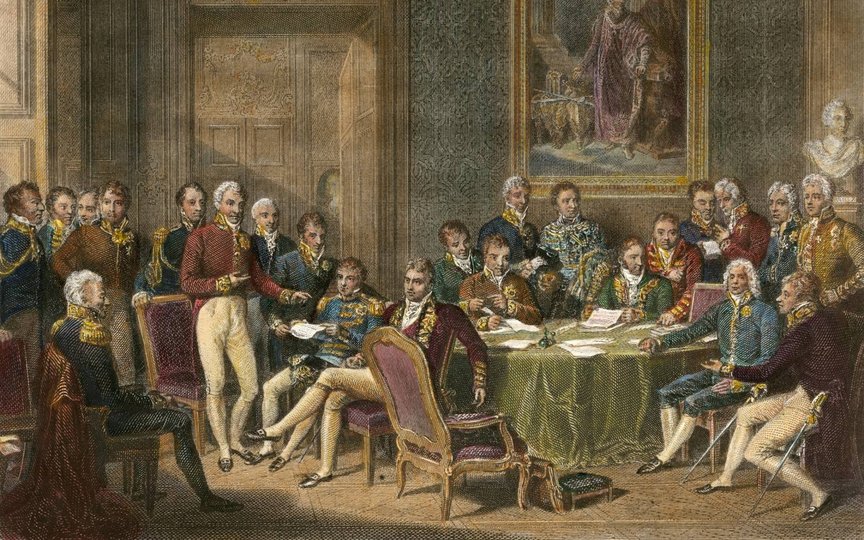
The Congress of Vienna recreated the balance-of-power system as the Concert of Europe. The concert brought a century of relative peace. It collapsed after the system ossified into a contest between two blocs: the Germanic powers opposed to a Franco-Russian alliance, usually supported by Great Britain. In the absence of the flexibility to shift coalitions to meet emerging challenges, this bipolar competition produced the First World War.
Another task is de-emphasising the role of ideology in interstate relations. States will naturally compete over values and ideologies – the United States itself will not likely ever abandon its belief that its values are universal in application – but if they become the defining feature of competition, pragmatic compromise becomes impossible. Conflicting ideologies create either/or choices, not the more-or-less ones to which geopolitical competition is as a rule susceptible.
Just as the Peace of Westphalia eliminated religion as a basis for interstate conflict, leaving it to the purview of each sovereign state, so competitive co-existence would leave each country the right to determine its own guiding political philosophy – democratic, authoritarian, theological, or some hybrid – and abjure interference in a state’s domestic affairs.
That principle is essential, even if it would be honoured in the breach on many occasions – in an interconnected world it is impossible to isolate domestic affairs from outside influence. It is even more difficult because modern technology, particularly developments in cyberspace, makes borders porous today in a way that was unthinkable at the time of the Westphalian peace. The task then would be to develop a framework for determining when inevitable interference begins to pose an unacceptable threat to a regime’s survival and, thereby, to the stability of the global order – when, for example, routine public diplomacy crosses over into state-sponsored campaigns designed to corrupt and discredit electoral processes.
A final task would be the development of a code of conduct, which in effect would legitimate the system. Major countries would be expected to exercise restraint. The goal in any contest would be not a crushing defeat of a rival but rather incremental gain that allows all parties to survive as part of the system. Diplomacy would take precedence over the use of force.
Managing a world order grounded in competitive co-existence would not require a dense institutional structure and rigid multilateral bureaucracies, but rather flexible multiparty arrangements. The major powers, for example, might want to meet at regular intervals to review global conditions, identify threats to stability and discuss ways to counter them. Ad hoc groups could be formed to deal with specific issues, much as the United States, Russia, China and three European states came together to deal with Iran’s nuclear programme in the 2010s.
No grand strategy is sustainable in the United States over the long run without popular support. The policies of both integration and containment had to satisfy that requirement. So must competitive co-existence. A strategy gains that support by appealing to Americans’ sense of exceptionalism. Across the political spectrum, with rare exception, Americans believe that their country is uniquely virtuous among the world’s great powers and a force for good in global affairs. It is a country that does not engage solely in the pursuit of national interests, but seeks to bring benefit to the world as a whole through the spreading of freedom and the promotion of universal truths embodied in American democracy and the economic practices that undergird American prosperity.
That material well-being was a central element of exceptionalism. When the United States engaged actively in the world, spreading its values, the expectation was that it would also increase Americans’ well-being, as indeed it did during the Cold War and the first post-Cold War decades. Even if various indicators suggest otherwise, Americans still tend to believe that their country is without peer and, because of that, bears an obligation to provide moral leadership to an unruly world. Detractors may denounce it as all myth and disingenuousness, but American exceptionalism remains a potent political and emotional force nonetheless.
President Trump appears to falsify that assessment. He himself has repeatedly questioned whether the United States is exceptional. He has pursued a foreign policy that is almost purely transactional, focused solely on interests to the exclusion of values. He has little regard for the United States’ traditional allies in Europe and East Asia – his threat to seize Greenland speaks volumes. His America First philosophy has no place for US leadership or coalition-building; it is rather a call for the United States to win in whatever competition it engages in.
Whether his approach survives his presidency remains to be seen. Polling suggests that it is not popular, especially because it has not brought the success he promised. Moreover, a sizeable majority believes the United States should show moral leadership in the world, although significantly fewer believe it does under Trump. The data also suggest that attitudes are shifting, opening up space to redefine American exceptionalism in ways more favourable to competitive coexistence.
In any event, competitive coexistence faces a far more formidable challenge in generating public support. It posits a world of enduring rivalry, in which victory – the ending of conflict on terms dictated by the United States – is impossible. Indeed, to the American ear, competitive coexistence sounds like moral abdication.
Not surprisingly, proponents of American exceptionalism have challenged the principles of competitive coexistence – three in particular.
First, for them, accepting a world of diversity and competing value systems is equivalent to refusing to draw moral distinctions – between a democratic America and an authoritarian China or Russia, for instance. But competitive co-existence is not grounded in moral equivalence. US leaders can and should prefer democratic systems to more oppressive ones. But they should also recognise the formidable obstacles to changing the domestic systems of rival great powers and the urgency of dealing with transnational threats and destabilising geopolitical conflicts.
Moreover, accepting diversity does not entail desisting from promoting democracy. The United States can and should continue to do that. But preference should be given to the exemplary approach – that is, to creating that ‘city on a hill’, so dear to proponents of exceptionalism, which other countries would want to emulate. In this regard, the United States needs to demonstrate that it is a successful country, that it has the wisdom and capacity to deal with the socio-economic, political, and technological challenges of the modern age.
Second, acknowledging that other countries have legitimate national interests that at times run counter to US interests is not a call for appeasement, as opponents claim. Under competitive co-existence, the United States would continue to vigorously defend its interests, even if that entailed crossing another country’s red lines. That said, it should cross a red line only if it is prepared to contend with the fierce response of a rival determined to defend that line.
Likewise, accommodating the interests of a rival power is not appeasement. Accommodation should only be considered when it does not jeopardise the advancement of American interests. What is called for is a prioritisation of US goals and a refusal to insist that the United States must counter a rival across the board, even on matters of little intrinsic value, as a way of demonstrating moral consistency.
Third, managing competition responsibly is not a form of defeatism, as opponents argue. Rather, it is a recognition that many conflicts are complex and defy quick, easy resolution, and that the United States no longer has overwhelming power to dictate outcomes on most matters. Victory in the traditional sense – the crushing defeat of Nazi Germany, for example – is an illusion. Success comes in managing competition in ways that advance US goals step by step over an extended period. That is akin to the way the United States triumphed in the Cold War.
That leaves open the question of moral leadership. How can the United States stand out as a moral leader in a multipolar world it does not dominate? How can it ensure that engagement will also undergird American prosperity?
Since the beginning of the Second World War, the United States has typically posed as a moral leader in two ways: as the indispensable defender of freedom in a bipolar struggle against a rival that posed an existential threat to freedom – Nazi Germany and Imperial Japan during the Second World War; the Soviet Union during the Cold War – or as the leading promoter of freedom in a unipolar, US-dominated world. The George W. Bush administration endeavoured to combine the two, advancing the Freedom Agenda as the counter to the allegedly existential threat posed by international terrorism.
The conditions of the emerging multipolar world preclude both avenues to moral leadership. The temptation is to reconstruct a bipolar world. The Biden administration, for example, sought to portray the Russia-Ukraine war as a struggle between democracy and autocracy with global implications and organised a summit of democracies to underscore its leadership. That approach gained little traction, however.
In a similar vein, some experts have identified an Axis of Autocracy (or Upheaval) – China, Russia, Iran, and North Korea – that poses the primary threat to the United States. Competitive co-existence is, however, designed in part to advance the emergence of a multipolar order by preventing this grouping from ossifying into a permanent hostile bloc by exploiting the latent rivalries, such as Russia’s fear of excessive economic reliance on China.
In a multipolar order, moral leadership will have to be redefined. Instead of displaying missionary zeal in actively advancing democratic values across the globe, the United States can exercise moral leadership, and enhance American prosperity, by protecting the space in which democracy and free markets can flourish. In the first instance, that entails creating zones of stability, balances of power that favour American interests, in key strategic regions around the world.
Acting effectively in a multipolar world does not have to entail cynical manipulation of other states or devious diplomatic manoeuvring, all with the aim of aggrandising power. There is room for moral leadership – especially for the great power that still stands first among equals on the world stage. That is the role the United States should aspire to: creating equilibria that favour American interests, keeping open the space for democratic advance at home and abroad, and bolstering American prosperity. And it can lead, as it pursues those goals, not through dominance but through persuasion and example. Competitive co-existence is the only way the United States can preserve its sense of exceptionalism while reconciling that belief with the permanent engagement required to defend its interests in an interconnected, multipolar world it can no longer dominate in competition with rivals it cannot decisively defeat.
Thomas Graham


More from History

The rehabilitation of Livia, Augustan Rome’s first lady

What did the Mongols do for Eurasia?

My grandfather, the Swedish Stalinist

When the Mediterranean was a British lake


