In Paris, the violence swirls surreally around the rhythms of French life.
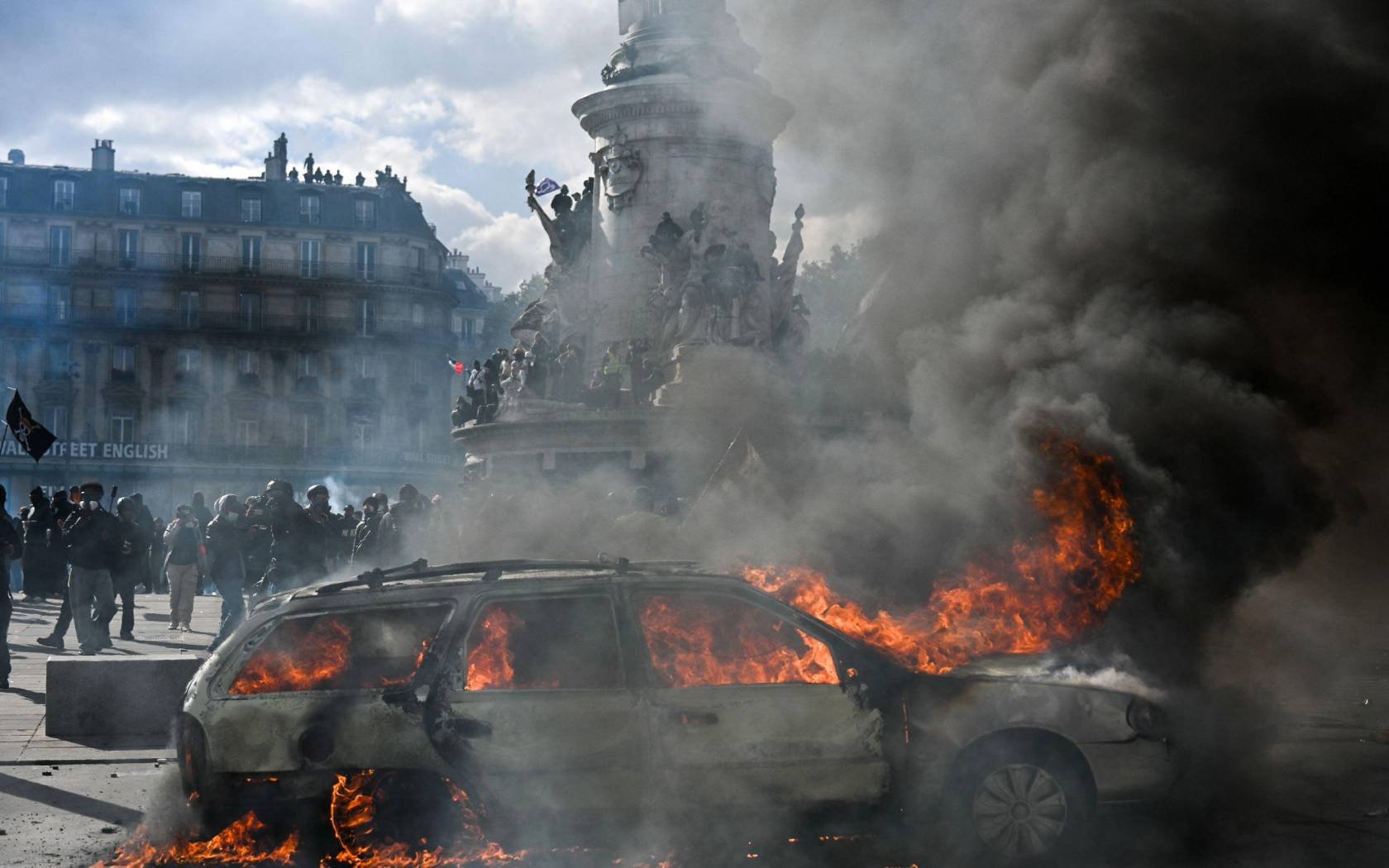
There is a first time for everything, including being tear-gassed. The chances of that were high in Paris on 17 October – the day of the 17/10 Revolution, as it was billed on the posters that covered the streets in the east of the city. Tonton Lulu is one of those classic but modest cafés that pepper Paris, this one situated on the Avenue Ledru-Rollin, crucially, just a few hundred yards west of the Place de la Bastille, the epicentre of the trouble on that side of the city, ostensibly about educational grievance and billed as a ‘cost-of-living day’ (France spends above the EU average on education, although, like many European countries – England and Estonia are exceptions – it has taken a wrong turn). The violence is clearly rooted in much more.
Popping inside for a glass of La Chouffe, a Belgian blond beer, to avoid the increasing number of black-clad, masked teenagers seemed a good idea. Not that one felt threatened especially by youths on Lime bikes who stopped at zebra crossings for you to pass. Many still maintained a veneer of Parisian politesse amid the tension, a politeness long lost in London. Of course, the symbols of the omnicause, the Palestinian flag and the keffiyeh, were omnipresent.
Soon, around 7.30 as the night darkened, a pyre of those same Lime bikes was set alight. The fire service turned up to douse the flames, and then the gathering crowd, massed across the Faubourg Saint-Antoine, scarpered south. The CRS had arrived, looking like Jedi warriors, announcing themselves by throwing tear gas down into the Ledru-Rollin metro station.
The staff at Tonton Lulu, some of North African descent, had already taken the café’s zinc tables and chairs inside, stacking them against the closed glass doors, which offered a clear view of the events outside. Unfortunately, they were of little protection from the tear gas, which seeped in, to the distress of a table of young American women, who were clearly frightened as things took a turn not promised by Emily in Paris. The air stung the eyes, but the teary unpleasantness soon passed, and the police had done everyone a favour. It was possible to leave the café and head north towards the Gare de Lyon, behind police lines.
En route, it appeared that most Parisians, eating at the cafés and brasseries that hadn’t closed their doors – and that was most of them – did so with a shrugging insouciance and nonchalance born, presumably, of experience. In the 12th arrondissement, a bistro served the staples of confit and Crozes-Hermitage (Guigal, ever reliable). As the CRS wagons passed by, the welcoming waiter laughingly said: ‘You’ve had your Paris experience.’
It was not the experience expected, but it was, ironically, fitting in some perverse way. For the following day offered a matinee performance at the Opéra Bastille of Wagner’s Le Crépuscule des Dieux – Götterdämmerung, the concluding work of the Ring cycle. The opera house, brutalist, cavernous, which does little, perhaps pointedly, to celebrate the city’s considerable operatic heritage, stands imposingly on the Place de la Bastille, which is dominated by the July Column, commemorating the overthrow of the monarchy of Charles X in July 1830. There is, one might argue, a reckless celebration of revolt throughout the cities of France. It can come back to bite.
From inside the opera house, looking out on the July Column, the graffitied square was quiet, though the journey there, along the Faubourg Saint-Antoine, offered a typically French juxtaposition of burnt-out bikes, boarded-up shops and polite queues at the boulangerie. Some of the glass doors of the opera house had been smashed, recalling Pierre Boulez’s naively transgressive and very soixante-huitarde desire to blow them all up. Thankfully, the rioters seemed more interested in trashing and looting outlets for trainers and luxury clothing. The bookshops, like the opera house, were largely untouched. One will struggle to recall Frantz Fanon’s thoughts on the revolutionary potential of sneakers.
The production was a good one, though the Brünnhilde was indisposed: Christiane Libor proved a more than adequate replacement. The Hagen – what a role to relish that is – was played magnificently with menace by Mika Kares, a Finn whom I hope to see much more of. Andreas Schager is the Siegfried de nos jours, as good here as recently at Covent Garden, tireless in this most punishing of roles. The orchestra was lyrical, chamber-like, as it should be, under Pablo Heras-Casado, who offered shades of the great Clemens Krauss.
Six hours later, after witnessing the end of the world, the Bastille area felt calm in the crepuscular light. Five minutes away is Chez Paul, that most stereotypical of French brasseries, with steak frites and andouillette on tap. For un moment it felt that all was well, even in Paris. But the TV news offered a jolting correction, with reports of looting around Châtelet-Les Halles – A Clockwork Orange came to mind – and of a synagogue vandalised in the 19th. In the heart of Paris, the police were clearly overwhelmed. News came, too, of copycat rioting in Milan and Turin. Thoughts turned to London, where, compared to France, state capacity is weak to say the least.
President Macron declined the resignation offered by his interior minister, Laurent Nuñez, who admitted that the authorities had lost control. The gilets jaunes, the yellow vests, are scheduled to march on Saturday. As one piece of graffiti read, it is dark in the city of light. It is dark, too, in France’s other cities, and now across the Alps. It is best that Le Crépuscule des Dieux remains in the opera house. In France, it has seeped into the streets and begun to spread. Are the lights about to go out all over Europe?
Paul Lay


More from Politics

Joshua Wong, heir to the Cold War dissidents

Catherine of Siena, saint and stateswoman

Star Wars and the dawning techno-empire

The wrong prescription for liberal democracy’s ills


