The dream of Constantinople
- November 9, 2026
- Mathew Lyons
The V&A’s new exhibition offers a dream of the city that would become Istanbul, pieced together from fragments scattered across a millennium and a half of history.
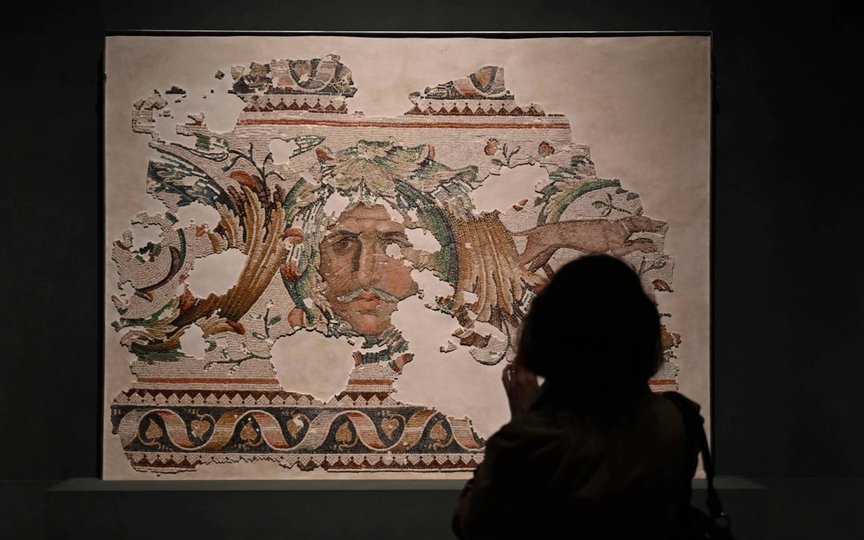
One of the first things you see when you walk into Constantinople to Istanbul: One City, Two Empires, which runs at the V&A until 9 May 2027, is a sixth-century fragment of mosaic from the Great Palace, founded by Constantine I. The fragment features the head of a moustachioed man, perhaps in early-middle age, in a loop of acanthus, which itself loops into oblivion on either side as the tesserae fall away. To the right a lithe, tawny hunting dog leaps with glee into the same unknown.
The mosaic’s meaning, if it ever had one, is impenetrable, but it aches with a fierce energy and life. The man’s full lips are parted, as if he has just exhaled; his brows are furrowed, his eyes are deep-set and anxious. You cannot shake his gaze; it stays with you as you walk from room to room. He seems entangled in those repetitive circles of leaf and flower, a perfect metaphor for human life in this most eternal, and eternally re-invented, of cities.
The exhibition divides into four sections. The first two focus on the transformation of the city into the Roman capital and the later splendour of the Byzantine centuries, caught in its architecture, its religious art, and the luxuries of its court. The last two explore Constantinople’s rebirth as a great human and artistic entrepôt under Ottoman rule, drawing in myriad peoples and their crafts, and the experience of daily life in the city, its rituals of piety and pleasure. Those sections are framed by three key dates, each written large upon its walls: 330, when Constantine made it his capital; 1453, when the city fell to the Ottomans and became the capital of their empire; and 1922, when, with the dismemberment of that empire in the aftermath of the Great War, it ceased to be the capital of anything at all.
But if the catastrophe of Byzantine defeat forms the spine of the exhibition, around which all else folds, it is elided in the few steps from one room to another. The exhibition is little interested in that kind of history. To the extent that it is concerned with power, its interest is in its display, its visual rhetoric, not its visceral realities. Hence a late fourth-century bronze chariot panel from the Hippodrome inlaid in silver with scenes from a hunt. Hence, diplomatic gifts like the breathtakingly fine Pallium of St Lawrence, a large silk cloth, blood-red, showing the lives of various saints embroidered in gold and polychrome thread, which was given to the Republic of Genoa c.1261, or the pair of gold pistols presented by the first permanent Ottoman ambassador to Britain to George III in 1795.
And hence, in particular, the only surviving fragment of the heads of the Serpent Column, which once stood in Constantinople’s Hippodrome – a suitably sinuous upper jaw in bronze from one of the three heads that once crowned the column, forming the tripod for a gold cauldron. Its history reflects both the gravitational power of great imperial cities and the deep histories they embody. The column was created from the armour of the defeated Persians at the Battle of Plataea in 479 BC and long stood before the temple of Apollo at Delphi. It was brought to the Hippodrome by Constantine I in the fourth century. It somehow survived the Fourth Crusade, when Crusader armies sacked the city in 1204, only to be broken up and lost in 1700.
Such destruction was always part of the city’s story: before the catastrophe of 1453 there was the city’s iconoclastic fervour in the eighth and ninth centuries, represented here by a rare sixth-century relief of Christ with his face hacked away and a quite remarkable 11th-century psalter with a marginal illustration showing two iconoclasts whitewashing his image, as if reaching up to erase him from the page.
Meanwhile, the symbolic metamorphoses the serpent’s head has undergone – beginning as an object of violence only to be recast as a spiritual offering and then re-appropriated to the celebration of imperial power in a place of entertainment – speak powerfully to the protean possibilities of empires and cities alike. They are particularly apt for this city, which for centuries either side of 1453 was one of the world’s great marketplaces, a place of transition, of translation, between East and West, Europe and Asia, peoples and their goods. Those processes are everywhere here. The stylistic formula of Byzantine religious iconography was borrowed wholesale by the Russian Orthodox Church; Chinese blue-and-white porcelain was enthusiastically imitated by Ottoman potters; women’s fashions in the 19th century changed under the influence of European, and particularly Parisian, design. The city is a single place, but its worlds are in constant motion.
This version of the city is both a receptacle of the past, and a transmitter of it. Here, for instance, is the oldest surviving complete copy of Homer’s Iliad, compiled in the tenth century, each folio comprising 25 lines of verse surrounded on three sides by impenetrable blocks of dense commentary, as if protecting the poetry from assault, a literary cognate to the immense fifth-century Theodosian walls that kept the city safe for a millennium. At some point in the 12th century, this Iliad gained illustrations that seemed to locate its gods and heroes in contemporary Byzantium – another kind of transposition, another renewal of life. Here, too, are an early printed edition of the Torah from 1546, its Hebrew text similarly hedged with translations and glosses in languages such as Aramaic and Judeo-Persian, and a ravishing 16th-century illustrated Armenian manuscript of the Romance of Alexander created for the city’s Armenian patriarch.
If the complexities of mire and blood, to borrow a phrase from Yeats, are largely missing, this is still an exhibition with a sense of the city’s streets as places of human theatre. Indeed, one early treasure is the only known street view of the entire Byzantine period, a small but exquisitely delicate ivory panel, possibly dating to the fifth century, which shows a casket containing the relics of St Stephen being brought in triumph through the thronging colonnades of the city. Later we see a densely patterned walnut cradle, inlaid with mother-of-pearl, which would be carried through the streets to celebrate a sultan’s daughter giving birth, and a 17th-century scroll detailing the participants in an imperial procession. The last room is overseen by a film from the turn of the 20th century, each view of the late-imperial city buzzing with people and life.
There is something powerfully paradoxical about Constantinople to Istanbul, though. While there are views that take in the entire city – a 1485 copy of Cristoforo Buondelmonti’s bird’s-eye view and an early 19th-century panorama after Henry Aston Barker, for example – its geography is otherwise imprecise. There are no great maps of empire to help us understand its place in the world; there are no maps to locate the great streets and buildings gestured at throughout the exhibition. The city is largely invisible. What is offered instead is a dream of the city, something to be pieced together from fragmentary impressions in the mind: the blazing serenity of the faces in an icon; a naive watercolour of men enjoying an early-17th-century funfair; radiantly floral tiles from a 16th-century bathhouse.
I found myself thinking back to the melancholy man in the mosaic who welcomes you to the first room. There is something recursive about the image itself – a fragment of a mosaic, itself a thing made of fragments – which speaks to the experience of the exhibition, as if each object were itself a tessera teasingly hinting at the infinite marvels that comprise the miraculous illimitable city itself.
Constantinople to Istanbul: One City, Two Empires, runs at the V&A until 9 May 2027


