The consumer-voter is killing German politics
- October 22, 2026
- Lukas Schmelter
- Themes: Europe, Geopolitics, Germany
Friedrich Merz’s collapse in popularity owes less to his own failings than to the hollowing out of civic culture across the world’s democracies.
Germans generally admire the British. For much of the 18th century, German reformers looked across the Channel for inspiration in their struggle against the iron fist of absolute monarchy. Later, moderate German conservatives sought to take their cue from Burke’s approach to the upheavals that were shaking Europe following the French Revolution, while liberal reformers wanted to transplant the British model of constitutional monarchy to Berlin, along with its ancient English liberties. They all came away disappointed when the hoped-for ‘Anglicisation’ of Germany failed to materialise.
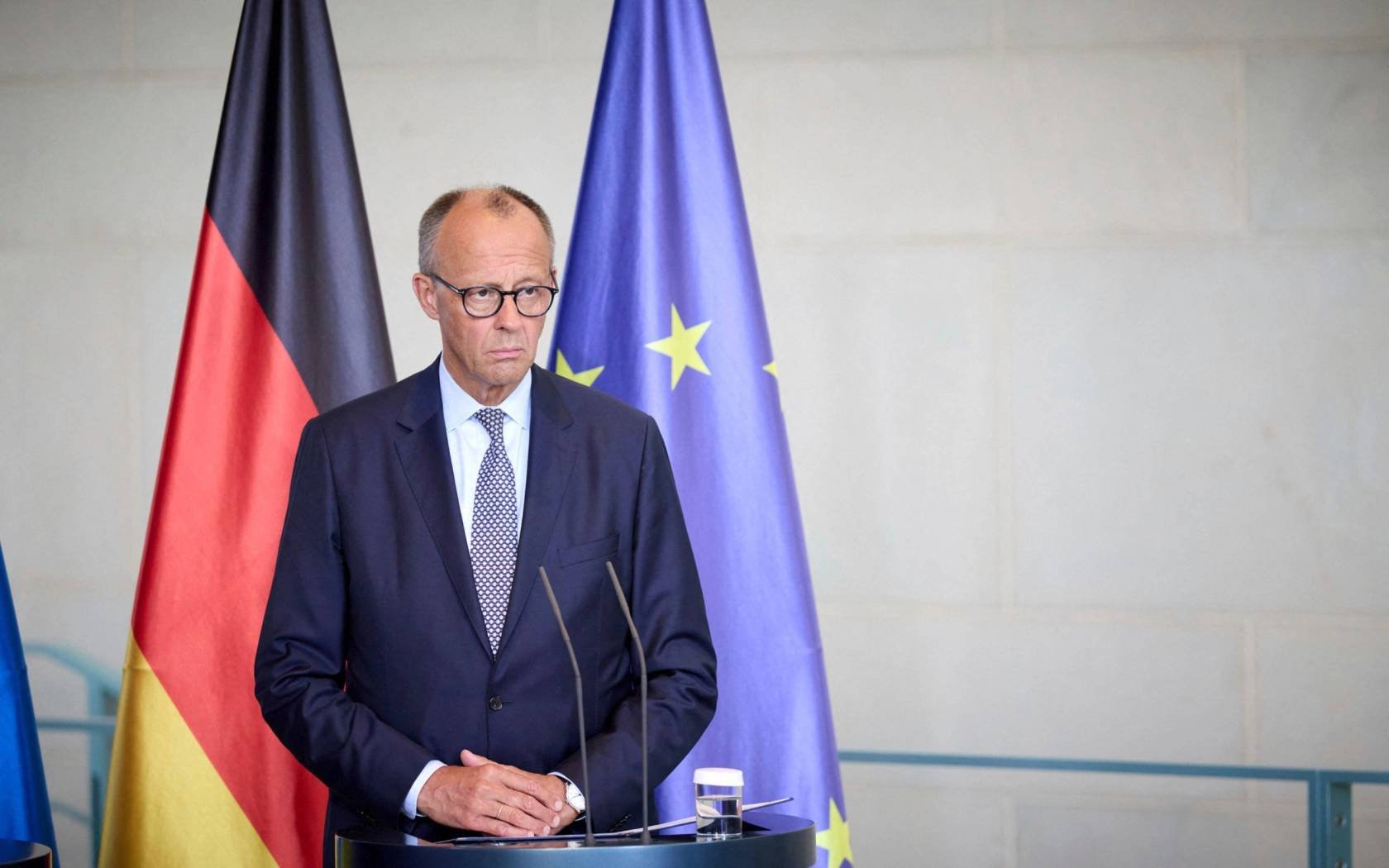
Now, in the autumn of 2026, Germany has finally gone ‘full English’, albeit not in the manner hoped for by long-suffering German Anglophiles. Instead, Germany seems to have adopted the very aspect of recent British politics that has been the least admirable: its fickleness. A series of devastating defeats in the state elections over the past few weeks has pushed Chancellor Friedrich Merz’s already dismal poll ratings to new lows. A premature departure from office, after just one and a half years, now seems a serious possibility. Since his predecessor, Olaf Scholz, was also forced to step down before the end of the legislative term, the chopping and changing in the Chancellery is beginning to resemble what has happened in Downing Street over the last decade. No wonder, then, that German commentators are readily comparing Merz to the recently departed British Prime Minister, Sir Keir Starmer, and identifying a convergence of British and German political fortunes.
Indeed, despite their opposing party-political leanings, Friedrich Merz and Keir Starmer have quite a lot in common. Like Starmer, Merz reached high political office circuitously, having spent long periods of his adult life outside professional politics, which gave him the appealing image of someone with an independent mind. Furthermore, Merz cruised through an election campaign without seriously doubting his eventual victory because, like Starmer, he was running against a government widely regarded as having failed. Olaf Scholz’s ‘traffic light’ coalition was, just like the Conservative government against which Starmer stood in the summer of 2024, a spent force. Merz positioned himself as the level-headed, professional alternative to years of incoherent policies, internal strife and a general lack of direction. Starmer, likewise, promised stability after years of turmoil.
Just as there are parallels to be found in their respective rises to power, so, too, are their abrupt downfalls strikingly similar. Both took office with far-reaching promises of rapid change, and both failed to deliver. It turned out that, despite years of leading the opposition, both had failed to develop a coherent plan for government. This general lack of direction was further exacerbated by regular communication blunders and a knack for ill-advised personnel decisions. Consequently, both Starmer and Merz saw their public standing plummet at a pace and to an extent never before seen in modern politics in either country.
Yet whatever Merz and Starmer’s weaknesses may be, they are not enough to explain how quickly and how deeply both have fallen from grace. Only ten per cent of Germans are still satisfied with Merz. In a remarkable post-election survey following the recent state election in Mecklenburg-Western Pomerania, just one per cent of respondents believed that Merz had helped the CDU during the campaign; 80 per cent saw him as a liability. And this is a man who has been in office for barely a year and a half, who is not responsible for any significant scandal, and whom no one seriously accuses of malicious intent. Even taking into account the justified dissatisfaction with the stagnating economy, the rising cost of living and the unresolved consequences of mass migration, this is an unusually harsh verdict.
Merz and Starmer are by no means isolated cases. In South Korea, President Lee Jae-myung, who took office around the same time as Merz, in June last year, has experienced a similarly dramatic slump. Within four months, his approval rating plummeted from 67 to 37 per cent – an extreme decline even by the standards of South Korea’s turbulent political landscape. If heads of government in systems as diverse as a parliamentary consensus democracy with proportional representation, a Westminster-style majoritarian democracy, and a presidential democracy wear themselves out so quickly, then the cause clearly lies in something deeper than individuals or institutions alone. Clearly, we are witnessing a structural crisis of democratic politics.
It is frequently lamented that the quality of political leadership has declined over the past decades, and not without cause. As western democracies reaped the benefits of the peace dividend bestowed by the end of the Cold War, politics seemed to lose its high-stakes nature and became a field increasingly populated by more mediocre, technocratically minded figures, who now seem ludicrously unsuited to meet the challenge of the present moment of historical, geopolitical and technological shifts. Yet what is underappreciated, and less popular to emphasise, is that while the end of history certainly diminished the quality of political elites, it also rendered the voting public less suited to upholding liberal democracy. Especially in Europe, where the ‘end of history’ was symbolised by the fall of the Berlin Wall and most fervently believed in, the population became politically infantilised as it slipped into the comforts of the post-Cold War cocoon.
Many in western publics no longer see themselves as citizens in the classical sense, as cives, who, as political actors, assume responsibility for the community through active civic participation. They have become consumers of politics and treat it like a streaming subscription or a delivery app: they expect results, and they expect them immediately, on demand.
This consumerist attitude is exacerbated by a media environment that delivers almost exclusively ever-shorter, highly emotional stimuli, rather than the type of information on which rational judgement and participation in political discourse are based. Jürgen Habermas, who died this year at the age of 96, described the essence of this development as early as 1962 in The Structural Transformation of the Public Sphere as a shift ‘from a culturally reasoning to a culturally consuming public’. In the final years of his life, he had to witness how ‘the raucous noise’ of social media was eroding even what remained of the reasoning civic public sphere he idealised.
What has taken its place is the mob behaviour described by Elias Canetti in his 1960 treatise Crowds and Power. In it, Canetti analyses the archetype of the frenzied mob that rapidly forms around an accessible victim, whose members act all the more unrestrainedly as the blame is spread amongst them all. The digital ‘s***storm’ follows this pattern exactly: a target is found, the mob gathers, everyone contributes just a single post, and in the end no one feels responsible. Every cycle of outrage online also confirms Canetti’s observation that the mob disperses as soon as its victim has been dealt with.
Equally relevant to understanding today’s virtual public sphere is Canetti’s concept of the ‘double mob’. The most stable mobs, according to Canetti, are sustained by an opposing mob, his prime example being war itself. The culture wars online follow this model. Each camp needs the other to stay mobilised, while algorithms drive engagement by rewarding anything that makes the opposing side appear especially large and threatening. Anyone who, like Merz or Starmer, wishes to govern from the centre belongs to neither of these two masses within this structure, and thus becomes a target for both.
Conversely, those politicians who unreservedly engage with the voter as a consumer, and approach the digital public sphere as a potentially deadly arena, are the ones who prevail. To survive, they must constantly ride the latest wave of emotion, or face being swept away by an overwhelming tide. Hungary provides a case study for this phenomenon. It is still early days, but five months after taking office, Péter Magyar’s popularity remains undiminished. This is chiefly because he has never stopped campaigning: he has simply carried over into his time in government the enthusiasm on social media that propelled him to victory over Viktor Orbán. He is always ready to stream, microphone perpetually clipped to his lapel, and transforms his day-to-day government business into clickbait with such virtuosity that observers already see him as the founder of a Hungarian ‘Netflix democracy’.
Whether this spells the salvation of representative democracy or its undoing remains to be seen. Canetti’s work would suggest that this approach will reach a natural end point. Under the conditions of modern, highly individualised societies, Canetti believed that a mass holds together only as long as it is growing and has a direction. This demands a head of government who never stops broadcasting. Yet even the most popular TV shows eventually peak and decline, with an impatient audience ready to move on at speed to whatever catches its eye next.
Lukas Schmelter
More from Europe

Moscow is watching Latvia. Is Washington?

Britain and Germany: Europe’s original special relationship

Germany must relearn the language of power-politics

Europe’s overseas possessions could be a major global asset