The KGB’s phantom plot to kill the pope
- November 25, 2026
- Alexander Faludy
The attempt on the pope’s life in May 1981, long attributed to Soviet agents, is more likely to have been the work of Turkish ultra-nationalists seeking to strike against the ‘Imperialist West’.
Killing the Pope: John Paul II and the Last Battle of the Cold War, Serhii Plokhy, Allen Lane, £25
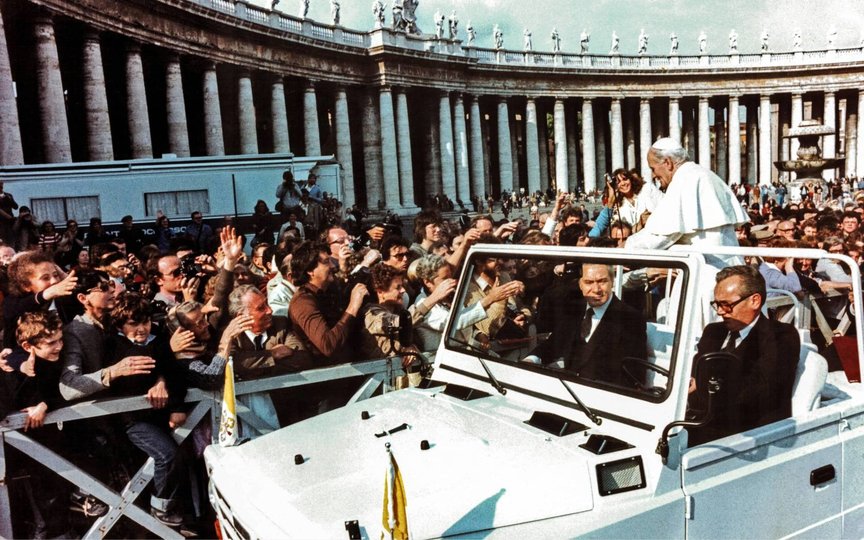
At 17:19 on Wednesday 13 May 1981, Pope John Paul II was hit twice by bullets fired at close range while greeting well-wishers from his open-top ‘popemobile’ in St Peter’s Square. Nearing the end of a routine general audience, the 60-year-old Polish pontiff had just set down a child presented for him to kiss while the car paused. As the vehicle crept forward again on its final lap, the noise of a pistol being discharged caused several hundred pigeons to scatter into the blue sky above, and sent shockwaves around the globe.
One bullet struck the pope’s right elbow and broke his left index finger. The other pierced his abdomen, colon and small intestine, but narrowly missed his aorta. John Paul needed 20 units of blood during emergency surgery in Rome’s Gemelli hospital. Afterwards he’d say that ‘One hand shot, and another guided the bullet’, ascribing his survival to the Virgin Mary.
A Turkish citizen called Mehmet Ali Ağca was apprehended at the scene. In his hand he held the Browning automatic from which the bullets were fired. In his pocket was a letter proclaiming his act ‘a protest against the imperialism of the Soviet Union and the United States’, especially ‘the genocide that is being carried out in Salvador and Afghanistan’.
Under interrogation, Ağca affirmed his culpability while maintaining that he acted alone. He also claimed that he’d previously undergone training at a camp run by the Palestine Liberation Organisation (PLO) in Lebanon. It was the first of many red herrings with which Ağca baffled interrogators over several years and two trials. In Killing the Pope, Serhii Plokhy (best known for Chernobyl: History of a Tragedy) explores the mystery, and reflects on its diverse framings during and after the Cold War.
Superficially, the matter was resolved when an Italian court found Ağca guilty of attempted murder on 22 July 1981 and sentenced him to life imprisonment (he was later pardoned and extradited to Turkey, where he was released on parole in 2006). Really, though, this was only the beginning. The judgement alluded to the likelihood of a conspiracy, opening the way for a second trial in which Ağca would appear alongside others.
There were good reasons for those suspicions. A picture snapped by an ABC photographer showed a second man fleeing the scene and carrying a gun. Ağca’s extensive travel, hotel stays and spending on entertainment also suggested organisational backing. Moreover, he was a member of the ‘Grey Wolves’, officially a youth branch of the Turkish Nationalist Movement Party, but actually a terrorist organisation.
In June 1979, Ağca was arrested in Turkey for gunning down Abdi İpekçi, editor-in-chief of the liberal newspaper Milliyet, as he sat in his car outside his Istanbul home. At first, Ağca confessed to the crime, but then retracted his confession during the trial and escaped from prison. He spent the next 18 months on the run across a string of countries stretching from Iran to Tunisia via Bulgaria and Switzerland before washing up in Rome on 10 May 1981.
At a minimum, then, investigators suspected that the conspiracy involved diaspora Grey Wolves with whom Ağca associated during his wanderings. Suggestions that the trail led ultimately behind the Iron Curtain first appeared in a hastily assembled SISMI (Italian military intelligence) report shared on 28 May 1981 with Francesco Mazzola, the undersecretary in the prime minister’s office overseeing the security services.
The report highlighted Moscow’s alarm at the challenge John Paul posed to Poland’s Communist government in its struggle with the independent trade union Solidarity. It claimed Soviet defence minister Dmitrii Ustinov had proposed the assassination attempt at a meeting of Warsaw Pact peers in Bucharest in November 1980, but then adjusted the plan to one of wounding. Ağca, the dossier alleged, was a KGB agent loaned to Soviet military intelligence. To fulfil the mission, the KGB extracted Ağca from prison before transferring him to a Crimean training camp disguised as a PLO facility.
This was nonsense. Ağca’s escape preceded the (misdated) Bucharest meeting by over a year; and it is highly unlikely that Ustinov would have discussed a highly sensitive operation in a large forum six months beforehand. Plokhy posits that SISMI’s head, General Giuseppe Santovito, forwarded the bogus but eye-catching report in a desperate bid to retain his job amid a major corruption scandal.
Yet in May 1981, against the background of a feared Soviet intervention to ‘restore order’ in Poland, Mazzola believed it. In a broadcast interview with the British programme TV Eye in September, after he’d left office, he pointed towards orchestration by the KGB. Subsequently, attention shifted to the so-called ‘Bulgarian Connection’, with authorities claiming that the Soviets had subcontracted the operation to CSS, Bulgaria’s secret service. CSS had become a byword for assassination following the notorious killing of dissident BBC Bulgarian Service journalist Georgi Markov in London in 1978.
Ağca certainly had connections with Bulgaria, notably via Ömer Mersan, a Turkish businessman based in West Germany. Mersan acted as a link between Turkey’s smuggling mafia and CSS under the cover of his dealings with Bulgaria’s state import-export company Kintex. Mersan and Ağca met at Sofia’s Vitosha Hotel on 24 July 1980. Mersan provided Ağca with cash, used his Bulgarian connections to extend the transit visa in Ağca’s (fake) Indian passport, and pulled strings in Turkey to secure him a more convincing travel document enabling his onward journey in Europe.
That incident may have been merely part of a regular trading of favours between Bulgaria’s security services and Turkey’s smuggling mafia, whose Bulgarian operation was tolerated by CSS in exchange for a cut of the profits. Alternatively, it might have been a CSS recruitment exercise.
The latter view was favoured by Italian prosecutors and the CIA. The claim’s plausibility seemed strengthened when the Bulgarians first denied that either Ağca or Mersan had been in Bulgaria in the summer of 1980, only to admit it reluctantly in the face of independent evidence from Italy and West Germany.
During the further investigations, Ağca, hoping that co-operation would lead to early release, identified from photographs two Rome-based Bulgarian diplomats and one employee of state-owned Balkan Airlines as enablers of his attempt. His constantly changing testimony, however, fell apart on the stand during the subsequent conspiracy trial (1985-86). Not only did Ağca bury himself in contradictions, but he also claimed to be the reincarnation of Jesus Christ. The Bulgarians were acquitted.
Scrutiny of the CSS archives after 1989 found no trace of any plot. Pope John Paul, for his part, forgave Ağca and repudiated the ‘Bulgarian Connection’, but privately continued to blame the KGB, whose archives remain inaccessible. In context, however, Plokhy thinks this unlikely. Certainly, John Paul’s forceful anti-communism was a challenge to Moscow. However, at the end of March 1981, he had also just helped to avert a general strike in Poland by leaning on Solidarity at the request of Nikolai Lunkov, the USSR’s ambassador in Rome. The diplomatic picture was complex.
Ağca, conversely, had already issued a public threat to kill John Paul during the latter’s November 1979 visit to Istanbul, in a signed letter to Milliyet on the day following his escape from prison. Ağca’s hostility to the pope as a symbol of the ‘Imperialist West’ (and need to prove himself to the Grey Wolves after a period of drifting) may, Plokhy argues, have been enough cause for him to lobby for authorisation to undertake the operation and for the resources required. Among all the explanations offered to date it is, perhaps, the least unlikely.


