Anita Brookner’s answer to ‘Death in Venice’
- October 26, 2026
- Lesley Chamberlain
Read alongside Thomas Mann’s novella, ‘Hotel du Lac’ reveals Anita Brookner as a rare connoisseur of female desire.
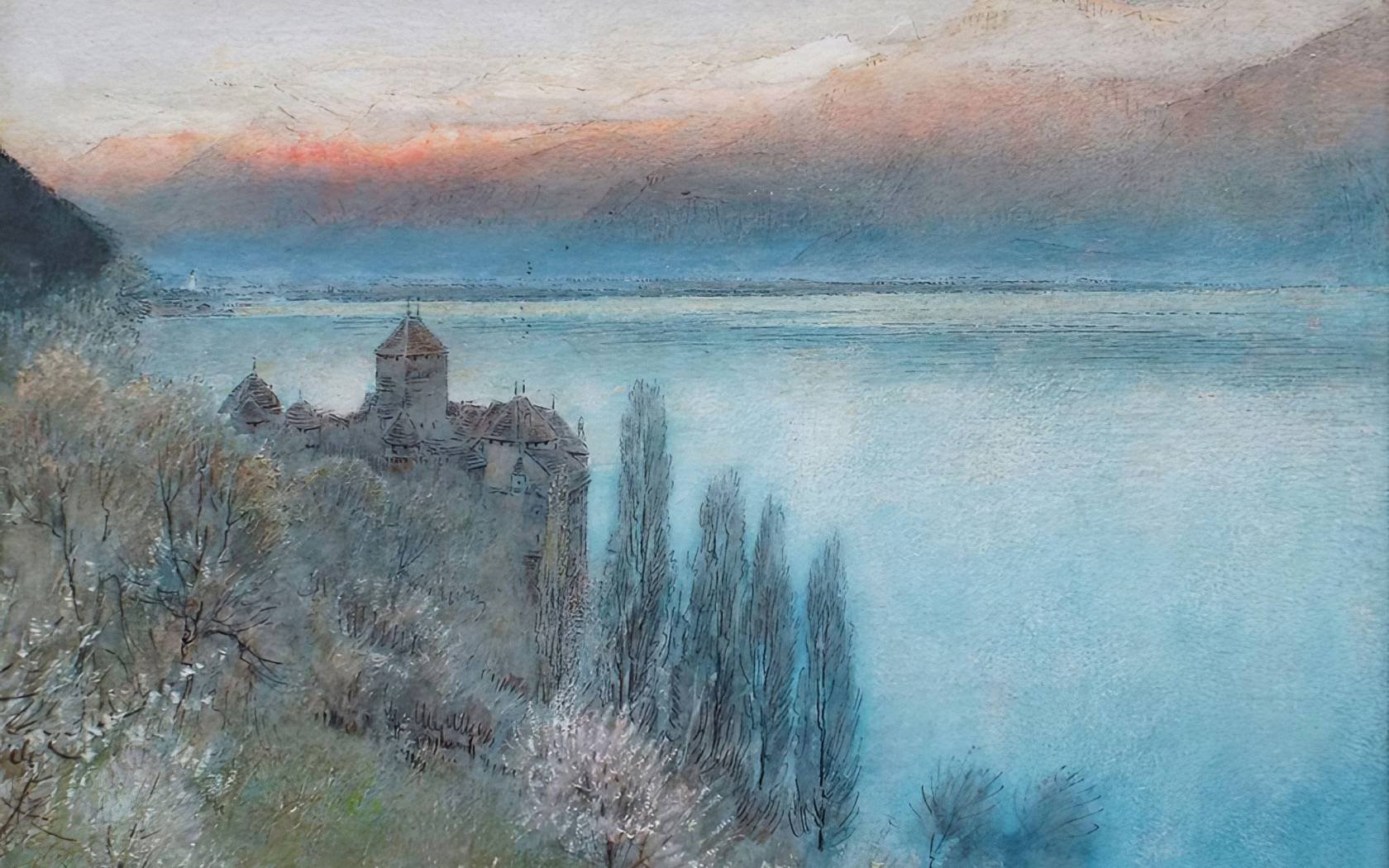
Thomas Mann’s Death in Venice (1912) is a peerless tale of secret desire slowly unmasked. A middle-aged man on holiday comically strains to ignore his desire for a beautiful boy espied across a hotel dining-room. He is a writer who owes his eminence, and the message of his work, to an idea of self-mastery, and still he fails. His infatuation undoes all his defences and ends his life. Could there ever be an equivalent story written by a woman, I wonder? Could a woman’s desire for a forbidden lover bring about such a fierce clash between self-control and self-abandon? Anita Brookner, currently in the spotlight as the subject of a pioneering biography by Hermione Lee, is perhaps still not quite as celebrated as a connoisseur of female desire as she should be. A constraint maybe that her perceptions fly in the face of feminism. She wonders about ‘women who raise altars to themselves’. ‘The lonely energy, the wild strangeness and concentration of her gesture’ strike her about another female soul. Some dress up, others give up. Others again are ‘complacent consumers of men with their complicated but unwritten rules of what is due to them’. She may be too harsh on women, she says through her narrator, but she understands them better than men. These quotes and allusions come from her prizewinning Hotel du Lac (1984) and there are many, many more, all exquisitely expressed.
One way to appreciate her unusual perspective as well as her outstanding gifts as a novelist is to read Hotel du Lac alongside Mann’s timeless novella. Both are set in hotels with imposing formal rules of behaviour and both feature illicit longing. To make the comparison is to feel the power of the stately, highly wrought prose in which both writers excel. For both of them self-control is mirrored in a style of writing that is devastatingly self-conscious and exact, functioning like a harness for their high-wire act. Both give their main character a passion for decorum and an even more powerful wish to break free of it. In an expensive, understated European hotel suitable for an aristocratic clientele, and where the activity of every hour is coded to appear comme il faut, their social conservatism collides with their inmost wishes. Brookner admired Mann’s work and, as Lee points out, one of her late novels, unusually focused on a man, suggests a direct parallel with the fate of Gustav von Aschenbach. Still, I believe, we go deeper into Brookner’s attitude to sexual passion if we pursue the parallel between Mann and her women.
Edith Hope is 39 and unmarried, and by the time she arrives for her two-week stay on Lake Geneva she has long since committed herself to an illicit love. There would be no crisis if well-meaning, disapproving friends were not trying their hardest to make her abandon her secret married man. Their efforts have led Edith to accept a proposal of marriage from a suitable suitor, only for her to abandon him at the altar. They have ushered her abroad in the hope that distance and rest will somehow ‘cure’ her and stop others talking. Like Mann’s Aschenbach, Hope is a writer, but whereas his task is to uphold the dying humanist order of the Prussian state, hers is to write romances to escape a disappointing middle-class reality. She writes, just as he does, to keep her own difficulties at bay. All the while Aschenbach is sliding into a hopeless passion, Edith is being asked to abandon one.
Much of the charm of these two short fictions comes from the mismatch between the hotel’s exacting strictures of behaviour and the private passions of a handful of guests. Gustav von Aschenbach, the stiff, lonely Prussian whose masterwork is a biography of Frederick the Great, spends long minutes gazing at his loved boy as if through the bars of a cage. The rows of beach huts laid out on the hotel strand are as orderly as the dining tables indoors and keep private desires hidden. Yet every hotel guest is on display, a great or lesser island of mystery and unknown desires to those around. We are left to imagine contorted feelings beneath the polished surface. Does this boy of 14 know of the old man’s infatuation? Yes, and he plays the coquette. Is his family aware of the perverted threat Aschenbach presents? Indeed, and they warn the boy to stay away from him. Mann’s narrative crosses over with Brookner’s at the point where in the face of public disapproval we are asked to accept the truth of a private passion; at least that. Brookner amplifies her picture by decrying the greyness and grossness that here and there mask a stifled or merely transactional sexuality. She’s a rebel against the convention that good women should be appropriately married.
Mann was never at ease with his own homosexuality though fully committed to it. He did not glorify Aschenbach’s homoerotic longings but made them comic and grotesque, as if parodying his own weakness of will. But Brookner’s straight-backed Edith Hope is proud of the kind of love she has chosen. Her lover’s wife and children, often enough mentioned, are not her concern. She and her lover have an arrangement which dictates that no one will get hurt. The deal, which means nothing painful may be said, nor may the covert situation ever change, is not emotionally or socially satisfactory but she accepts it. For her it is love, not something less. Her notion of love is the very opposite of the ‘arrangements’ that her friends want to foist upon her, first in London, then on Lake Geneva, to ensure her social position. She wants emotional truth, a nice conceit given that her affair is socially unreal.
Brookner wants us to understand adultery – when it means love – as positively heroic. It celebrates a Nietzschean rejection of herd mentality and an equally Nietzschean refusal to apologise. (Nietzsche is another of her fond references, as noticed by Lee in passing.) As for Mann, the climax of Death in Venice is Aschenbach’s self-abandon, gazing out at the loved one as he cavorts god-like on the edge of the sea. His death may be a Platonic parable about the perfection that lies the far side of the water, but it also has a Tristan and Isolde feel, a decadent sense that romantic love and death are indissoluble. Brookner is in her way infinitely more practical. Edith Hope, not about to die, will take the illicit love she has. At least it is genuine and true. We learn towards the end that after a fortnight of writing goodbye letters she has not posted a single one. The very last paragraph of Hotel du Lac sees her send a telegram signalling a return to her David, and to how things were. She crosses out that she is coming home. She and her beloved will never have a home together. She is returning to their snatched afternoons in her flat.
Brookner hungrily explores other women for their passions, not out of desire but out of unlimited curiosity. Her penetrating observations of how women seek and feel the love of men mark all her novels. They love grotesquely, pathetically, and are often narcissistically more interested in themselves. A desperately childless anorexic woman and her little dog, a corrupt and gluttonous old mother and ageing daughter, though protected by the projections and expectations of social class, are transparently fascinating to Edith Hope. The old woman’s birthday party, with its glorious dressing-up and its magnificent cake, has some of the decadence about it, and the hidden emotional chaos, that surround Aschenbach in decaying Venice, the afternoon he throws caution to the wind and buys a bag of squelching fresh strawberries. When he goes to the hairdresser to have his hair dyed and his face painted to look younger he is a parody of the kind of womanhood Brookner despises. But Edith Hope most resembles Aschenbach before his fall, because she never quite loses her poise, which she sees as a moral stance. The man who does momentarily unsettle her is a gross immoralist hiding behind the veneer of the most cultivated and eligible widower of the season, and just in time, for the reader’s sake as well as her own, she rejects him. We would be sorry to see her give in.
A theme I appreciate in Brookner is how explicit female sexual hunger is intertwined with her memories of a European Jewish heritage. Her background was German or Viennese as she portrayed it in the novels, Polish in her actual family history. Jewish women were gutsier. Not afraid to shout out their frustrations. Brookner pairs the problems of the refugee in an alien society with the difficulty of not being a straightforwardly nubile woman. That comparison is awkward. But her point is how both situations can lead to an unfulfilled life. In her 1988 masterpiece, Latecomers, for which she felt she should have won a second Booker, refugees and unusual women all know ‘the problem of having entered life by the back door’.
Brookner belongs to a different age. But a female Nietzschean in matters of sexuality is too rare a thing for us to confine to English literature. I don’t think she belonged there at all. The French 18th century, where she focused her eye as an art historian, is nearer the mark. Shades of Laclos’s Les Liaisons dangereuses cross with Aschenbach’s sojourn on the Lido.


