Benjamin Britten’s outsiders on trial
- November 23, 2026
- Benjamin Poore and Isobel Roele
Fifty years after his death, Benjamin Britten’s operas continue to interrogate ideas of justice and law.
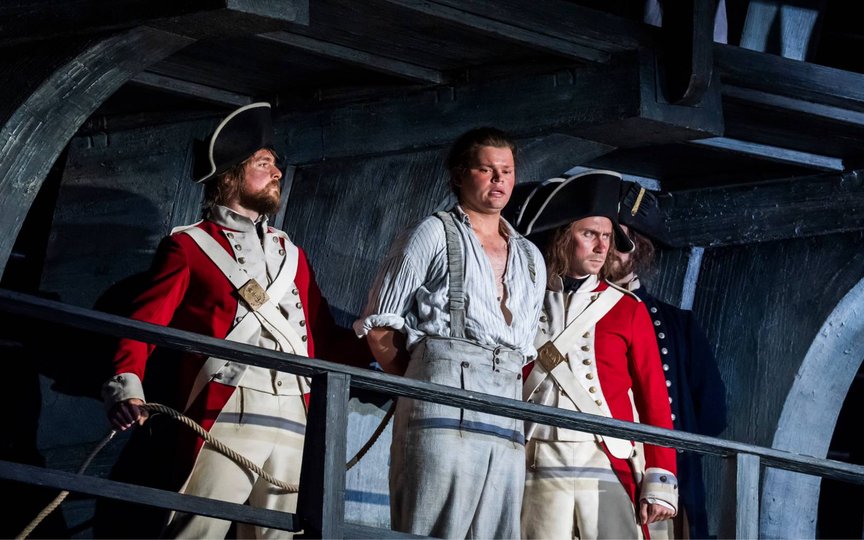
It is half a century since the death of Benjamin Britten, widely hailed as the most significant British composer of our time, whose birthday falls, as fate would have it, on St Cecilia’s Day – the feast of the patron saint of music. His work was especially remarkable for its reinvention of a homegrown operatic tradition that had been in abeyance since the time of Henry Purcell, but the influence of works such as Peter Grimes (1945), The Turn of the Screw (1954) and A Midsummer Night’s Dream (1960) reached far beyond Britain, making an indelible mark on Anglophone opera ever since. It is a body of work celebrated not just for Britten’s glorious music but also for its articulation of potent political and psychological insights. Among the most remarkable of his stage works is Billy Budd, the 1951 operatic retelling of Herman Melville’s novella. It is set aboard a warship, HMS Indomitable, commanded by Captain Vere. Billy, ‘a fine recruit’ judged ‘a pearl of great price’ by the ship’s officers, is brought low by his single flaw – he stammers – and the opera culminates in his trial and execution.
The act of legal judgment is central to much of the operatic repertoire. The absurdity of legal machinations is the bread and butter of Gilbert and Sullivan’s operettas, which are rife with bizarre paradoxes. Eighteenth-century opera seria was preoccupied with the forms of judgment exercised by the rulers at the centre of its plots; Mozart’s La clemenza di Tito sees its titular emperor exercise mercy towards those who are condemned to be thrown to the wild beasts for plotting against him. Other operas hinge on bent and broken legal processes, portrayed as a mere front for brute force and self-interest – in Le nozze di Figaro, the Count turns Marcellina’s claim on Figaro, a loan contract with marriage as the forfeit, to his own advantage. In Puccini’s Tosca, the corrupt police chief Scarpia tortures away and merrily signs death warrants; his ultimate double-cross is that the apparently mock execution of Tosca’s lover Cavaradossi is not a simulation at all.
Billy Budd’s contribution to this train of operatic thought uses Britten’s remarkable gift for musical ambiguity to worry away at ambivalences inherent in our everyday concepts of justice and law. Set at sea, during wartime, the opera gives these problems an especially acute character, one that speaks to the 20th century’s turbulent record of making and breaking laws, both human and divine. At its centre is a man in whom the letter of the law is incarnated as a form of injustice.
Britten and his co-librettists, EM Forster and Eric Crozier, departed from Melville’s detached third-person storytelling to frame the tale as the final testimony of Captain Vere, an old man who has ‘experienced much’. Vere’s initial testimony is the first of many sequences that echo and invoke legal processes. Like a courtroom witness facing cross-examination, the tenor’s vocal line sits exposed – unprotected and unsupported by the vast orchestral garrison at Britten’s disposal. Twice he states his name, rank and command of HMS Indomitable as if he is standing before the law.
Vere’s opening and closing monologues begin with two flickering figures in the violins and violas, oscillating between just two notes. The way Britten dovetails their simple parts has complex musical consequences. One line implies a home tonality of B-flat major; the other suggests B minor, both hovering around a D, the pitch common to both. The music becomes, so to speak, unanchored, adrift on the harmonic sea, bobbing uneasily on the semitone that separates the two chords. A simple melodic figure hides fathomless complexity. This lack of harmonic ground speaks to the unresolved and unreconciled character of the legal drama at the heart of the opera.
It is through the ambivalent figure of ‘Starry Vere’ that these questions are posed. ‘He cares for us like we’re his sons,’ the crew sings. He is the ‘wise judge’. During his first appearance, he is reading Plutarch’s Parallel Lives, and the passage he reads aloud – on the Athenians at Salamis – points to the Life of Themistocles, the Athenian politician popular with the common people owing to his prudence as a magistrate. Plutarch writes that he ‘rendered the service of a safe and impartial arbitrator in cases of private obligation and settlement out of court’. Themistocles is incorruptible – he refuses an improper request from the poet Simonides, chiding him that he would not be a good poet if he sang contrary to measure, ‘nor I a clever magistrate if I should show favour contrary to the law’. ‘Plutarch, the Greeks and the Romans – their troubles and ours are the same,’ Vere reflects in his cabin.
In an early scene, the men press-ganged from the merchant ship Rights o’ Man are formally processed into service on the Indomitable by the master-at-arms. The first of these, Red Whiskers, complains. ‘I object! I object!’ he sings, recalling innumerable US courtroom dramas. But his objections are neither here nor there and he is silenced with the threat of a beating. His mistake is thinking reasoned debate has a place on a warship; likewise, he fails to see that times of war abrogate liberties – inter arma enim silent leges, as Cicero had it.
When Billy bids farewell to his previous berth on the Rights o’ Man, or les droits de l’homme, the music sounds a lamenting motif that takes harmonic and melodic colour from a rocking semitone, disturbing the diatonic clarity of the rising fifth around which the phrase pivots. The figure gnaws away throughout the opera, appearing again when Vere and his officers discuss the mutiny at the Nore – here the figure disturbs the humdrum, procedural triads that otherwise rise pompously from below. The same figure is associated with Vere’s sense of guilt. The first time we hear it is in Vere’s ‘O, what have I done?’. Here, it is the sound of rights unacknowledged.
Between Vere’s testimonies, the opera shows us how the jealous, scheming master-at-arms John Claggart sets out to bring Billy low. Repeatedly confounded by Billy’s goodness, Claggart brings a false accusation of mutiny to Captain Vere. Expecting to unmask a deception on Claggart’s part, Vere asks Billy for his testimony. Staggered by the accusation and, stammering, unable to speak, Billy answers with his fists, killing Claggart.
The incident sets in motion another legal process, as Vere calls a drumhead court to render summary justice. Pontius Pilate-like, Vere declines to sit in judgment on Billy, delegating the burden of responsibility to three of his officers. ‘There’s the Mutiny Act. There are the King’s Regulations. There are the Articles of War,’ they sing. ‘We’ve no choice,’ they conclude – three voices in musical and judicial unison. The conclusion weighs heavy on them. In contrapuntal arrangement, they sing: ‘Claggart, I never liked Claggart’; ‘Claggart was hard on them all’; ‘How they hated him’; ‘Still Claggart has been murdered.’ At the end of the passage, the officers return to their gloomy refrain, turning over the same three pitches – B-flat, E-flat, C – in different orders, as if they are looking for the combination that will spring the judicial deadlock. They find Billy guilty and sentence him to hang from the yardarm.
The opera puts Vere on trial in turn for his part in the process. ‘It is not his trial, it is mine,’ sings Vere in the aftermath of Claggart’s death. When Billy pleads ‘Captain, save me!’, Vere will do no more than testify to what he has seen. Sticking to the letter of the wartime laws passed to suppress mutiny and to the procedural efficiency of the drumhead process, Vere declines to use his discretion as ‘king of this floating monarchy’. He could have deferred Billy’s trial until they reached land, or taken Claggart’s dastardliness and Billy’s goodness into account, or commuted the death sentence.
Behind Vere’s reticence is a fear of mutiny. It does not matter if Vere rejects the possibility that Billy is ‘disaffected… ripe for the crimes of Spithead and the Nore’. It is enough that any of his (mostly impressed) men could turn out to be enemies within. It is a game played for high stakes. A scene early on in the opera shows how the officers’ minds see ‘France’ (‘who has killed her king’) and mutinous seamen (‘revolution, sedition, the Jacobins, the infamous spirit of France’) as one and the same. Indeed, Billy’s death is followed by the stirrings of rebellion among the crew.
Baby Budd’s case (‘beauty, handsomeness, goodness’) calls instead for natural justice. The impression is amplified by the intimacy and sympathy of the operatic form. ‘Billy in the Darbies’, for instance, is a tender and vulnerable aria sung as Billy awaits execution and calculated to pull at our heartstrings.
‘O, what have I done?’ Vere asks at the opera’s beginning and end. In the epilogue, Vere elaborates: ‘I could have saved him. He knew it, even his shipmates knew it, though earthly laws silenced them.’ The audience knows it, too.
The vexed nature of legal judgment features in several of Britten’s works for the stage. In Gloriana, the opera written for the Coronation of Queen Elizabeth II in 1953, Elizabeth I is forced to reckon with the Earl of Essex’s disastrous attempts to put down rebellion in Ireland; he is eventually branded a traitor and thrown in the Tower. The climactic scene sees the Queen vacillating over whether to sign Essex’s death warrant, unwilling to act despite the exhortations of her advisers. Just as Vere declines to save Billy, Elizabeth condemns Essex despite his wife’s pleas that she use her sovereign discretion to grant him clemency. Like Vere, she is left alone in uneasy reflection at the end of the opera.
Peter Grimes (1945), the story of a troubled fisherman run down by a viciously insular community, begins with a court hearing, the Coroner declaring a verdict of ‘accidental circumstances’ in the matter of the death of Grimes’ previous apprentice; Grimes goes free. The verdict might be legally satisfactory but is socially disastrous; the proceedings themselves have given the town the opportunity to fuel the gossip and speculation about the fisherman. Far from exonerating Grimes, the inquest ultimately condemns him.
Later in the opera, a posse assembles to go and confront the fisherman at his hut – perhaps even to lynch him – in a brutal passage for the chorus, but this is not an act of vigilantism. In Peter Grimes, the mob is sanctioned by the Magistrate.
It is not surprising that Britten was preoccupied with the nature of justice. He had himself been in the proverbial dock. On his return from the United States in 1942, he had to appear before a conscientious objector tribunal to defend his pacifist beliefs and wish not to serve in combat; the panel ruled that he should be assigned non-combatant duties. Following an appeal, supported by many of Britten’s influential friends, he was granted an unconditional exemption.
In 1953, the year of Gloriana, Britten was interviewed by the police about his relationship with Peter Pears. He was one of many high-profile gay men in the early 1950s approached by the authorities following Home Secretary David Maxwell Fyfe’s crackdown on homosexuality. In this context, Billy Budd itself, with its all-male cast and barely concealed subtexts, was provocative, inviting scrutiny of Britten and his circle. Britten, as a highly educated individual and public figure of significance, was decently equipped to tackle this kind of institutional wrangling. By contrast, the illiterate foundling Billy Budd drowns in the wash of legal argument.


