Hemingway’s lost generation turns 100
- October 30, 2026
- Katherine Pangonis
Hemingway’s ‘The Sun Also Rises’ is a period piece, but also an indispensable portrait of a chapter in Europe’s history: at once lurid, decadent and tinged with violence.
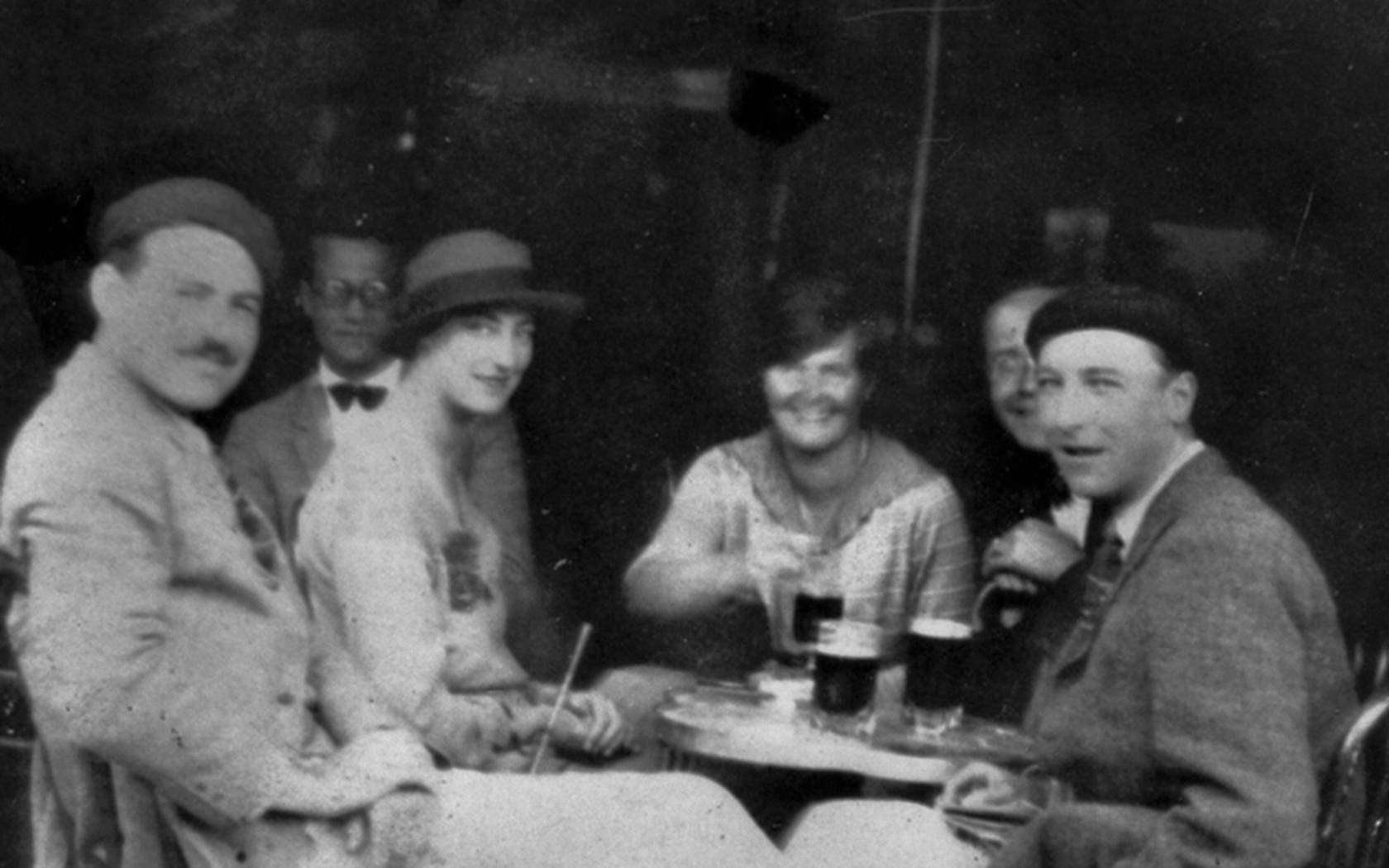
Outside the Café Iruña in Pamplona, every July, the Plaza del Castillo fills with people dressed in white with red bandanas. A hundred years ago, a young American writer sat in this square, watched his friends behave appallingly, and turned it into a novel.
I first read The Sun Also Rises aged 16, exactly 85 years after the events it describes. In 2016, fresh out of university, I travelled to Pamplona for the first time, to witness the San Fermín Fiesta and run with the bulls, hoping to experience that heady rush of chaotic, blistering emotion that Hemingway captured in 1926. I have returned to it every few years since. This year, for the centenary, I made the journey again – not to see the bulls this time, but to read the novel, in situ, on its 100th anniversary. The experience did not disappoint – and a huge banner proclaiming a hundred years of The Sun Also Rises was hung proudly across one side of the city’s bullring.
The Sun Also Rises was published by Scribner’s in October 1926, when Ernest Hemingway was 27, and the following year, as Fiesta, by Jonathan Cape in London. A century on, the question is not really whether the novel has aged well (if held against a modern value set, it hasn’t) – but why, despite my reservations which have only grown with each re-reading, I continue to come back to this text.
For a new reader picking up Sun now, it is hard to comprehend how groundbreaking it was in 1926. By now we are used to Hemingway’s prose; his style has been imitated, copied and parodied for a century. His books have become a prop for the tortured, monosyllabic male in mainstream culture (even Jess Mariano in Gilmore Girls is depicted as a fan) – but when it was released, it was radical.
The sentences are stripped almost bare. Short, factual sentences. Dialogue that sounds like a pared-down screenplay: people talking as people actually do, most of the meaning left unsaid, very little spoon-fed to the reader (except, memorably, a slightly condescending explanation of what the drink Pernod is). There are transcripts of drunken conversations with next to no explanation or ornamentation added, and bald descriptions of places that still manage to make them unfold, powerfully, before your eyes, whether it be the central square of Pamplona, a bus climbing the mountains of the Basque Country, or a train rammed with pilgrims who have taken over the lunch car. No superfluous adjectives clutter the images, and they resonate more strongly as a result. The novel was an instant hit.
Sun was never without controversy. It ruined several lives, or at least reputations. Hemingway gave his friends flimsy pseudonyms that echoed the syllables and rhythms of their real names and did little to conceal their identities. Lady Brett Ashley – the novel’s anti-heroine – was based on Lady Duff Twysden, a twice-married English socialite with whom Hemingway was infatuated. Brett’s lover, Mike Campbell, was Duff’s real-life lover, Pat Guthrie. The Jewish American novelist Robert Cohn was based on the Jewish American novelist Harold Loeb, who really had run off to the coast with Duff for an intense but short-lived tryst. The writer Don Stewart, who served partly as inspiration for the character Bill Gorton, said the novel was pure journalism.
The portraits were not flattering. Hemingway depicted his friends warts and all, then added a few fictional warts for good measure. Some of the most damaging incidents – Cohn cracking under pressure and punching Jake, or Brett seducing a teenage bullfighter – were inventions. But crowded in alongside so much that was factually true, the distinction was easy to miss. To add insult to injury, the novel that parodied his writer friends outsold anything they produced themselves. It must have rankled all the more when Hemingway took the Nobel Prize for Literature in 1954.
The novel’s central character is Jake, whom many read – at least in part – as Hemingway’s self-portrait. In fairness to Hemingway, he is no hero, and he is impotent, war-wounded. The book is – at surface level at least – all about balls, or lack thereof. An English teacher might have termed it ‘power and powerlessness’, but ultimately it comes to the same thing. Hemingway’s wife Hadley – who in reality was present on that fateful trip – is glaringly absent from the narrative, though she receives its dedication. After Hemingway left her for another woman, he ceded to her all rights and royalties for Sun as well, as part of their divorce, which came just before the publication of Men Without Women. Perhaps Hemingway imagined his married status as its own kind of impotence: the obstacle preventing the Jake-Ernest figure from consummating his love with the figure of Brett-Duff.
Jake and Hemingway both become less appealing with each re-reading. Early on, we see Jake picking up a prostitute for dinner in Paris, mentally sneering at her looks and manners all the while, his sense of superiority complemented by mediocre flirting. When Georgette orders Pernod, he quips ‘that’s not good for little girls’.
When they join a group of expats in a restaurant, he is acidly disparaging of his compatriots’ French abilities – we know Hemingway’s French was far from perfect. Gradually one begins to suspect that his unfulfilled romance with Brett may not be tinged with tragedy simply because he cannot sleep with her. What if he is simply wrapped around her little finger, kept on for emotional support, kidding himself that balls are the only obstacle to his romantic success? Is he just another in the line of lovers who cannot accept that it didn’t mean as much to her? How much do the alcohol, his anger and his obsession cloud his judgement as a reliable narrator?
I do take issue with the common – slightly WASPish claim – that all the characters are alcoholic – but nevertheless there is no escaping that the characters are not heroes. They are mostly hedonistic egotists wrapped up in their own traumas, doing their best to seem hard-boiled – and coming off slightly sociopathic as a result. Yet they are as vivid and real as Elizabeth Bennet or Casaubon or Jay Gatsby, rendered in a spare, modern style.
Consider Robert Cohn. The man Jake derides at every turn, and whom he repeatedly invites the reader to despise, begins, on re-reading, to look like the novel’s only honest sufferer. He is the one character who refuses to pretend he is not in pain, and everyone punishes him for it. He has elements of the ridiculous, certainly: a vain romantic who treats his real girlfriend, Frances Clyne, terribly. Reading as a woman entering my thirties, I find Frances a far more compelling character than I ever did before. Jake hates Cohn ostensibly because he wears polo shirts, is bigger than him, and sleeps with the woman Jake loves. He tolerates Brett’s other lovers, yet cannot stand Cohn. This is probably, in no small part, because Cohn is Jewish. His Jewishness is raised time and again, nearly always alongside a cutting remark or outright derision. Jake never says so directly, but Mike does: ‘No, listen, Jake. Brett’s gone off with men. But they weren’t ever Jews, and they didn’t come and hang about afterward.’ The others complain of Cohn’s ‘Jewish superiority’, and more.
It is an antisemitic text. This should not shock us for a book set in a pre-Holocaust Europe, but it should sober our reading. It is a period piece. Bill’s descriptions of his time in Vienna also reveal other chords of racism. The bal-musette scene betrays a snide homophobia. Jake regards Brett’s companions with an unselfconscious nastiness bordering on aggression. Her wavy-haired male friends transgress social and sexual norms, joyfully – and ‘with them was Brett’ – and Jake can’t stand it. As Jake zooms in on their luscious locks and ‘big-hippily’ dancing – can modern readers detect a note of jealousy? Desire? I’ll leave that to you.
The elephant in the room here is Hemingway’s treatment of female characters, and one woman in particular: Lady Brett Ashley. She enters the novel in the company of a group of gay men in a smoky Parisian dance club, before glamorously commandeering Jake to squire her around town in a taxi – and confide in him how miserable she has been – before embarking on a series of steamy affairs in various holiday spots that culminate in the arms of a teenage bullfighter whom she abandons in Madrid. Was this the original template for a hot girl summer gone wrong?
On my first reading, I was enraptured by Brett. She is the archetypal sexually liberated, universally desired, New Woman. It was hard not to be fascinated: a 34-year-old woman reeling from a bitter divorce who still captured the hearts of every man in the room, and danced through life ‘with curves like the hull of a racing yacht’, a glass of champagne in one hand and a cigarette in the other. She is as at home drinking champagne in Paris as swigging wine from a skin atop a barrel in a tavern in Basque Spain. At first glance, she seems empowered in the modern sense. But I did not understand her. She is the most lost of all Hemingway’s lost generation, blowing from bed to bed, dependent on men for diversion, validation, support and money. She may be drinking champagne, but she lacks the inner strength to really take command of her own life.
Brett sits at the centre of a century-long argument about Hemingway’s women, who were famously not hugely sophisticated in how they were drawn and, generally speaking, could fall into one of two categories: a castrator or a love slave. The other women in the novel are treated very dismissively. Is Brett a destroyer or a casualty, a misogynistic fantasy or one of the most complicated women in American fiction? The trouble is that the book sets her up as the cause of all the male suffering, which diminishes her own, or at least diverts attention from it. She even calls herself a ‘bitch’. But this characterisation doesn’t seem to have been Hemingway’s original intention: an early draft of the manuscript opened with the line, ‘This is a novel about a lady,’ and went on to give Brett’s history; the whole opening chapter and a half was cut late, on F. Scott Fitzgerald’s advice. Brett was always meant to be the main character.
Then there are the bulls, who, alongside balls, sit at the novel’s core. For Hemingway the corrida was far more than a sport; it represented a level of purity and nobility that contrasts with the chaos, base instincts and nihilism of the expats. En route to Pamplona this summer I fell into conversation with an aficionado of some 50 years’ standing, who spoke about bullfighting the way others speak about art, a ritual governed by rules older than memory. He explained to me that men have been ‘playing with bulls’ since before the invention of writing. Frescoes at Knossos show Minoan youths vaulting the horns of charging bulls three and a half thousand years ago; the bull has been a Mediterranean symbol of power and sacrifice since antiquity. The corrida – archaic and visceral in its brutality – is the last living descendant of that tradition.
As an animal lover, I find the modern reality far harder to romanticise than Hemingway did, and the world is with me: attendance is falling, Catalonia has even tried to ban bullfighting outright. Perhaps reading Sun is like attending a bullfight today. In both cases, we are watching something from another time. The corrida can be exciting and mesmerising – and still be horrifying and cruel. Hemingway can be artistically brilliant and morally reprehensible, his novels vivid, humane, toxic.
The expatriate Paris of the Left Bank is now the subject of a walking tour with laminated maps. The cafés where a broke young writer could once sit all morning over a single café crème now charge handsomely for the association. Pamplona has had both the worst and the best of it. The fiesta of San Fermín, which Hemingway introduced to much of the anglophone world as a secret, now draws hundreds of thousands of tourists – many of whom come because of a novel they have not read.
And yet the pulse remains. At seven in the morning the crowds line the streets, jockeying for a place to watch the running of the bulls, and the excitement, the anticipation, the adrenaline-like fear of those huge brutish creatures is felt by everyone. On my first visit I ran with them, and narrowly avoided injury when I tripped and fell.
There was so much I missed on the first reading. And that is why I keep coming back. In Death in the Afternoon, Hemingway compared his technique to an iceberg, seven eighths of its meaning concealed below the waterline. The term stuck. At 16 I saw only the visible eighth. Each time I come back I glean a little more; perhaps by the eighth reading – maybe in my fifties – I will finally have the whole of it.
Love him or hate him, Hemingway had a rare gift and, while his values have not aged well, his observations of people and social hierarchies have. The novels that survive their centenaries are those capable of bearing the weight of the criticism of the next age, and the one beyond that.
Hemingway placed two epigraphs at the front of the novel. The first is Gertrude Stein’s declaration, ‘You are all a lost generation’. The second epigraph is from Ecclesiastes: one generation passes away and another comes, but the earth abides forever. The ‘lost generation’ is gone. Hemingway, Duff, Loeb and Guthrie are all long dead. The earth abides. The Irati river still runs cold down from the hills. The waiters in Burguete are still unfriendly. The sun still rises over the plateau. The bulls still run at dawn. The book abides with them.


