The rise and fall of the ‘Byzantine’ Empire
- November 25, 2026
- Peter Frankopan
- Themes: History, Middle Ages
The Byzantine Empire never existed. It was simply the Roman Empire in the east, and far more resilient than Western Europe has long claimed.
Ask most people where, when or what the Byzantine Empire was and you will get a blank look. One reason for that is because the name itself is pejorative. In Europe, ‘Byzantine’ has long been a synonym for things that are over-complicated, unnecessarily bureaucratic, inefficient and ineffective. That is ironic, because the Byzantine Empire was not only one of the great political entities in history, but one of its great survivors.
It lasted for more than a millennium, a longevity that would suggest it was rather good at developing and maintaining institutions, at coping with crises and at adapting to changing circumstances. Why, then, does the name carry such negative connotations? Why is it that its greatest leaders and figures – such as Justinian and Theodora, the Empress Eirene, Basil the Bulgar-Slayer, Constantine VII Porphyrogennetos, Alexios Komnenos and his daughter Anna Komnene (to name just a handful) – are so little known? What even was the Byzantine Empire?
The short answer is that it never existed. What usually gets referred to as the Byzantine Empire was in fact another realm altogether: the Roman Empire. The use of the label Byzantine (or, as some scholars more generously call it, ‘the East Roman Empire’) is misleading, deceptive and wrong. The distinction is an artificial one, which speaks to the way that western Europe rewrote not only its own history but also that of others to justify its own dubious claims to a mythical past – one where England, France and no end of other states claimed to be the true heirs of ancient Rome. That was bad news for the Roman Empire itself.
Rome had grown from being a successful city-state on the shin of Italy into a Mediterranean powerhouse by the first century BC. It had seen off rivals, such as Carthage, and created a highly successful state that was characterised by institutions which made the functioning of the state run if not like clockwork then at least in a way that delivered results which are the prerequisites of all successful states: stability, but also a first-rate legal system that promised and usually delivered justice; tax-collecting powers that ironed out the most egregious examples of corruption and cronyism; and land-ownership records that kept disputes between citizens to a minimum.
It also developed a well-trained, finely tuned military machine, which not only provided security from outside threats but delivered victories that enhanced collective identities as well as measurable gains as a result of conquest. Being Roman was a reasonably loose concept: the state had jurisdiction over a myriad of minority populations who spoke different languages and had different religious persuasions and practices. But if you lived in territory controlled by Rome and you paid your taxes, that was enough to keep everyone happy.
Rome’s business model was a good one and over time led to enormous expansion – often through spotting and exploiting opportunities. A civil war that broke out after the death of Julius Caesar, for example, led to Octavian, later renamed Augustus by the grateful Senate, effectively annexing Egypt, the great breadbasket of the Mediterranean, and opening up access to trade routes into the Red Sea, the Indian Ocean and beyond. Not everything paid out so handsomely: the invasion of Britain did not enthuse everyone, to judge from letters found by Hadrian’s Wall that reflect on perfectly acceptable dinner parties in the local area but disappointing weather and even worse food.
By the turn of the fourth century, though, the Roman Empire had become so large that some thought it was almost ungovernable. The reality was not so much its size or the pressure on its institutions, but rather a set of crises that put the imperial centre under great strain. Economic compression, partly as a result of climatic turbulence that produced inflationary shocks and partly because of sudden expenditure on defence, demanded tight control.
That was one reason why the Emperor Diocletian launched a massive persecution of Christians – both for the familiar solution of identifying and offering up scapegoats to problems and to reinforce ideas about collective obligations. That was also why Diocletian intervened in the economy of the empire, setting up price controls that were so detailed as to specify maximum prices that could be charged for different kinds of footwear. And it was also why he instituted the constitutional reform of creating a ‘tetrarchy’, a novel system of government which divided the rule of the Roman Empire among four emperors: two senior emperors, one in the east and one in the west, and two junior emperors who were marked out as their successors. The aim was to establish authority and stability via a clear line of succession.
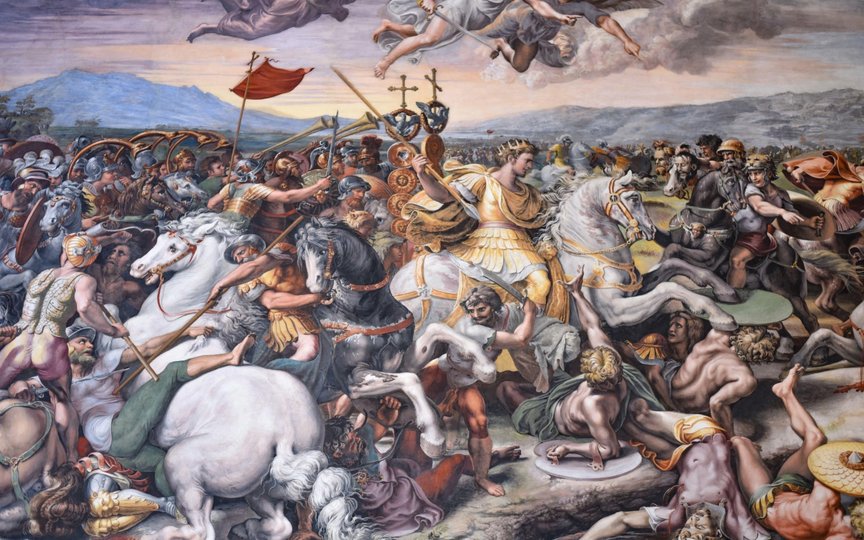
Things did not quite go to plan after Diocletian retired to his vast palace complex in what is now Split in Dalmatia – a Mar-a-Lago where he could keep an eye on things while following his passions, which included growing magnificent vegetables. Perhaps inevitably, within two decades there was a dispute about who should lead the empire. It was Constantine, son of Constantius – the junior ruler in the west – who emerged victorious, crushing his rival Maxentius at the Battle of Milvian Bridge in AD 312.
Constantine was now the undisputed ruler of the Roman Empire. His battlefield success owed much, it was said at the time, to divine inspiration and to signs that he should convert to Christianity. Constantine, it was said, had seen a cross of light above the sun, with the inscription saying ‘in this sign, conquer’ (‘in hoc signo vinces’). Furthermore, he had a vision of Christ in a dream, who commanded him to adopt the cross as his standard.
Constantine may well have reacted to this divine inspiration; equally and perhaps additionally, he may also have calculated that the growing number of Christians in the empire could be an important bulwark for him as sole ruler. There are indications that he may have been ambivalent about his own faith, since he continued to mint coins representing himself in classical pagan iconography.
What did matter, though, was that Constantine lifted restrictions on Christians in the empire – something that would become decisive because, over the centuries that followed, the Roman Empire not only stopped persecuting Christians but actively promoted Christianity (alongside Roman-ness) as key features of identity. For the next thousand years, being Roman meant to be Christian. Diversity and inclusivity were not frowned on; they were non-existent.
Constantine’s views seem to have hardened in particular when it came to ironing out disputes between different Christian sects. In 325, for example, he called all the bishops within the empire to gather at Nicaea in northern Asia Minor (Iznik in modern Turkey) to try to resolve differences of doctrine and ritual. The highlight of the council was the agreement of a statement of faith – the Nicene Creed – whose legacy is such that it remains the primary Christian articulation of beliefs to this day.
Constantine also decided to build a new city on the banks of the Bosporus, because so many of the empire’s interests, opportunities and challenges lay to the east, in Asia. The location he chose had been home to an ancient town named Byzantium. Enormous funds were now lavished on creating a new city at the point where Europe and Asia meet. The city was modelled on Rome, architecturally, institutionally and literally, as it was called New Rome when it was formally inaugurated on 11 May in AD 330. It did not take long, though, for the city to be named after its founder. And hence it became known as the city of Constantine – Constantinople.
The great city became famous for its magnificent buildings, most notably Hagia Sophia, the cathedral built by one of Constantine’s successors, the Emperor Justinian, in the sixth century. It also became home to an enormous hippodrome where crowds cheered on horse and chariot races, as well as to lavish palaces, statues and churches. It became by far the largest city in Europe, with a population in the year 1000 of perhaps a quarter of a million people; cities such as London and Paris were less than a tenth of the size, if that. So famous and beautiful did Constantinople become that it was known as ‘the Queen of Cities’. It was also stocked full of treasures, partly because of the endeavours of Constantine’s mother, Helena, who undertook pilgrimages to the Holy Land and brought back some of the most important Christian relics to the city’s treasuries.
Constantinople’s success and fame owed something to the fact that Rome became a shadow of itself following the raids by Goths, Huns and others that shattered the western half of the empire. Starting in the 400s, invasions from peoples from outside brought the empire to its knees. Rome was sacked; the institutions and networks that had held its territories together weakened and then collapsed in what is now France, Germany, Spain and much of Italy.
There were flickers of revival every now and again, but essentially the western part of the empire disappeared into what historians used to call ‘the dark ages’ – a time when literacy levels plummeted, when buildings stopped being made of stone and when the close ties between regions loosened before disappearing altogether.
Things were different in the other half of the empire, where Roman rule, laws, traditions and institutions not only successfully resisted these pressures but thrived – and continued to do so for centuries. Constantinople was now the undisputed capital of the Roman Empire, a state whose people thought of and called themselves Romans, whose rulers’ title was ‘Emperor of the Romans’.
The Christian character of the empire – and of the city – was of course different from that of classical Rome, though there, too, change happened all the time. Constantinople stood at the heart of the empire for more than 1,100 years after its eponymous founder had inaugurated it, and more than 1,000 years after the sack of Rome in 410.
The Roman Empire in the east was successful because it had the hallmarks of what makes states endure. Several emperors paid close attention to maintaining and streamlining the legal system, with the Emperor Justinian overseeing a root and branch review of the empire’s laws. Others invested time, energy and money into creating first-class ministries of foreign relations, whose roles included picking up early warnings of incoming problems and devising ways to deal with them – sometimes through military response, sometimes through alliance-building, sometimes through deft diplomatic gestures that bought precious time.
There were challenges, of course, including ones that brought the empire to the brink. For example, a devastating war with the Persians in the early 600s saw enemy forces camp by the walls of Constantinople, an existential threat that was made even more severe by an alliance they had struck with Avar nomads who had invaded from the north and were also bearing down on the imperial capital.
Then there were the Arab conquests just a few decades later, which displaced the Romans from some of their most lucrative provinces, most notably Egypt and other territories in North Africa, while also capturing cities such as Damascus, Jerusalem and Antioch. These dealt devastating blows to the empire’s prestige, as well as its economy. Or there were pandemics of almost biblical scale, such as the Justinianic plague in the sixth century, or the Black Death of the mid-14th century, both of which brought about mortality rates that many historians estimate at around 40 per cent of the population.
Despite setbacks like these, however, the empire kept on going. Its model was one that was attractive to neighbours and near-neighbours. For example, Scandinavian traders who travelled south along the river systems of what is now Russia and Ukraine to trade with the markets in Central Asia and the Middle East as well as in Constantinople set up permanent colonies that eventually turned into cities including Kyiv, Chernigov and Smolensk. Cultural, architectural, religious and intellectual ideas inspired by Constantinople were particularly strong: the Cathedral of St Sophia in Kyiv was named after the great church of Hagia Sophia, which drew gasps of wonder from visitors: ‘We knew not whether we were in heaven or on earth’, noted one visitor from Kyiv. ‘For on earth there is no such splendour or such beauty, and we are at a loss how to describe it. We know only that God dwells there among men.’ It paid for the imperial centre to stay vigilant. One text, compiled in the middle of the 10th century, purported to be something of a foreign policy handbook, offering a set of guidelines and instructions as to how to manipulate peoples beyond the frontiers through understanding their weaknesses as well as their strengths.
The De Administrando Imperio is a more complicated work than first meets the eye: although sometimes read uncritically as a foreign policy manual, the way the text was compiled as well as its purpose mean that it needs to be handled cautiously. Nevertheless, it demonstrates how information-gathering played a role in how the machinery of the state gauged its success: namely by maintaining stability. There were times when problems became so acute that the empire reached breaking point. Often, experience showed that time was the best medicine: the Romans in Constantinople could take a long view – partly because of the enormous land walls that protected the capital, but also because they had seen it all before. Rivals rose and fell; the main thing, in such circumstances, was to hold one’s nerve.
That was not enough at the end of the 11th century. A unique combination of economic paralysis, sclerotic political leadership and existential threat posed by enemies to the west (the Normans of southern Italy), to the north (pre-Mongol nomadic Pechenegs) and in the east (Seljuk Turks) resulted in a set of problems that were not so much acute as existential. In such circumstances, brave and decisive leadership was required. It came from the Emperor Alexios I Komnenos, a young and largely untested general who had seized the throne with the support of well-placed family and marital connections. He did the unthinkable. For a long time, Constantinople had had a testy relationship with (Old) Rome, a city that was politically and militarily insignificant but was home to the pope, one of five senior Christian leaders along with the patriarchs of Jerusalem, Antioch, Alexandria – and Constantinople.
Although all five cities had significant Christian populations, three (Jerusalem, Antioch and Alexandria) were under Muslim control. That led to a relationship between Rome and Constantinople that was uneasy and sometimes truly hostile. In fact, in 1054 envoys from the pope stormed into the Hagia Sophia while the Eucharist was being said and excommunicated the patriarch in front of an astonished congregation – sparking what historians often refer to as the Great Schism.
Faced with limited choices, four decades later Alexios sent envoys to the pope, Urban II, offering to unite the Christian church once and for all and to iron out differences whose resolution, among other things, would improve the pope’s own position in western Europe at a time when his leadership and authority were under pressure. The result was a massive military campaign whose aim was to boost the fortunes of the empire in the East and to push the (Muslim) Turks out of strategically important sites such as Nicaea – and Antioch. A particularly tasty carrot was offered to the knights of western Europe: they might even reach the Holy Land and Jerusalem itself.
Against the odds, the pope’s call to arms resulted in tens of thousands of men marching thousands of miles to places that many had heard of but few knew much about. Against even greater odds, the expedition came time and again within a whisker of disaster and annihilation. And yet, almost unbelievably, they conquered all before them – including the city of Jerusalem in July 1099. The expedition was the first of many that brought western Europe into greater contact with the Roman Empire, and with the Holy Land.
It became known as the First Crusade. That could, or even should, have been good news for the emperor, the empire and Constantinople. In fact, it set in motion a sequence that proved poisonous. As they passed through the imperial capital, Alexios had made the key leaders swear oaths of loyalty, promising not only to respect his authority but to hand back towns, lands and territories that had previously been part of the empire. Some leaders understood and respected these commitments; others, though, seized the main chance and realised that they could leverage the success of the Crusade into enhancing their own position, fame and wealth.
Within months, bitter texts were circulating around Europe accusing Alexios – and the Romans – of being traitors who had worked against the Crusaders. The Christians in the East were characterised as effeminate, weak and not only unable to defend themselves but unable to keep their word. This latter was ironic, of course, and masked the formal commitments that had been given – and sworn over some of the most important and famous Christian relics. The demonisation and denigration of the Roman world in the East had longer roots than the Crusades: after all, leaders like Charlemagne and, later, the Ottonians had claimed for themselves the title ‘Emperor of Rome’ to the astonishment and scorn of the Romans in Constantinople.
Nevertheless, the Crusades marked a key turning point in how the Romans in the East, who did not have a direct lineage to the Roman Empire but were part of it, were seen in the West.
That accelerated in the course of the 12th century, as relations deteriorated dangerously. By the early 1200s the stage was set for disaster. A new expedition designed to restore Christian control of Jerusalem after it was captured by Saladin had wildly overestimated the enthusiasm of the knights of Europe to put their money (and lives) where their mouths were. A massive fleet had been commissioned from Venice and its shipyards – and enormous debts accrued as many fewer showed up to fight for their faith than expected. Heavily out of pocket, the Venetians drove a hard bargain, first directing the assembled army to attack the Christian city of Zadar on the Dalmatian coast and then overseeing an assault on Constantinople itself.
The sack of the city in 1204 was a catastrophe. Constantinople’s treasuries were looted and the spoils shipped back to western Europe. Monuments were stripped and sent back, too – such as the statues of horses from the hippodrome, which were mounted above the entry to St Mark’s Cathedral in Venice. The emperor and his court retreated to Nicaea, while the Crusaders appointed one of their own – Baldwin of Flanders – to be the ‘Emperor of Constantinople’.
That experiment also proved to be half-hearted and reasonably short-lived. By 1261 the Roman emperor had regained his throne and moved back to Constantinople. The landscape was changing, too, both within the empire and beyond it. This was the age of the Mongols, whose own empire covered much of Asia by this point, culminating in the capture and sack of Baghdad in 1258. The Romans, ever alert, went into diplomatic overdrive, agreeing marriage alliances as a way of keeping the heirs of Chinggis Khan at bay.
It was soon to be the age of the Black Death, which from the 1340s wreaked havoc around the world. It was also becoming the age of the Ottomans, who were able to capitalise on collapsed population levels, weakened economies and the well-judged use of force to build a successful state that picked off vulnerable parts of the Near East and expanded into Europe. In 1389 the Serbian aristocracy was annihilated at the Battle of Kosovo, an event that opened the door to the conquest of the Balkans – and left Constantinople all but surrounded.
Even so, the city continued to thrive for another 60 years. It was only in 1453 that the Ottomans were able to finally mount an assault on a capital city that had formidable natural and man-made defences, and which had managed to find a way to neutralise, water down or cope with threats for more than a millennium. The fall of Constantinople was one of the great turning points in history. Among many other things, it marked the end of the Roman Empire.
That in itself presented opportunities for others. There had been plenty of claimants wanting to be the true heirs of Rome for hundreds of years – not only Charlemagne, but a never-ending stream of magnates from parts of the world that Romans paid little attention to and regarded as backwaters, like Austria, or Germany, where kings and rulers not only used imperial titles but connected these to Rome.
The empire in the East, then, was highly problematic. So it was no coincidence that one way of solving this awkward problem was to rename the empire ‘Byzantine’, after the town of Byzantium. This sleight of hand was a way of rewriting history to remove the inconvenience of the direct line that linked the final Roman emperor, Constantine XI, not only to Constantine the Great but to the Roman emperors and leaders before him.
Vitriol was poured on the Roman Empire, with Constantine’s conversion a convenient break point from which to attack. It was ironic, of course, that aristocrats, intellectuals and scholars in places such as England and France wanted to venerate the literature of pagan, pre-Christian Rome, but that too is best understood at a time when resistance to the church and to the papacy was a hallmark of the Reformation as well as the so-called age of reason.
And so, ‘Byzantine’ history, claimed Voltaire, was nothing but ‘a worthless collection of declamations and miracles, a disgrace for the human mind’. It was, agreed Hegel, ‘a disgusting picture of imbecility, wretched – nay insane – passions’. The history of the Roman Empire after Constantine, wrote the commentator William Lecky in the 1860s, was simply ‘a monotonous story of the intrigues of priests, eunuchs and women, of poisonings, of conspiracies, of uniform ingratitude’.
It is hard to square such robust views with the actual rise and fall of the Roman, or East Roman, or Byzantine Empire. It would be tempting to say that if these authors had actually read about the history of the empire from c.300 to 1453, then they had not understood it at all. The same remains true today, where classics faculties at universities around the world typically end their courses with Constantine’s conversion, or where medieval history is about reading texts about western Europe – while routinely ignoring those written in Constantinople.
Writers like Anna Komnene, the first woman to write a narrative history in a European language, should be a household name. Instead, even scholars writing today dismiss her work as that of an old, embittered woman whose book is an uncritical eulogy of her father (it isn’t), and even, according to some modern scholars, written by a man – since a woman could not be capable of top-grade research. Michael Psellos, John Skylitzes, Procopius, George Akropolites and many other authors remain obscure when their works hold the key to understanding important chapters in European history.
Such, then, is the challenge of studying the past. It is written by the victors. In Europe’s history of the last five centuries, those spoils have flowed to the west and the north of the continent. Walk around the Ashmolean Museum in Oxford and you can see no end of English aristocrats wearing togas, as though they were Roman. The Romans of 2,000 and 1,000 years ago would have baulked at that. They knew what it meant to be Roman – even if for centuries many others have forgotten.
This essay first appeared in Empires of Faith: The History of the Middle East, published by Bokförlaget Stolpe