What did the Mongols do for Eurasia?
- October 30, 2026
- Alexander Morrison
The nomadic peoples of the Eurasian steppe left uneven marks on neighbouring empires. Russia’s autocratic traditions owe more to Byzantium and Orthodox Christianity than to the Mongols.
The Steppe and Its Empires: The Russian Empire and Its Eurasian Counterparts, Michael Khodarkovsky, Yale University Press, £25
Writing over a century ago on the eve of the Russo-Japanese War, the geographer Halford Mackinder claimed that ‘European Civilisation is, in a very real sense, the outcome of the secular struggle against Asiatic invasion’. For Mackinder, these invasions had come in successive waves ‘of Turanian nomadic peoples – Huns, Avars, Bulgarians, Magyars, Khazars, Patzinaks, Cumans, Mongols, Kalmuks’, all of which originated in the great belt of steppe grassland that runs from Mongolia to Hungary, before sweeping west. Today, after more than a century of largely justified criticism, not much is left intact of the ‘heartland thesis’ that Mackinder advanced in his 1904 article, ‘The Geographical Pivot of History’. The territorial heartland that he identified as lying deep in Siberia and Inner Asia remains sparsely populated and politically marginal to this day, although a 1919 revision of his thesis, which moved the ‘heartland’ west towards Ukraine, perhaps still has some legs.
Mackinder’s claim that ‘European Civilization’ (which for him was western European) had been forged in repeated clashes with nomadic peoples was clearly exaggerated – even the Mongol conquests only touched Europe’s fringes. He correctly identified a phenomenon, however, that was of truly world-historical significance: what historians would now call the ‘closing of the steppe’. Between the 1750s, when the Qianlong Emperor’s forces defeated and destroyed the Zunghar Confederation, and the 1890s, when the Russian Empire completed its conquest of the western half of Central Asia, nomadic military power in Eurasia was extinguished. The consequences of this were momentous – not for Europe, but for the Eurasian land powers that were the steppe’s immediate neighbours, and which, unlike European states, really could be said to have derived significant elements of their dynastic and elite culture, statecraft and ruling ideology from nomadic traditions, while simultaneously seeking to resist invasion from the steppe.
It is this symbiosis that provides the central theme of Michael Khodarkovsky’s latest book, a stimulating comparative study of Muscovy/Russia, the Ottoman Empire, Safavid Iran, Mughal India and Ming and Qing China from the post-Mongol period to the beginning of the 19th century. This is an ambitious undertaking for a work of just 180 pages, but Khodarkovsky makes no claim to comprehensiveness – instead his book is meant to stimulate debate among specialists and serve as an accessible introduction for students. Viewed on those terms, it largely succeeds.
Across seven thematic chapters, Khodarkovsky compares the origins of each of these Eurasian states, their claims to universal monarchy, imperial policies and practices, ethnic and social hierarchies, slavery and servitude, law and military structures. Unsurprisingly, it is the Russian example which is by far the most developed: Khodarkovsky is the doyen of historians of the early modern frontiers of Muscovy and the Russian Empire, with substantial monographs on the Muscovite state’s relationship with the Qalmyq (Oirat) nomads of the Caspian steppes in the 17th and 18th centuries, the Central Asian steppe frontier from 1500 to 1800, and the Russian Empire’s conquest of the North Caucasus in the early 19th century.
While Khodarkovsky’s treatment of the Ottomans is also quite detailed, the Safavids and the Mughals sometimes get rather short shrift – the latter only merit half a page in the chapter on slavery – while I suspect Sinologists will take issue with some of Khodarkovsky’s judgements on China and its imperial traditions. I am, for instance, pretty sure that the Mongol Yuan dynasty was not ‘the first non-Han dynasty to rule China’ – the Northern Jin, whom the Mongols displaced, came from the same Jurchen people as the later Manchu dynasty. However, errors of this kind are almost inevitable in a work of such broad scope and synthesis, and do not detract unduly from Khodarkovsky’s overall argument.
Khodarkovsky notes that ideas, people and goods flowed in both directions between the steppe and the sown, and, if anything, that the balance tended to be in favour of the latter. As Anatoly Khazanov showed, nomadic societies are always dependent on their sedentary neighbours for certain commodities – grain, metalwork – that they cannot produce themselves in sufficient quantities. Because the nomadic economy always operates at or close to subsistence level, the surplus required to build a larger-scale nomadic state or tribal confederation also invariably has to be drawn – through tribute or plunder – from the sedentary world. This dependent relationship also extends to the cultural and technological sphere: the Mongols borrowed their script from the Uyghurs, gunpowder and siege weapons from the Chinese, and religion from the Islamic world whose caliphate they destroyed.
What redressed this balance, at least before the early modern period, was the innate military advantage that the nomadic life conferred on steppe warriors. Hunting, herding and raiding for livestock or other plunder all helped to produce a society in which superb horsemanship and accuracy with the compound bow were universal. Political fragmentation into small kinship groups usually prevented nomads from translating this advantage into outright conquest and dominion (the Mongols demonstrating in spectacular fashion what was possible when this was overcome). However, their martial prowess could still be used to extract favourable trading terms, tribute or plunder, while nomadic military skills were often purchased or co-opted by sedentary rulers. As David Christian has argued, the key to successful state-building in Eurasia was the yoking together (smychka) of nomadic military skills with sedentary agrarian and mineral resources. The Qing were a good example of this, combining Han China’s vast population and productive agriculture with their own martial qualities and those of their Mongol allies, though their seat of power was clearly in the sedentary zone.
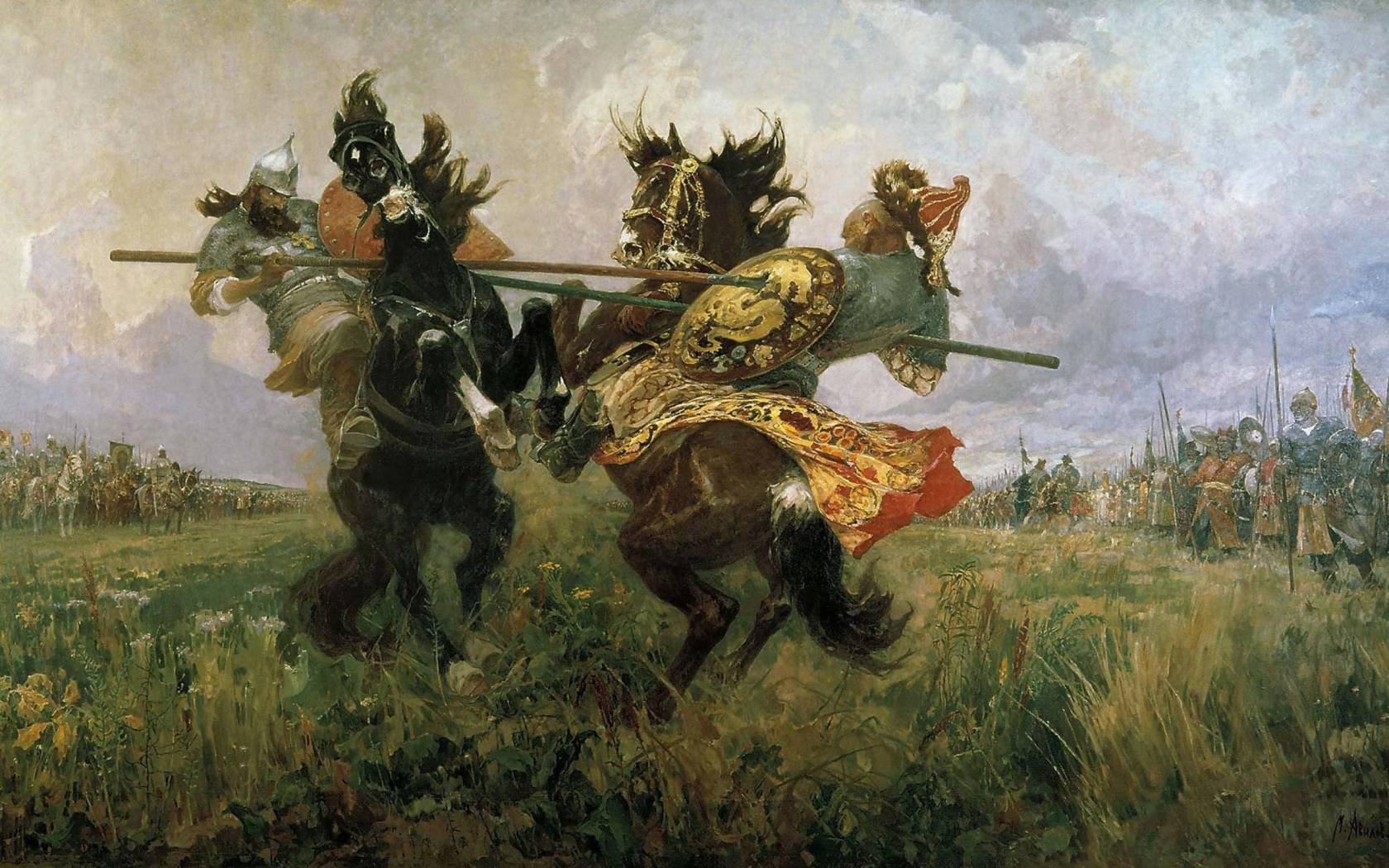
The Qipchaq Khanate, better known by its later name of the Golden Horde, instead had the nomads, quite literally, in the saddle. From their capital/encampment at Sarai in the Caspian steppes on the lower Volga (about 100km north of Astrakhan), its khans were able to maintain a tight tributary grip on the Rus’ principalities of the forested zone from the mid 13th to the late 14th century, although it was not until a hundred years later, in 1480, that the principality of Moscow stopped paying tribute altogether and formally rid itself of the last elements of ‘Tatar’ suzerainty. As late as 1571 the Crimean khanate, the Golden Horde’s principal successor, was able to burn the suburbs of Moscow, and even in the late 17th century the majority of Muscovite cavalry regiments were still armed with bows rather than carbines or pistols, as the former were needed to counter their steppe nomadic foes.
If the appeal and effectiveness of nomadic military skill in the sedentary world are clear, it has proved more difficult to demonstrate the political and administrative impact of the steppe on the sown, which is Khodarkovsky’s main goal in this book. This is in part because the great majority of our written sources on nomads come from their sedentary neighbours, and these are often keen to emphasise an absolute division between settled civilisation and restless, mobile barbarism. The most obvious case would indeed appear to be the Rus’, whose quarrelling early medieval princedoms emerged from two centuries as tributaries to the Golden Horde in a significantly more unified state. They were now ruled from the previously unimportant settlement of Moscow, which had achieved its eventual prominence through conspicuous loyalty to the Khan and the prompt payment of tribute.
Historians have, however, largely discarded the legend of the ‘Tatar Yoke’ and the notion that Russia’s autocratic traditions were of Mongol origin. In Chinggisid successor states, khanal authority was constrained by the collective power of a wider aristocratic elite, something which, if it had ever existed in Muscovy, was destroyed during the reign of Ivan the Terrible when the power of the boyars was broken.
The extent to which Muscovy really was beholden to Mongol culture and statecraft has been the subject of a lively and learned debate between Donald Ostrowski and Charles Halperin. Byzantium exercised a powerful counter-attraction to steppe traditions, and Orthodox Christianity remained the most important ideological foundation for Muscovite Tsardom. Nevertheless, there is a degree of consensus that in some spheres – notably taxation – Muscovy owed a good deal to its former Mongol masters: to this day, Russian fiscal vocabulary is replete with Mongol or Turkic words – kazna (treasury), iasak (tribute) and, most fundamentally, den’gi (money).
The sophisticated bureaucracies of China and the Islamic world, on the other hand, had little to learn about taxation or any other aspect of administration from their nomadic neighbours. What they did draw from the steppe were military traditions and tactics – in Persian and Urdu, Turkic vocabulary relates almost exclusively to weapons, warfare and horses – and above all ideas of universal monarchy. Central Asia was a region that produced far more dynastic charisma than could be consumed locally, most obviously in the case of Chinggis Khan, Timur and their descendants.
The fact that by the mid 17th century the Ottoman Empire, Safavid Iran, Mughal India and Qing China were all ruled by dynasties whose real or imagined descent lay in Inner Asia and the Turkic world has, of course, been remarked on and analysed before by historians. Joseph Fletcher memorably coined the term ‘bloody tanistry’ to describe the Chinggisid-inflected resolution of succession disputes through fratricidal murder in the Ottoman Empire. The Timurid legacy can be found not just in India, but in the Safavid and Ottoman adoption of the Timurid astrological title of Sahib-qiran, or ‘Lord of the auspicious conjunction’. Victor Lieberman’s monumental Strange Parallels pays particularly close attention to the role which Inner Asian political traditions and dynastic charisma played in integrating China and South Asia under the rule of the Qing and the Mughals.
Much of this literature is quite dense and specialised – the second volume alone of Lieberman’s book is 947 pages long – and Khodarkovsky’s work provides a more accessible account of this pattern. As he makes clear, Russia is an exception to this Inner Asian dynastic roll-call, as neither the Rurikids nor the Romanovs who replaced them made any direct claim to Chinggisid heritage, though a converted Tatar nobleman of Chinggisid descent, Simeon Bekbulatovich, did nominally reign in Moscow during the dark years of Ivan the Terrible’s Oprichnina.
If the debate over Chinggisid and Timurid dynastic legacies is now largely of historical interest, Khodarkovsky does not shy away from historical controversies with significant contemporary resonance. One of these is what we might call the ‘colonialism controversy’. His second book on the Russian steppe frontier was subtitled ‘the making of a colonial empire’, a description that earned him considerable hostility in Russia (often compounded by being mistaken for his oligarchical near-namesake, Mikhail Khodorkovsky). Khodarkovsky returns to that theme in the conclusion to this book, where he writes that both the Russian and Chinese empires could (and still can) be described as colonial. What Khodarkovsky means by this is that both observed a colonial rule of difference – specific forms of administration for subject populations, defined by ethnicity, which gave them fewer rights than members of the empire’s titular nationality, and cultural hierarchies which placed the latter at the top. I would broadly agree with this, with the caveat that Imperial Russia’s ruling elite was Christian and European rather than ethnically Russian – Baltic Germans, Poles and Georgians were all over-represented within it – while in Qing China Manchus and Mongols were privileged over Han Chinese.
There are some other important qualifications to consider in the Chinese case. Although the sheer ruthlessness with which the Zunghars were eliminated and then replaced with Han Chinese settlers after 1759 is certainly reminiscent of contemporary European colonial practice, Tibet was an indirectly ruled protectorate under the local control of the Dalai Lama, while Xinjiang only really emerged as a colonial domain following its reconquest in the 1870s, well after the period Khodarkovsky is covering in this book. Qing rule may have been unequal, yet by comparison with the ruthless repression and cultural erasure that Tibetans and Uyghurs suffer at the hands of the CCP today, it was relatively benign.
On the Russian side, Foreign Minister Sergei Lavrov’s claim in 2022 that Russia was ‘unstained by the bloody crimes of colonialism’ – an attempt to appeal to African countries in the wake of Russia’s full-scale invasion of Ukraine – reflects an allergy to the idea of Russia as a colonial power which only developed in Soviet times. Although Khodarkovsky writes that officials in Imperial Russia also denied the existence of Russian colonialism, here I would disagree. The language of colonialism was used freely in the late Tsarist period to describe policies and rule in the Caucasus, Central Asia, Siberia and the Far East. G.V. Glinka, head of the state resettlement administration charged with moving Slavic peasants from European Russia to supposedly empty (but in fact occupied) lands in Siberia and Central Asia, wrote in 1914 that ‘The lands of Asiatic Russia are an indivisible and inseparable part of our state, and at the same time our only colony.’ The house journal of his organisation was called Voprosy Kolonizatsii (‘Questions of Colonisation’). Russia was a founding member of the International Colonial Institute in Brussels. Far from being something to deny, having colonies was a marker of Russia’s status as a gold card member of the European Great Power club.
Khodarkovsky eschews the colonial label for the Islamic Eurasian empires, and here I think he is right – their hierarchies were not determined by ethnicity, and it is impossible to identify a ruling nationality or a body of obviously colonial subjects in the Ottoman, Safavid or Mughal Empires in this period, though in the Ottoman case this would change in the last half-century or so of the empire’s existence. They were much more purely dynastic polities, where elite membership could be secured through religious conversion and fluency in the imperial language. Ottoman viziers were more likely to be of Balkan Slavic or Albanian than of Turkish origin, while the Safavids were served by Georgian slave elites and the Mughals by Rajputs and other high-caste Hindus.
Another clear, and somewhat striking, distinction that Khodarkovsky finds in the three Islamic Eurasian empires is the far greater role that was played by law. Russian and Chinese autocratic power were basically unconstrained by any system of law, which was little more than a synonym for the ruler’s will and a collection of imperial edicts – there was no independent judiciary or private legal profession in either empire before the second half of the 19th century. By contrast, law in the Islamic world, while certainly not wholly independent of the power of the state, constituted an institutional and intellectual field of its own. A series of authoritative jurisprudential texts, the interpretative role of judges and an accumulation of legal precedent offered a counterweight to the power of the ruler.
As this suggests, a common experience of cultural and political interaction with the steppe did not necessarily produce common patterns of governance or political ideology among its neighbours, and this is perhaps the most important conclusion the reader can draw from Khodarkovsky’s thought-provoking book.
Alexander Morrison


More from Russia

The ‘madness’ of Valeriya Novodvorskaya

The Kremlin’s problem with plague is nothing new

The absurd theatre of Russia’s choice-free election

Tennis and the decline of Russian soft power


