The triumph of the trad wives
- November 6, 2026
- Zoe Strimpel
The most accomplished ‘trad wives’ are entertainers with a shrewd sense of the market.
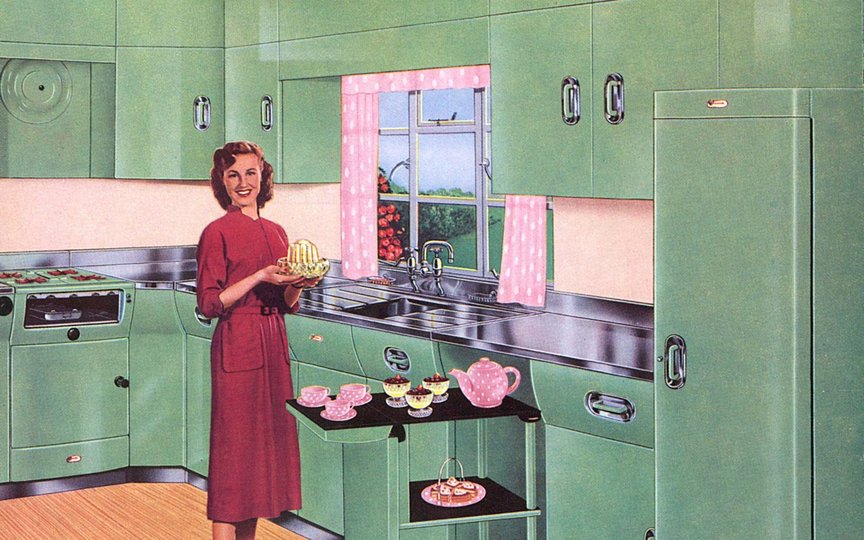
Does spending most of your day in an anglospherical kitchen cooking to order for your oft-invoked family and husband make you a ‘trad wife’? When that life is accompanied by a commitment to Jesus and a belief in women’s inherently subservient and home-bound role, then the answer may be yes.
But the ‘trad wife’ is an archetype that emerged from the fevered imagination of the Maga-adjacent manosphere in the late 2010s before being associated with, and sold by, actual women. Through its merger with those actual women, the true definition crystallised: the most accomplished ‘trad wives’, however much they support the idea of a gendered division of labour, are entertainers with a shrewd sense of the market.
This requires dispensing with modesty in any ‘traditional’ sense. If you’re an American ‘trad wife’, you are expected to be molten hot in your maternity and domesticity. See, for instance, top Maga wives and mothers: while heavily pregnant earlier this year, the ex-White House press secretary Karoline Leavitt and prominent insider Katie Miller, the wife of White House deputy chief of staff Stephen Miller, dressed in exceedingly sexy figure-hugging garb. Miller posted a pro-natalist picture of herself on X with jeans unbuttoned low, bump looming over just-out-of-sight pubis. Even reticent Second Lady Usha Vance, very pregnant with her fourth this summer, wore demure but sexily clingy bump-showing dresses.
By contrast, a traditional wife, rather than a ‘trad wife’, might well be wasting away from depression, drinking and taking pills to numb the pain of wasted talent, boredom and subjugation. This, certainly, was what Betty Friedan found in her study of American suburban homemakers, The Feminine Mystique, published in 1963. Modern housewifery isn’t much better. A major, oft-cited 2012 Gallup poll of more than 60,000 US women found that 28 per cent of stay-at-home mothers said they had been diagnosed with depression, compared with 17 per cent of working mothers.
Of course, escaping the dullness or desperation of life through sharing it with the world is a well-established rationale for content creators. Social media has been a lifeline for many a drudge trapped at home. But that’s not the ‘trad wife’ story. Theirs is of the perfectly ordered domestic vista, with the woman at the matrimonially satisfied centre of it all. Money and health – not misery – sparkle from every marble countertop.
This is because the life of a ‘trad wife’ is lucrative and empowered, a kind of Lean In of the kitchen. Certainly, it is often one of strict and disciplined entrepreneurial commerce. These dreamy homemakers shoot their own video and become very skilled editors, releasing videos, each taking eight or more hours of work, that sometimes win them millions of followers and billions of views ‘across platforms’ (TikTok, Instagram and YouTube). Brand collaborations, not just with food but also with beauty and fashion brands, often run to over $10,000 per video.
The case of the model Nara Aziza Smith, 25, whose first cookbook Homemade was released earlier this month in the UK, is an intriguing one. Along with Hannah Neeleman, the Juilliard-trained, sinewy blonde mother of nine who runs the Ballerina Farm account from her ranch in Utah (21 million followers between Instagram and TikTok), Smith is often labelled a ‘trad wife’.
On one level, this is an obvious categorisation. Born in South Africa to a German father and South African mother, raised in Germany and now living in the US, she is the beautiful, sinuous queen of her kitchen, which is light-filled and marble-topped, kitted out with chic yet homely ware of fibrous wood and glass. She already has four children. She is married to the model Lucky Blue Smith in a love story for the ages. She cooks in couture. She uses a demure voiceover for her videos to give viewers a feeling of relaxation.
Smith likes to make things from scratch, as she – in common with her kind – takes very seriously her exclusive role in nourishing her family. (Consumers of women’s food content like me can get very sick of invocations of ‘what I feed my family’ – it’s both ostensibly apolitical and, through repetition and smugness, pure conservative family values.) In keeping with the delicacy of her generation, Smith also has an autoimmune disease, lupus. Stripping her food of all additives is vital for her skin and wellbeing, she says.
But Smith has roundly rejected both the ‘trad wife’ and ‘ex-trad wife’ labels. Instead, she openly, and admirably, pushes a much more neo-liberal vision. I went along last week to the Union Chapel in north London, where Smith was in conversation with the British TV presenter Rochelle Humes. Smith said: ‘Whatever you want to do, I want women and people to feel empowered to do that.’ That might mean ‘working all hours’ or staying home as ‘one of the most admirable jobs there is [being at home and] raising the next generation’. In short, ‘you do you’.
But Smith’s version of ‘doing’ herself is more sophisticated than one might assume. She has much in common with an artist. Talking of her recent attempt at recreating Skittles at home: ‘It took me eight hours to make 16 Skittles and they were gone in like three seconds.’ Why do it then? ‘It’s just fun.’ Fun in this case includes working with the likes of bloomed gelatin and citric acid; she’s not afraid of complex chemistry in pursuit of the vision.
She mentions ‘curiosity’ as driving her remaking of things like chewing gum and Coca-Cola from scratch. ‘I find joy in beautifully made things,’ she writes of her radical approach to fashion, in and out of the kitchen, in the surprisingly articulate, even intellectual introduction to Homemade. ‘Clothes can… [give] you freedom to change your identity… Maybe I’ll knead dough in a glamorous gown the colour of cherry blossoms. Why not whip up pancakes in a feathered robe, like a madcap 1920s actress?’
It is the artist, not the cowering traditionalist, who dresses in corsets and feathers to bake bread because ‘it fills my day with whimsy and helps me tell a story’.
Smith’s earnings – or at least the most reliable estimates of them – are entirely in keeping with those of a successful ‘trad wife’. Forbes put her at $9 million on its 2025 Top Creators list and $7.5 million on the 2026 list. Estimates of per-post endorsement fees for influencers of her stature are $18,800-$62,500. She advertises beauty and fashion: Hourglass and Charlotte Tilbury make-up; Marc Jacobs and Chanel; Aveeno skincare; and the electrolyte drink mix Liquid I.V.
She far outearns, and outdazzles, her once better-known husband. She cannot be in any true sense a ‘traditional wife’ – at least not the sort imagined by the angry men of the alt-right internet – but in her mobilisation and marketisation of her arch-feminine attributes, from childbearing to the perfect figure to love of plunging couture necklines, she embodies the commercial and creative spirit of the label to a tee.
Zoe Strimpel


More from Economics

The wrong prescription for liberal democracy’s ills

The case for climate realism in an age of soaring energy demand

Judging leadership is not a science

Did globalisation cause the First World War?