Putin loses his Balkan Trojan horse
- November 3, 2026
- Hannah Lucinda Smith
- Themes: Democracy, Europe, Geopolitics, Russia
With Russia’s influence over Serbia and Hungary on the decline, the Kremlin may be turning to more drastic methods to threaten Europe’s eastern flank.
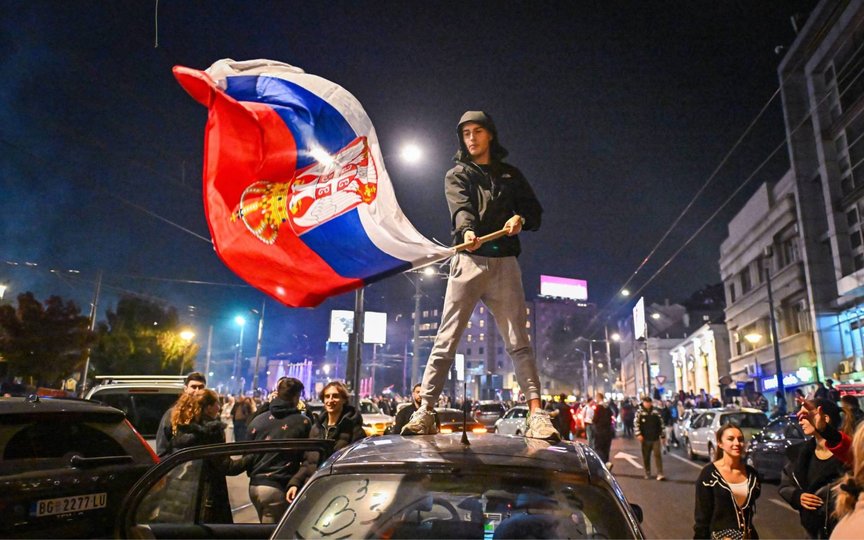
For a decade, Vladimir Putin’s reach in the Balkans has been tangible on the streets of Belgrade. The St Sava Orthodox temple, which towers over the city on the Vračar Hill, looks ancient but was finished only in 2020, its vast interior mosaics paid for by Gazprom. The Russian state propaganda outlets Sputnik and RT have Serbian branches, but most of the local media also broadcast the Kremlin’s line. Since the invasion of Ukraine there have been pro-Russian marches in which Serbian participants held images of Putin aloft – despite Belgrade also being a hub for Russian dissidents.
All of this was possible because of Aleksandar Vučić, who came to power as Serbia’s prime minister in 2014 and was president from 2017 until September 2026, when he stood down to run for prime minister again – only to be voted out in the recent election. Vučić, who was Slobodan Milošević’s ultra-nationalist minister of information during the Yugoslav Wars, briefly recast himself as a liberal democrat before slipping back towards autocracy once he was in power. He was also the conduit through which Putin opened up a front against Europe in the Balkans, the most combustible corner of the continent.
By playing on Russia’s deep historical and religious links with the Serbs, Putin has exploited ethnic tensions in the region, steering post-Yugoslav countries away from the West and reigniting disputes that could easily tip into conflict. Serbia is an EU candidate country, yet even as Brussels poured billions of euros of pre-accession funding into Belgrade, Vučić allowed both Russia and China to build influence there through infrastructure and trade, Covid vaccine diplomacy and weapons deals. Russia is also believed to have built a large intelligence capability in Serbia on Vučić’s watch, which it used to train operatives to stir up unrest around elections in Moldova.
From Serbia, Putin projected his influence out into other corners of the Balkans with ethnic Serb populations. In multi-ethnic Bosnia, where the wounds of the war that raged between 1992 and 1995 are still raw, he patronised the Bosnian Serb leader Milorad Dodik, who has repeatedly threatened to hold a unilateral independence referendum in the semi-autonomous Republika Srpska region, which would upend the Dayton Peace Accords. In 2015, Russia vetoed a UN Security Council resolution to recognise as a genocide the slaughter of more than 8,000 Muslim men and boys by Bosnian Serb forces in the town of Srebrenica in 1995; in 2018, the Republika Srpska also reneged on its recognition. As in Serbia, Moscow has funded the building of Orthodox churches in the territory, not to serve the spiritual needs of the population, but as a sign of Russian alliance.
In Kosovo, where there is also a Serb minority, Putin has pulled similar levers. In 2019, on the anniversary of NATO’s bombing of Yugoslavia during the Kosovo War, the Kremlin released a statement falsely claiming that the attack was a cover for the ethnic cleansing of Serb populations. In fact, the strike was launched to halt the massacre and expulsion of Kosovar Albanians by Milošević’s forces. Russia is believed to have been involved in a spate of unrest at Kosovo’s border with Serbia in 2022, and to have launched cyber attacks on Kosovan government websites.
Playing on the Balkans’ ethnic fault lines and the lingering resentments from the wars of the 1990s was a low-cost and low-stakes way for Putin to wage hybrid war within Europe. His relationship with Vučić was key to that. In Hungary, he similarly used the former prime minister Viktor Orbán as a Trojan horse within the EU. While he was in office, Orbán took loans from Moscow and blocked an aid package to Ukraine, as well as dragging Hungary down its own illiberal path.
The defeats at the ballot box of Orbán in April, and now Vučić, have stripped Putin of some of his most potent weapons. Russia has been waging war against Europe not only with drone and missile strikes, but also through hybrid tactics, including by co-opting leaders and populations on the continent with the aim of undermining European institutions. The new governments in Hungary and Serbia will almost certainly deprive him of the access he has previously enjoyed in their countries, while under rules proposed by the European Commission last month, new member states will be subjected to a 15-year probation period in order to neutralise the damage that any backsliding leader like Orbán could cause to the bloc as a whole.
Putin’s influence is also waning elsewhere. Turkey’s President Erdoğan, whose close relationship with Putin similarly caused years of problems within NATO, has recently become more pro-Western in his foreign policy, even though he has grown even more autocratic at home. In the Caucasus, Putin has squandered Russia’s influence in Armenia by allowing the territory of Nagorno-Karabakh to fall to Azerbaijan in 2023, and the EU has positioned itself as an alternative partner for Yerevan.
While these developments are positive for Europe, they do, however, raise a dangerous possibility: that Putin may revert to more conventional types of warfare to make up for the hybrid weapons he has lost. Already, there has been a rise in attacks outside Ukraine. In October, the Financial Times declared the Black Sea the world’s most dangerous shipping route: more seafarers have been killed there this year than in the Strait of Hormuz, and attacks on vessels rose fivefold in July to September compared with the previous three months. On average, more than four ships were attacked each day, with Russia accounting for around 90 per cent of those strikes in the past month and a half. Some of the attacks have occurred inside Bulgaria’s exclusive economic zone. Over the past month Poland has also blamed Russian intelligence for an arson attack on a Starlink ground station, there have been drone and missile incursions into Moldovan territory, and what appeared to be an organised attempt to push migrants into Latvia from Belarus.
While Putin’s soft power is declining in Europe and around its fractious edges, his willingness to use hard force appears to be rising. The celebrations in Belgrade and Budapest may signal the start of a more dangerous phase in this war.
Hannah Lucinda Smith


More from Europe

The consumer-voter is killing German politics

Moscow is watching Latvia. Is Washington?

Britain and Germany: Europe’s original special relationship

Germany must relearn the language of power-politics


