The rehabilitation of Livia, Augustan Rome’s first lady
- November 3, 2026
- Daisy Dunn
- Themes: Ancient History, Books, Classics, History, Rome
Caitlin C. Gillespie’s new biography of Livia liberates this formidable woman from ancient and modern caricature.
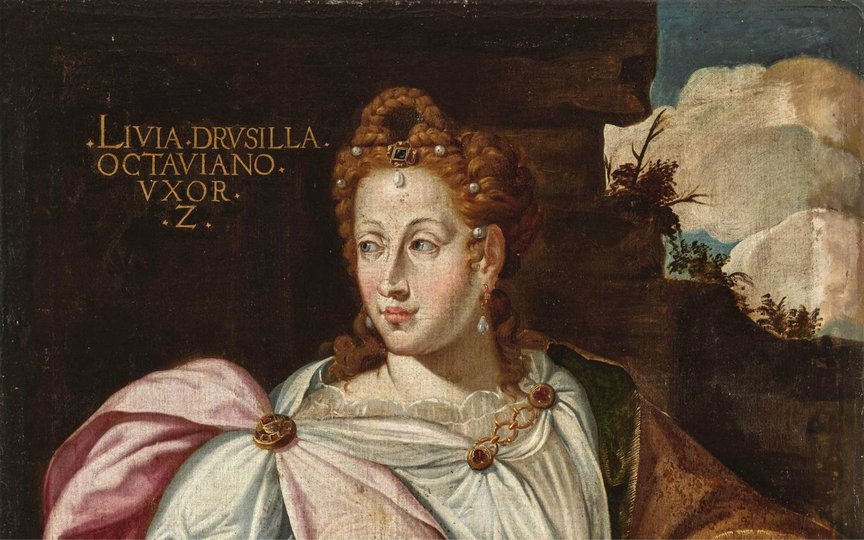
Livia: Mother of Rome, Caitlin C. Gillespie, Yale University Press, £20
What can one say of a man who loses his wife to a love rival, willingly attends their wedding and assumes custody of the two young boys they had planned to raise together? Today, he’d sooner be hailed a magnanimous hero than a hamstrung cuckold, but in first-century BC Rome? It is harder to say. As for his ex-wife, Livia Drusilla, she might just as well be described as an iron-hearted opportunist as a victim of coercion.
For many people, Livia is best remembered through Siân Phillips’ acidic performance in the 1976 BBC adaptation of Robert Graves’ I, Claudius. Manipulative, merciless, spiteful, Phillips’ Livia was even darker than that of Cassius Dio, the second-century historian who provided the claim that she murdered her second husband, the ageing emperor Augustus, with poisoned figs. Caitlin C. Gillespie, an assistant professor at Brandeis University, Massachusetts, promises ‘a more sympathetic’ portrait in her biography of the Roman matriarch, but pays tribute to Phillips in her acknowledgements all the same.
While the BBC gave us Livia in her forties, and Tacitus began his account with her in her early seventies, Gillespie dedicates a substantial proportion of her short book to Livia’s youth. This proves instructive in helping us to understand how Livia became the tough woman she undoubtedly was.
Livia’s teenage years were heavily shaped by the assassination of Julius Caesar in 44 BC. Having pledged their allegiance to Caesar’s assassins, both Livia’s father and new husband, Tiberius Claudius Nero, found themselves in a difficult corner. While the former committed suicide following the defeat of Brutus and Cassius at Philippi, the latter allied himself with Mark Antony, only to come unstuck again. A loss on Antony’s side led Tiberius Claudius Nero to go on the run with the young Livia and their baby son Tiberius to Praeneste, then Naples, then Sicily, then to Antony in the east and finally to Sparta. In the course of their flight, they were caught up in a fire, which singed Livia’s hair and clothes. By the time it was safe enough to return to Rome, Livia was pregnant with her second son, and her husband was practically bankrupt. Much of the property Livia had stood to inherit from her father had also been seized.
It was at this point that the man aspiring to govern the state – the enemy the young family had fled – made his move. Tacitus’ description of the future Emperor Augustus’ romantic obsession with the heavily pregnant Livia is notably at odds with his characterisation of Augustus as an older man. Still, lust – and the desire to benefit from her Claudian name – may well have propelled him to make the unlikely match. Tacitus was uncertain whether Livia entered the agreement gladly or not, but with Tiberius Claudius Nero’s career in freefall, she might have ‘grabbed’ the opportunity, as Gillespie puts it.
The quick succession of events was extraordinary even for the time. Livia gave birth to her first husband’s second son, Drusus, on 14 January 38 BC. Three days later, she married Octavian, as Augustus was then known, and less than two weeks after that, she turned 21.
The loss of custody of her children was the price paid by any Roman woman who went through a divorce. That Livia endured it more stoically than some is credible, given the strength she later showed at Drusus’ early death following a riding accident. According to Seneca, Livia ceased mourning her son the moment he was interred. For this, he praised her, noting that she had taken counsel in her grief from a wise philosopher. Modern readers may take a less sympathetic view.
When it comes to Livia’s toughness, the evidence speaks for itself. Gillespie valiantly retraces her many travels with her husband throughout the provinces and client states of the Roman Empire, including grand tours of Sicily and Greece, Asia Minor and Judaea, and perhaps Gaul. The couple were often away from Rome for years at a time. The schedule of goodwill meetings, unveilings of statues, dedications at religious monuments, and conferences with foreign dignitaries – including Herod the Great and his sister Salome, with whom they got along famously – would be familiar to a modern royal family. To survive so many journeys in the Roman era required both robustness and luck.
Livia’s strength was not wholly innate. One of the most surprising and rewarding aspects of Gillespie’s book is its focus on Livia’s health regimes. Gillespie mines the evidence from the garden wall paintings from Livia’s splendid villa at Prima Porta, as well as the Natural History of Pliny the Elder and texts of Columella, to present Livia as a keen plantswoman and grower of medicinal herbs. The first lady concocted recipes for throat mixture and a remedy for nervous pain and winter chills, drank only a certain kind of wine from Trieste, and ate a lot of elecampane herb in her salad. She lived to the age of 86.
Gillespie writes precisely and well, though the occasional phrase may irritate. We read that Livia ‘had no job description’; that ‘there was no business school to teach her how to deal with people or money’; and that ‘even the wife of the emperor deserved a day for self-care’. Particularly impressive is her ability to make sense of some of the more obscure aspects of Livia’s ancient biography. She renders convincing, for example, Cassius Dio’s description of Livia’s use of her sexual propriety as a tool for self-advancement. She also treads a careful line between apologist and revisionist, even if she cannot rescue her subject entirely from the accusations levelled against her; it is surprising to find Gillespie endorsing the label of ‘rather pushy wife’.
Gillespie fulfils her promise to portray Livia as ‘a bold innovator who refused to be controlled by the men around her’. By presenting her as the heir of the most politically active women of the Late Republic – Fulvia, Servilia and her own ancestor Clodia Metelli among them – Gillespie liberates her from the status of an unlikely anomaly and caricature to make her a credible natural leader. A diplomat who campaigned for the freedom of Samos, a signer of official documents, ‘a strict headmistress’ who raised the children of many elite families at the imperial residence, Livia was many things besides the wife of the first emperor and the mother of the second. She was, for all her flintiness, something of a marvel.
Daisy Dunn
More from Ancient History

Aristotle: a biography without a life

Republics fall when they forget the past

Slavery was the air the Romans breathed

Athens and Sparta’s epic struggle for supremacy