Miyazaki’s Swiftian skies
- November 13, 2026
- Christopher Harding
Jonathan Swift used Japan as a vehicle for anti-Dutch polemic. More than two centuries later, his fantasies helped to kickstart the early career of the animator Hayao Miyazaki.
Of all the exotic destinations in Jonathan Swift’s Gulliver’s Travels, only one is a real country: Japan. He records an audience with the Emperor in Edo, in May 1709, and then an onward journey to ‘Nangasac’ – Nagasaki – where the Dutch had a trading base at Dejima. Gulliver’s time in Japan was brief, and seems mainly to have been a means for Swift to express a little English distaste for the Dutch. Ever since Portuguese and Spanish traders and missionaries had been ejected from Japan at least 70 years before, the Dutch had been the only Europeans with whom the Japanese were prepared to trade. In many an Englishman’s imaginings, this privilege had been purchased at the cost of the Dutch soul. It was said that they were prepared even to perform the notorious fumi-e: stepping on a Christian image, to prove their repudiation of the faith.
None of this was entirely accurate or fair. Edo was home to the shogun rather than the Emperor – Swift was inheriting here a convention used by other European commentators. Nor were Dutch merchants usually required to perform the fumi-e. They couldn’t preach Christianity, and their ships were checked for biblical contraband. But the craven ‘Hollanders’ of Gulliver’s acquaintance are obviously a caricature, their performance of the fumi-e appearing to nag at their consciences, leading them to pepper Gulliver with questions about whether he has done the same. As if to underscore the point, some of Gulliver’s Dutch interlocutors at Nagasaki turn out to belong to a ship called the Amboyna. English readers would have bristled at that name, taken from an island where around 20 men – including ten men of the English East India Company – had been killed by Dutch East India Company agents back in 1623.
Swift had drawn on Japan for some anti-Dutch polemic; more than two centuries later, his fantasy helped to kickstart the early career of one of the country’s greatest animators: Hayao Miyazaki. His first job in 1963 was at Toei Animation, a studio whose aim was to become the ‘Disney of the East’. Miyazaki began as an in-betweener: drawing the linking frames between key moments, on which it was not worth senior animators spending their time. Two years in, he worked on a film called Garibā no Uchū Ryokō: literally ‘Gulliver’s Space Travels’, but later released in English as Gulliver’s Travels Beyond the Moon. The film portrays Gulliver as an old man, who travels to the Planet of Blue Hope only to find that it has been overrun by robots. The young Miyazaki somehow mustered up the courage to tell the film’s director that its ending, in which good robots are rescued from bad ones, needed to be changed. What if, Miyazaki suggested, the ‘robots’ turn out to be human beings trapped in metal shells?
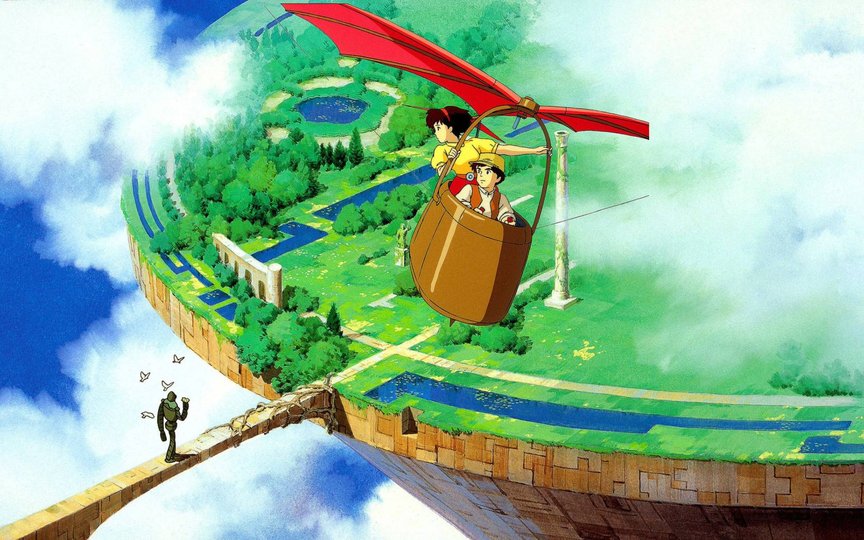
The change was duly made, launching Miyazaki on a career in which a guiding theme would be the entrapment of human beings by machinery. Humanity’s predicament, in Miyazaki’s work, often reveals itself in the form of terror from the skies. In Nausicaä of the Valley of the Wind (1984), an advanced military power sends huge, soulless aircraft against a thriving, peaceful people. After the film did well enough to warrant the creation of Studio Ghibli, the new organisation’s first production, in 1986, featured an island floating in the sky. By his own account, Miyazaki was never a deep reader of Swift. His initial idea for the film was a flying Treasure Island. But in the end, he chose the name Laputa – and the film proved to be a more-than-worthy extension of Swift’s original idea.
The Laputa to which Gulliver is hauled up on a chain is full of people so abandoned to abstraction, so absorbed in their mathematics, music and astronomy, that servants must hit them with bladders before they are able to listen or speak. This, for Swift, was England lording it over Ireland. It was the infectious folly of rulers who give themselves over to pointless and eccentric theorising: many of the theories that Gulliver encounters on Laputa and in the kingdom beneath were based on real papers published by the Royal Society, led in Swift’s day by Sir Isaac Newton.
Miyazaki’s Laputa is more nuanced. Both islands have the potential to rain ruin on people below: in Miyazaki’s film, the island has at its core a formidable ancient weapon. And yet Studio Ghibli fans will recall Laputa in terms of some of the most beautiful, enchanting drawing that Miyazaki has ever done: old ruins lusciously overgrown, full of birds, fox-squirrels and flowers. Nor do machines turn out to be all bad, hell-bent on humanity’s destruction. Miyazaki rarely deals in heroes and villains, preferring to think in terms of balance and connection. The source of Laputa’s trouble is people becoming unmoored from nature and its cycles, trying to fashion something wholly new rather than living within the rhythms of what they have been given.
Wales in the era of the miners’ strike was as much an influence on the film as Swift: the hero Pazu’s mining town, and the solidarity of its people, owe a good deal to what Miyazaki saw in the valleys when he visited in 1984. Among the film’s minor but most memorable characters is Uncle Pom, an old miner who lives among glowing stones underground. He warns that the crystal the film’s heroine Sheeta wears – made from the same stone that keeps Laputa aloft – belongs to the soil it came from. Later, Sheeta recalls a song from her mountain home: put down roots in the earth, live with the wind, sow seeds in winter, celebrate the spring with the birds.
What did Japanese audiences make of the literary connection to Swift? Probably quite little. He and Gulliver’s Travels get a mention early on in Laputa, but in interviews Miyazaki tended to downplay any debt to the famous satirist. Audiences for Disney’s dub, Castle in the Sky, would not have known from the title alone that there was any connection at all. Someone at the company appears belatedly to have realised that it was a bad idea to release a film called ‘Laputa’ in the United States, where 10 per cent of the population spoke Spanish at home. They were likely to be confused, or possibly insulted, by an animation called ‘the whore’ (la puta). There also appeared to be doubts at Disney about the likely western market for Miyazaki’s fable. Its dubbed version, featuring Mark Hamill as part of the voice cast, was recorded in 1998. But it was only after Miyazaki’s Spirited Away became the first Japanese animation to win the Best Animated Feature Oscar in the spring of 2003 that Castle in the Sky was finally released on DVD.
Laputa is now firmly established as one of Miyazaki’s great works, backed by a classic soundtrack from Joe Hisaishi. It seems remarkable that the connection between Gulliver’s Travels and Japan grew from such modest beginnings – Japan a passing thought for Swift, much as Miyazaki claims that Swift was for him – to produce what feels like a fleshed-out modern take on one of Swift’s most pressing concerns. For both Swift and Miyazaki, power that floats free of the ground cannot last – indeed, should not be allowed to last. The two men differ only in how this problem can be resolved. For Swift, the answer was rebellion of the low against the high. For Miyazaki, it was renunciation and a characteristic faith in nature to hold everything together. The island in the sky is saved, in the end, by a giant tree enfolding all in its roots.


