All of France was in Limoges’s town hall
- October 22, 2026
- Muriel Zagha
The arson attack on Limoges’s town hall destroyed centuries of history and damaged an inclusive vision of the Republic. Whether France defends it is a question for the future.
Arson is all the rage in France. Since a teachers’ and pupils’ strike which began on 21 September at a lycée in the Paris suburb of Créteil spiralled into nationwide student protests, workers, unions and gilets jaunes have joined the demonstrations, with each group bringing their own grievances. But distressing images of chaos and destruction have also been relayed by the media, showing gangs intent on violent rioting, looting and vandalism all over France. Lime bikes, wheelie bins and cars have all been set on fire, and so have buildings, from the recently built lycée Nelson Mandela in Nantes to the 19th-century pavilion that housed the tourist office in Lyon.
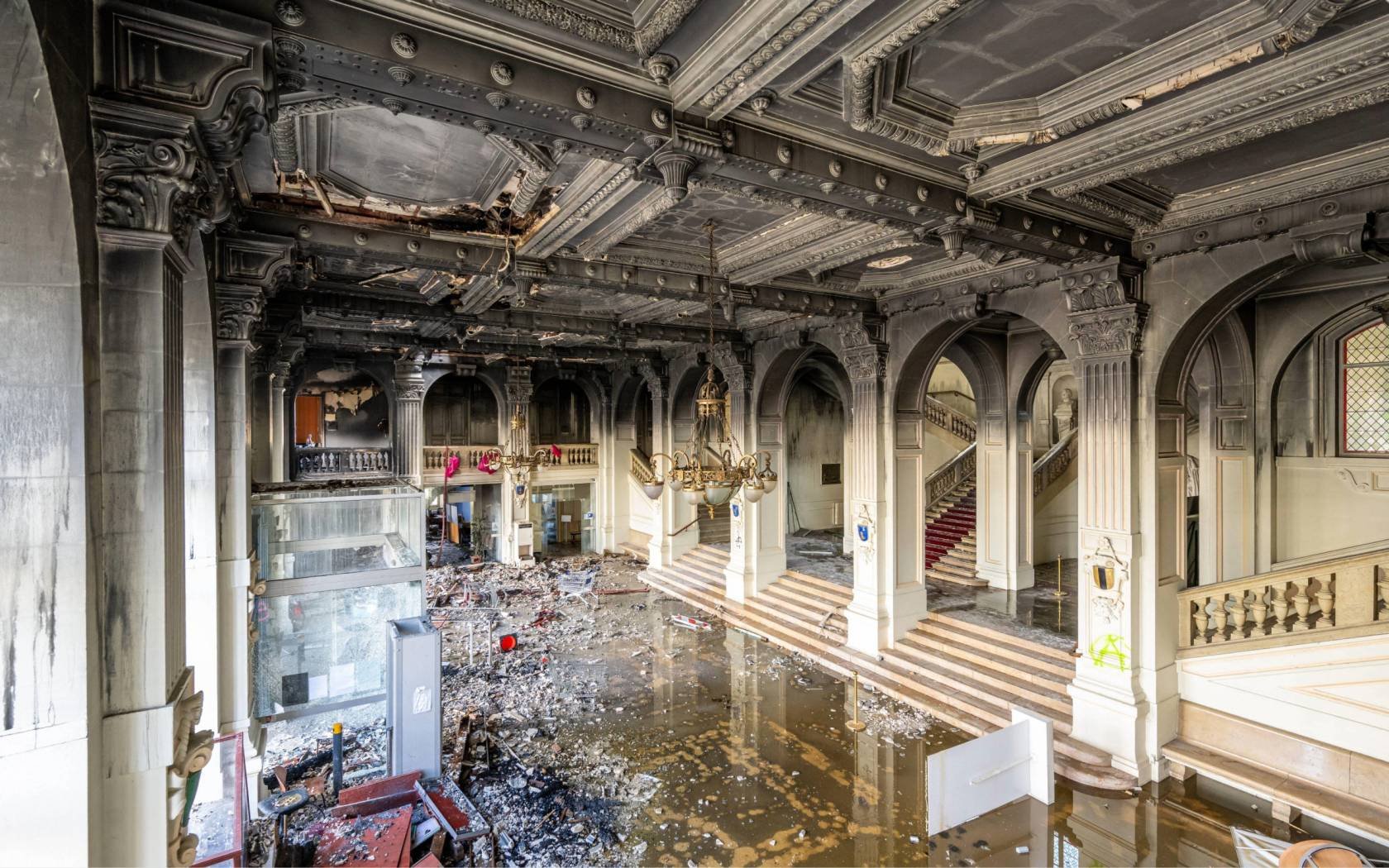
On 17 October, a day of co-ordinated nationwide protest, there was another fire, this time engulfing the monumental Hôtel de Ville (town hall) of Limoges. The images caused widespread astonishment and consternation. In part, they resurrected memories of the fire that ravaged Notre-Dame in Paris in 2019. The collapse of the Limoges town hall campanile, the emblem of the town, echoed the dramatic collapse of the spire of Notre-Dame. The French reaction to the catastrophe that befell the Parisian cathedral reminded us that France, a secular Republic born of a violent revolution, has remained culturally Catholic and deeply attached to her historical and architectural patrimoine, a word that encompasses all cultural and historical legacy, both material and immaterial.
The images of the ravaged Limoges town hall took the focus away from Paris, to a provincial town that – unlike Marseille, for example – is not associated with high levels of criminality. This made the event especially shocking. While the Limoges town hall is in some ways the opposite of a church – it is a secular Republican public building – the spectacle of its destruction cut as deeply into the sensibility of French onlookers as the images of Notre-Dame. In the aftermath of the incident, the mayor of Limoges, Guillaume Guérin, pointed out that the words ‘Vive la Commune!’ had been spray-painted on a wall of the town hall in reference to the 1871 Paris Commune – an uprising which is a familiar revolutionary reference on the left of French politics. What the attackers meant to damage and deface through its symbols, Guérin suggested, was the ‘beating heart’ of the town and the ‘face of the Republic’. ‘Our mairie,’ he said, ‘is more than a mere building: it is the common house.’
The town hall of Limoges, hollowed out by flames, is no less significant a French symbol than the monument in place de la République in Paris – a traditional gathering point for protests and celebrations alike. The monument, a bronze statue of Marianne, the female embodiment of the French Republic, standing on a stone pedestal adorned with allegories of Liberty, Equality and Fraternity, was the work of Léopold Morice and his brother Charles. It was extensively defaced by protesters, who graffitied it with slogans and splattered it with paint.
Both the Parisian monument to the Republic and the Limoges town hall were inaugurated in 1883, under the Third Republic, at the height of a period of intense nation building. In the 1880s some fundamental French institutions were forged by the state, most notably perhaps Jules Ferry’s vast programme of public instruction, starting with primary education for all, free, compulsory and laïque (secular). The Third Republic also invested massively in infrastructure and commissioned hundreds of public buildings – from primary schools and lycées to mairies and courts of law – designed to embody France’s new identity as a Republic and to give it the stamp of legitimacy and permanence.
This political will to transform the public space by expressing itself in stone did not create any specific ‘Republican style’ of French architecture. Rather, in their eclecticism, Republican public buildings of the 1880s are expressive of the 19th century’s fascination with and reverence for history. The Limoges town hall was conceived during the Belle Époque, before the flowering of the more fantastical expressions of Art Nouveau but at a time when style and ornamentation borrowed from the past were thought to ennoble the purpose of a public building and to promote civic pride.
The work of architect Charles-Alfred Leclerc, winner of the prestigious Grand Prix de Rome in 1868, is a case in point. Leclerc’s project was selected by a jury that had stipulated that the building would be ‘in a word, the people’s palace […] and ought to be worthy of [the people]’. Accordingly, it was built of granite and ashlar with tall slate roofs, in a neo-Renaissance style reminiscent of that of the Hôtel de Ville in Paris that inspired it.
The façade borrowed from the repertoire of classical ornamentation – columns and capitals, pillars and allegorical statues. On either side of the monumental clock, two reclining women, the work of sculptor Edme-Antony-Paul Noël, embodied the arts of enamelling and goldsmithing. References to local history were woven in with Republican elements that gave a sense of the building’s purpose: the face of Saint Martial, patron saint of Limoges, features on the town’s coat of arms above the clock, and below it is an ornate escutcheon containing the letters RF (for République française) framed by wheatsheaves. The façade was punctuated with four medallions of mosaic by the Venetian mosaicist Giandomenico Facchina, the likenesses of Limoges worthies whose lives spanned the history of the town from the Renaissance to the Monarchie de Juillet: the artist and enameller Léonard Limosin (c.1505–1575), the Chancellor of France Henri-François d’Aguesseau (1668–1751), the Revolutionary Girondin Pierre Victurnien Vergniaud (1753–1793) and Marshal Jean-Baptiste Jourdan (1762–1833).
Above the clock, a cartouche bore the name of the Lémovices, the tribe of Gauls who gave their name to Limoges and the region of Limousin. At the top of the building sat a Republican campanile, modelled on a church bell tower and housing a Republican bell.
Inside the building, in the vestibule, twelve pilasters bore enamelled porcelain medallions by the Haviland factory showing the coats of arms of the medieval guilds of Limoges. The allegorical subject matter of the paintings featured on the walls and ceilings of the state rooms on the piano nobile married national destiny and local history: a painting by Henri-Paul Motte celebrates Limousin becoming a part of the kingdom of France under Henri IV; another by Jean-Joseph Weerts represents the Spirit of Liberty granting their freedom to the towns of Limousin.
Why set fire to such a building? And should we mind? Some voices online dismissed the ‘pearl-clutching’ response to the damage done to mere ‘belleepoqueslop’. This might in turn prompt the reflection that it is a great blessing to live amid a wealth of such buildings, once conceived as radical statements of confident nationhood, power and permanence – so many that we can take such a backbone for granted. The town of Limoges has no particular history of sedition or unrest; in the shape of its town hall what was attacked was a symbol of the French Republic, in the same way that the monument to the Republic in Paris was defaced and a bust of Marianne vandalised in the Marseille town hall.
Alongside the grievances of students and workers and the workaday criminal agenda of the looters of designer goods, this is another dimension of the current unrest and, at a time when a core element of Republican values, the non-denominational framework of laïcité, is increasingly under threat, it ought to be taken seriously. In the aftermath of the fire that ravaged the Palais des Tuileries at the time of the Commune, reconstruction was recommended by the architects Hector-Martin Lefuel and Eugène-Emmanuel Viollet-le-Duc, but the French Parliament voted to destroy the ruins, thus erasing ‘un passé honni’, a hateful memory of the monarchy. Part of the palace does survive today, incorporated into the buildings that make up the Louvre Museum.
On the other hand, the Paris Hôtel de Ville, which had suffered the same fate, was rebuilt in 1874–82 because, being a part of the mechanism of the Republic, it was deemed more useful. Deciding what to do about the devastated Limoges town hall – and how best to safeguard civic architecture that belongs to all – will be a test of French political will.
Listen to Muriel on The EI Podcast.


