France’s long history of revolt
- October 23, 2026
- Julian Jackson
The French have often taken to the streets to force the state’s hand – but the difference today is that the state itself increasingly resembles a void at the heart of society.
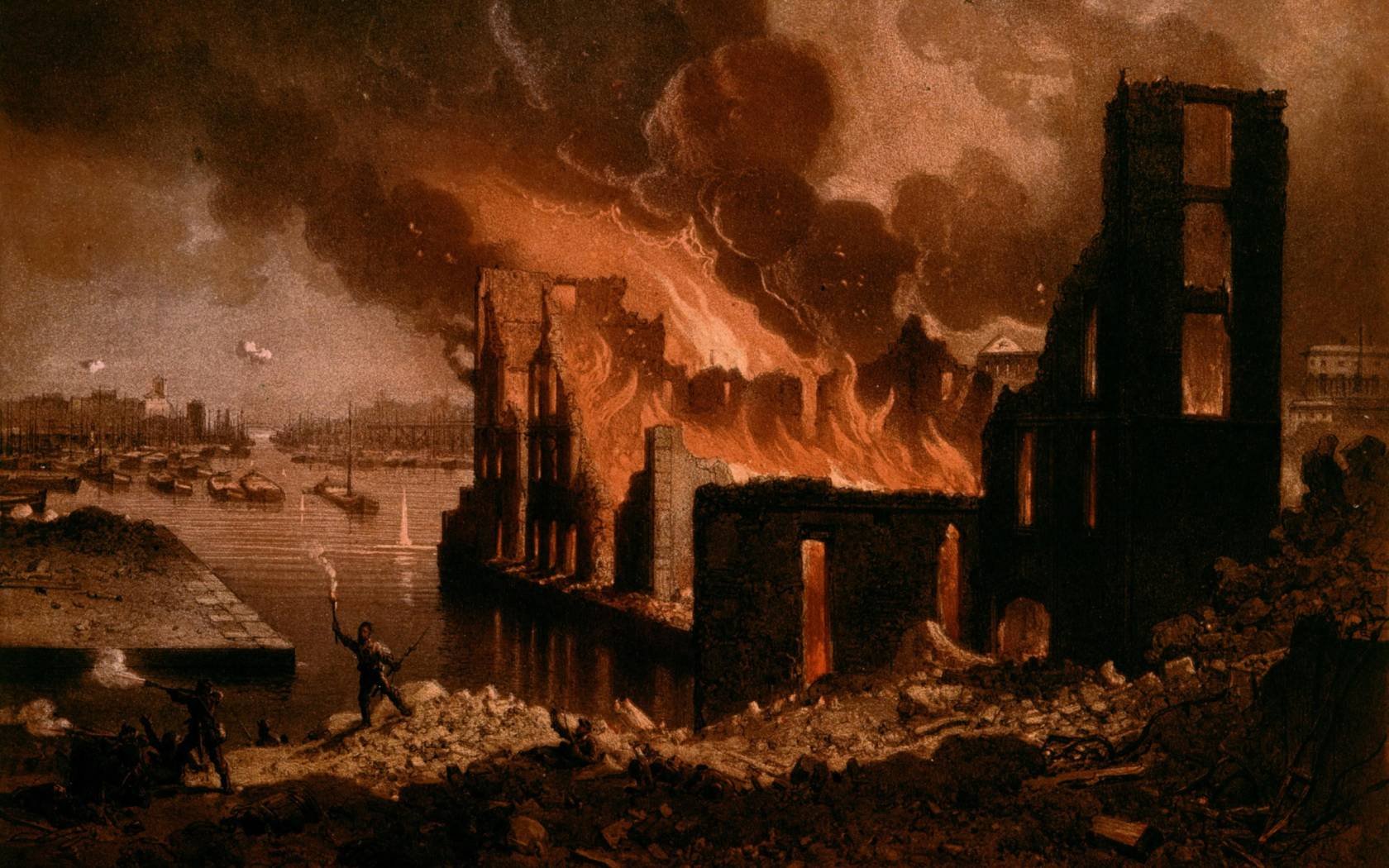
‘A fit of vomiting, the saturnalia of madness’: this is how the French writer George Sand described to her friend Flaubert the Paris Commune of 1871. Flaubert agreed. When the insurrection had been crushed at the cost of between 10,000 and 20,000 lives, another French writer, Edmond de Goncourt, wrote in his Journal that ‘the bleeding has been thorough’.
I was reminded of this at a dinner last Sunday evening in Paris, the day after the huge Paris demonstration of 17 October, which ended in violence, vandalism and looting. One of the guests, from the French art world, was in a state of frenzied fury that makes Sand’s reaction seem timid. When I tried to suggest that, first, one must distinguish between the legitimate protest of the lycéens and this mindless violence, and second, that, while the violence was indefensible, one must also try to interpret its causes historically and sociologically, he only got angrier. He screamed that the rioters – ‘racaille’ (scum) as he called them using a word Nicolas Sarkozy had popularised some years ago – should be shot dead without mercy. Lives, it seems, were less important than property.
When my partner and I set off to leave, announcing that, despite staying near Opéra, where some violent scenes were occurring, we would return home by metro and on foot, not by taxi, the guests looked at us incredulously, as if they would never see us alive again. In the end, we returned unscathed although witnessing disturbing and menacing scenes as we walked the last stretch where small groups of masked youths roamed streets littered with the signs of looting and vandalism.
That dinner revealed an explosion of class fear and social panic I have never witnessed before. None of the guests were natural supporters of the extreme right. They were liberal centrists or moderate conservatives – George Sand had been of the left – but this event had suddenly revealed the irruption of a world that is normally invisible: a world lurking on the fringes, a world one vaguely knows exists but prefers not to think about. Similarly, one of the most shocking aspects of the Commune was the irruption into the centre of Paris of thousands of workers and artisans who had been displaced to the outskirts by the urban building of Haussmann. This was another version of what the historian Louis Chevalier described in his classic book Classes laborieuses et classes dangereuses (1958) about a similar social panic in the 1830s.
France has a long tradition of direct popular protest. Indeed, it is from France that we get the term Jacquerie, which was used to describe a peasant uprising in 1358 (Jacques Bonhomme was a generic name for peasants) and has since been generalised to characterise other such peasant movements. It was resuscitated to describe the Gilets Jaunes movement of 2018, whose inchoate spontaneity seemed different from other recent, more ‘modern’, forms of protest. The sociologist Charles Tilly wrote a classic study entitled The Contentious French (1986), which tracked the history of popular French protest from the 1600s to the 1980s. His book analysed the evolving ‘repertoire’ of political violence and argued that these protests had their own rationality and rules in the vein of E.P. Thompson’s famous article on the ‘Moral Economy of the Crowd’ in 18th-century Britain.
To France’s ‘repertoire’ of protest, the 19th century added the barricade (1830, 1848 and 1871). Its symbolic power was such that it was revived by the student protestors of 1968. One of the most important moments of May 68 was the ‘Night of the Barricades’ (10-11 May). But in that case the function of the barricades was entirely symbolic – they were a performance of revolution – and they had the effect not of protecting the protestors from the police but hedging them in – and making it harder for them to escape the police! Just as those protestors drew on the romantic repertoire of the revolutionary past, today’s lycéens invoke the precedent of 68. One banner reads ‘Génération 6-7 [reference to a TikTok meme] refait 68’.
The number of French popular protest movements since 1900 is so extensive that one can only list a few of the most important. In June 1907, there were huge protests throughout southern France by winegrowers worried about falling prices. The biggest demonstration, in Montpellier, was attended by about half a million people. In June 1936, the victory of the Socialist Popular Front government was accompanied by the occupation of thousands of factories all over the country. In the autumn of 1948, there were semi-insurrectional protests and strikes in French coalfields. In the early 1960s, there were waves of demonstrations by farmers all over France, blocking roads with their tractors. In 1968, one thinks above all of students, but much more important was the wave of factory strikes (and factory occupations) which broke out two weeks after the student protests. This was possibly the largest general strike ever to have taken place in any advanced industrial society. In 1973, protestors from all over France (and Europe) demonstrated against the extension of a military base on the plateau of Larzac in southern France. In the autumn of 1986, a proposal (the Devaquet Law) to introduce a greater degree of selection to French universities led to weeks of protests which paralysed the country, culminating in a demonstration in Paris in December attended by hundreds of thousands. In 1995, a massive wave of public strikes and demonstrations erupted against welfare and pension reforms by the government of Alain Juppé. This was the biggest social movement since 1968, involving at the peak two million people. In March 2006, a reform of labour laws by the government of Dominique de Villepin produced another massive protest movement.
One reason advanced for France’s tradition of protest is that the combination of a highly centralised French state with relatively weak ‘intermediary’ organisations – levels of trade union membership in France have always been historically low compared to Britain and Germany – means that direct action comes to be seen as the only effective way of achieving one’s aims. Hence the famous (and possibly apocryphal) exchange between Raymond Aron and de Gaulle. When Aron remarked that ‘the French from time to time have revolutions but never reforms’, de Gaulle quipped back ‘in France reforms only come through revolutions’.
The frequency of demonstrations has certainly increased since the founding of de Gaulle’s Fifth Republic in 1958. This is often ascribed to the fact that the arrival of a stronger executive and the subsequent weakening of parliament have further closed off other channels of protest. Street protests became seen as the only means of exerting pressure on the State. And this pressure can be effective: the reforms of Devaquet (1986), Juppé (1995) and Villepin (2006) were all withdrawn. This is an inverse of de Gaulle’s maxim: revolution does not make reforms but prevents them.
This does not fit the case of the recent movement of school students (lycéens) which started in September. If anything, the opposite is true: they started not as a protest against a state that was seen as too powerful and oppressive, but one that was seen as impotent. Since Emmanuel Macron’s dissolution of parliament in 2024, which produced no clear majority and made it impossible to form any effective government, there is a sense that the State is no longer functioning. This is a government that only voted its last budget after many months, and has still not voted the next. The old political parties (Socialists, Gaullists) are in terminal decline, and most political space is now occupied by extremes of left and right.
The current protest started in a lycée from a relatively deprived Paris suburb (lycée Saint-Exupéry in Créteil) and was soon joined in solidarity by others. They were demonstrating initially about concrete issues – dilapidated buildings, lack of heating, absent teachers – and also the introduction some years ago of the so-called Parcoursup, a notoriously complicated and unwieldy system, which was supposed to rationalise and streamline entry to university but has only caused huge anxiety. But these specific demands were symptoms of a wider malaise among young people about the future – or lack of future – facing them. These lycéens were of that generation whose early years of learning had been dramatically disrupted by Covid.
The first demonstrations were good humoured, almost playful. The most striking feature was that instead of the huge, often quite sophisticated, banners which one usually sees in demonstrations, in this case most protestors were carrying artisanal placards made out of cut-up cardboard boxes with the slogans clumsily drawn on with felt pens or biros.
This was the revolution of the cardboard boxes. They looked often as if they had been cut up that morning on the kitchen table; the slogans were often witty; and the protestors were sometimes accompanied by their parents. One of my favourites was a placard with a photo of Marc Bloch the historian and resister and around it the slogan: ‘Marc Bloque’. This playful inventiveness is very much in the spirit of that ‘rire de mai’ [the laughter of May], which was described by the sociologist Pierre Bourdieu in relation to 1968.
The government responded not by dialogue but repression. In little more than a week, an astonishing total of more than 6,000 demonstrators, most of them minors, were taken into custody. The fact that only around a third of them faced any charges suggests that this was being used simply as a measure of intimidation to undercut accusations of laxity from the extreme right. If that was the reason, the tactic backfired. The repression only further radicalised the demonstrators.
In this there was a clear parallel with 68, when protests against police brutality were added to the grievances which had initially sparked the movement. One of the new demands of the students was the release of their comrades who had been arrested. A famous poster of 1968 read ‘CRS [The name of the riot police]=SS’. In 2026 also there has been a proliferation of humorous anti-police slogans. One just about translatable example is: ‘la police nous prothèse’ swapping ‘protège’ [protect] for ‘prothèse’ [prosthesis]. In other respects, however, this movement could not be more different from 68, which was a period of economic growth not stagnation, and revolutionary optimism rather than morosity.
The anti-police aspects of May 68 aroused the scorn of the radical Italian filmmaker Pasolini, who wrote that he had more sympathy with the police who were often of working-class background than the well-heeled students who were demonstrating. Astonishingly, in 1968 there were almost no fatalities. Over the years the state has become more efficient at repressing protests without causing deaths. In 1907 at least seven protestors were killed, and possibly the same number in 1948. The most notorious recent case is that of a 22-year-old student Malik Oussekine, who was beaten to death by the police in the 1986 protests. It was the reaction to this horrifying event that caused the government to withdraw its reforms.
Even if the reality of repression has become less violent – although in these demonstrations the police did seem to revert to more heavy-handed tactics than recently – its impact has been amplified by social media. Already in 1968 an important role was played by the radio. The famous night of the barricades was relayed live by the radio station RTL, which was dubbed ‘radio barricade’. This time it is TikTok. Depending on a person’s algorithm, they are fed videos showing police brutality and peaceful demonstrators or the opposite. At my dinner everyone was riveted to their mobile phones constantly transmitting new scenes of vandalism.
After about a month a movement that started out with specific causes limited to one group became a kind of magnet for a whole series of other discontents about the state of contemporary France – especially the cost of living – combined with a generalised contempt for Macron. As in 1968, the student demonstrations soon drew in the trade unions, with teachers and energy workers coming out on strike (with talk of 1936 very present). All these discontents coalesced in the massive demonstration which took place on Saturday 17 October.
Initially there was nothing unusual about that demonstration, although the police tactics of ‘kettling’ created from the start some unnecessary tension. The police seemed a bit trigger-happy with their tear gas for what seemed to have started out as a mostly peaceful and good-humoured event. But it was when the main demonstration was dispersing that outbreaks of violence and vandalism started to erupt all over the city. And, indeed, all over France: the single most shocking scene was the burning of the town hall of Limoges. In some cases, these may have been the work of extreme leftist political activists, especially the so-called ‘black bloc’ protestors who dress entirely in black, with hoods and masks so that they cannot be identified. They are linked to far-left anarchist circles aiming to smash the state and destroy property.
But in this case these activists were less important than the gangs of masked youths (casseurs) from the banlieue, who piggybacked off the demonstration to smash shop windows and loot the contents. And for those who think this can only happen in France, these scenes were reminiscent of those that took place in Britain in August 2011 on the back of demonstrations against the police after they had shot dead a mixed-race man, Mark Duggan. The most extraordinary thing is that the police seemed so overwhelmed by the rioting last weekend, despite some 2,400 arrests across the country. This has led some conspiracy-minded observers to wonder if the police, many of whose members are sympathetic to the RN, were only too happy to allow this to happen to fuel support for the extreme right. More probably, the police had simply underestimated the situation, and were outwitted by small but well organised groups of delinquents who kept in contact with each other via social media. Certainly, these dramatic events revealed a state seemingly unable to perform its most basic function: to preserve order. The Minister of the Interior pretty much accepted this by offering his resignation, which Macron did not accept. Macron made a speech on the next day, which was as ineffective as the television appearance of de Gaulle three weeks into the events of May 68. In both 1968 and 2026 the mass of demonstrators are too young to have remembered anyone else at the head of their country. Like de Gaulle in 1968, Macron in 2026 has been there for almost ten years.
‘There will forever be a before and after October 17’ wrote one political commentator the morning after the riots. One must be wary of this kind of instant prediction. Who now remembers the 2011 riots in Britain, which were seen at the time as the end of civilisation as we know it? Actually, as one graffitist has pointed out, there had already been an ‘October 17’ before. That was in 1961 when, during the latter stages of the Algerian War, a peaceful march of Algerians was brutally repressed by the Paris police, whose Prefect Maurice Papon had started his career deporting Jews under Vichy. On the night of 17 October 1961 probably about 100 Algerians were killed and their bodies thrown into the Seine by the police. This terrible event was covered up and lingered in the popular memory much less than the repression by the police four months later, on 8 February 1962, of a huge left-wing-led demonstration against the diehard supporters of French Algeria. This was so ferociously repressed (again Papon) that nine demonstrators lost their lives when crushed against the barriers of the Charonne Metro station. For years the Charonne ‘massacre’, which involved white CGT members and activists, completely overshadowed that much bloodier event in the previous year which involved only Arabs. In recent years, the memory of that massacre – the bloodiest event in the history of modern France – has been rightly resuscitated. It will be a pity if the new ‘17 October’ once again buries it.
Walking through the debris of broken glass and the carcasses of tear gas grenades, of scattered plastic bottles of shampoo and ketchup, of boxes of cigarettes or smashed televisions which the looters had left in their trail, was a ghostly and sad experience. In 1968 the students who ripped up paving stones for their barricades produced the famous Situationist-inspired slogan ‘sous les pavés la plage’ (under the paving stone there is the beach), whose utopian playfulness was one strand of that movement. Under the pavés in 2026 one senses only black despair: a void not a beach.
It is impossible to predict what will happen next. The Gilets Jaunes have called further protests for 24 and 31 October, and the CGT a general strike for 5 November. The lycéens are still calling their own marches, but their movement has now been rather subsumed by other events. This is partly because the two-week half-term school holidays have now started. One cannot force the closure of schools which are closed already. That is another echo of 68, when a lot of people suggest that one reason why the movement lost momentum at the end of the month of May was the beginning of the Whitsun holiday.
If we cannot know how the movement will progress – and the government has now cracked down with curfews and bans on marches in many cities around France – there is no doubt of its enduring political impact, accentuating the radicalisation of French politics, and further squeezing the already shrinking centre. Jean-Luc Mélenchon, leader of the leftist LFI (La France Insoumise/France Unbowed), has certainly increased his popularity among the young. No one has more vocally supported the lycéens while adroitly managing to avoid condemning the casseurs without actually supporting them. Marine Le Pen has needed to do no more than sound statesmanlike and condemn disorder. The politicians of the centre have been inaudible. The events of 1968 resulted in an election in June which gave to the Gaullists the biggest parliamentary majority that the right has ever won in French history – much more extreme than de Gaulle himself wanted. But this time it is not the Gaullist right – which hardly exists – that will benefit, but the extreme-right of the RN.
Just as the lycée movement got under way, the RN seemed on the back foot after some investigative journalists dug up antisemitic comments that had been made by the RN leader Jordan Bardella in his youth. This was a blow to Marine Le Pen’s attempts to ‘detoxify’ her party’s brand by distancing it from its Pétainist and even fascist origins – even if many people remained plausibly convinced that behind the makeover its ethnonationalist DNA has not fundamentally changed, except that the target is now Muslims, not Jews. But current events have completely overshadowed the allegations against Bardella.
In the more innocent early days of the lycée movement, which now seem like another era, I passed by the prestigious Paris Lycée Condorcet where Proust went to school. It was closed because of the strikes, but over the door was one of those cardboard slogans which read: ‘truth comes from the mouths of children except when their jaws have been smashed’.
Tellingly, just to the left of the door was the black plaque affixed to the wall of the lycée, as to many other Paris schools, whose words, etched in gold, remind people of the Jewish children deported between 1942 and 1944: ‘innocent victims of Nazi barbarity and the Vichy government’. It will be a tragedy for France if the events of the last week increase the chances of victory of a movement that has direct historical links both to the defenders of Algérie française – the indirect cause of the tragic events of 17 October 1961 – and to the Vichy regime. Some of the demonstrators had chanted ‘on refait 1789 pour ne pas revenir en 1939’ [‘We are redoing 1789 so as not to end up in 1939’] but unfortunately the events of last week may produce exactly the opposite outcome.


