Albertus Pictor’s Nordic Renaissance
- November 6, 2026
- James Blake Wiener
- Themes: Art, Culture, History, Scandinavia
The late-medieval painter infused sacred art with secular details, allowing us to view the Renaissance through a Scandinavian lens.
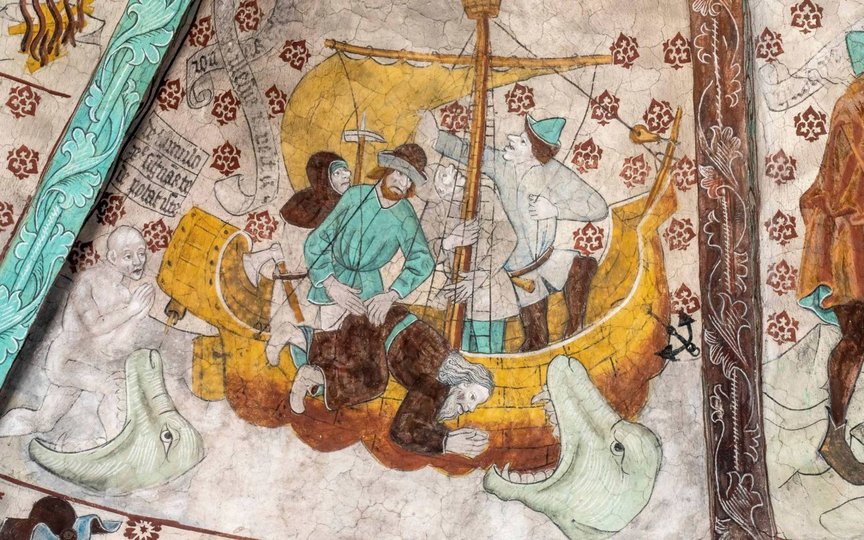
When we think of the brilliance of 15th-century European art, our minds turn to the grand masters of the bel paese – Leonardo da Vinci, Gentile Bellini and Sandro Botticelli. Their psychological depth, narrative grandeur and mastery of perspective have come to embody the dynamism and high spirit of the Italian city-states. Yet around the shores of Sweden’s Lake Mälaren, a gifted craftsman named Albertus Pictor (c. 1440-1509) covered the vaults and walls of more than 30 parish churches with scenes that ordinary worshippers could understand. Pictor turned sacred stories into a record of how the Swedes of his day lived. In doing so, his body of work suggests that the Renaissance was not merely an Italian cultural package exported northwards. Rather, Northern Europe had its own forms of artistic renewal.
One could describe Sweden’s 14th and 15th centuries as de tyska århundradena – ‘the German centuries’ – a nod to the scale of German immigration, trade and cultural presence in Scandinavia and the Baltic as the might of the Hanseatic League reached its apex. German cultural influence left a profound imprint on Sweden’s language, urban architecture, legal codes, administrative institutions and artistic production as the Middle Ages drew to a close. Albertus Pictor – or Albert Målare, as he is better known in Sweden – was born into this world, but his exact birthdate and birthplace are shrouded in uncertainty. For centuries, scholars posited he was German and came from Immenhausen in Hesse. Still, it is possible that he was the descendant of German migrants to Sweden, of mixed Swedish-German parentage, or simply Swedish. No known paintings or documents related to him exist in Germany. Several signatures from Pictor have survived beneath his murals – ‘Albertus Y(m)menhusen’ from a church in Sala is the clearest. Yet whether this is an actual surname or indicative of German origins remains a matter of speculation.
The first written records of Pictor emerge from the small, prosperous town of Arboga, roughly 150 km west of Stockholm. These documents identify him as a freeman and guild member in 1465, and they portray him as an ambitious and business-savvy craftsman. In 1473, he married Anna, the widow of a painter named Johan, and took over her late husband’s workshop in Stockholm’s Gamla Stan. Like the goldsmiths-turned-painters of quattrocento Italy, Pictor moved fluidly between crafts. In the summer, he painted churches with members of his workshop and he oversaw an embroidery workshop in Stockholm during the colder months. As a pearl embroiderer, Pictor created luxurious liturgical textiles, from chasubles and copes to altar cloths, pennants, and banners, studded with pearls, gems and gold thread. This was a lucrative and coveted talent to possess in pre-Reformation Sweden. Pictor became so wealthy that he paid more taxes than any of his fellow craftsmen during the final decades of his life and was even the proud owner of two storehouses at Norrport in Gamla Stan.
Pictor worked prolifically over the course of three decades, painting some 35 to 37 parish churches and other ecclesiastical structures around the Mälaren Valley in what is presently Västmanland, Södermanland and Uppland. Members of his workshop are known to have travelled as far afield as Gammelstad, near Luleå in Norrbotten, where they contributed to the decoration of Nederluleå Church in the 1490s. He preferred the al secco technique (pigment bound onto dry lime wash) alongside stencilling, rather than the time-consuming buon fresco technique (pigment painted into wet plaster) often favoured in Italy. This approach allowed him and his assistants to make the most of the short Nordic summers.
His sources were as varied as his craft. Medieval works such as the Biblia pauperum and the Ars moriendi, as well as drypoints by the anonymous Late-Gothic artist known as the Master of the Housebook (fl. c. 1470-1500), shaped Pictor’s compositions and motifs. Nonetheless, he softened the rigid solemnity of medieval iconography, recalibrating and transposing the old narratives into scenes charged with movement and human expression, rendered through his application of light, shadow and colour.
When patrons commissioned biblical scenes, Pictor filled them with the people and details of his own era. Beneath his angels and prophets, demons and witches, lies a vivid account of life in late-medieval Sweden: the hem of a noblewoman’s frock, the wooden staff of a peasant and the worried faces of farmers and aristocrats fearful of divine judgment or plague. Each figure is differentiated by occupation, piety, social rank and physical appearance. Nobles wear flowing cloaks trimmed with ermine, peasants wear plain tunics and the Virgin Mary is clad in the finest silk brocade. Fashion clearly fascinated Pictor, who eagerly captured every fold in a woman’s dress and the varied ways men styled their hair. One can even trace changes in Swedish sartorial taste across Pictor’s career via his church murals. Hats, in every size and colour, are among his visual trademarks.
Humour runs through Pictor’s murals as well. Dishonest and impious figures are shown with poor hygiene and excess facial hair, while his pale red devils grin widely as they try to beguile astonished saints. Pictor was less successful in rendering unfamiliar animals: his lions look like apes or bears, and the whale that swallowed Jonah resembles an enlarged canine with sharp fangs. Music is everywhere, especially in New Testament scenes. Bagpipes, lutes, drums and harps sound on earth and in hell, and Pictor’s beautiful angels make music, too. Perhaps the most memorable is the smiling sow playing the organ in Härnevi Church, a subtle bit of moral satire whose precise meaning remains open to interpretation. Framing it all is whimsical foliage – stencil-painted flowers and flowing evergreen vines – which binds Pictor’s compositions to the church’s architecture.
In the 1480s, Pictor executed his most famous mural, ‘Death Playing Chess’, in the vault of Täby Church, just 20 km north of Stockholm. In this painting, a cocky, yellow skeleton personifying death sits to the right of a knight clad in a green robe. The skeleton grins as he moves his piece on the chessboard, while the knight looks on helplessly, hoping for more time to play. In ways similar to the Totentanz or danse macabre of 15th-century Germany and France, Pictor’s chess mural reminded parishioners of the inescapability of their own mortality, regardless of social class or wealth. Chess becomes a metaphor for the illusion of control: however deftly one plays, there is no strategy that can outmanoeuvre death. The banderole above the scene, now faded, once read in Swedish, ‘I checkmate thee.’
Pictor’s murals caught the attention of the young Ingmar Bergman more than four centuries after their completion. The son of a Lutheran pastor, he accompanied his father on visits to rural parishes in Uppland, where he admired the painted vaults. Pictor’s chess-playing Death would later inspire a key scene in Bergman’s cinematic classic The Seventh Seal (1957). In the film, a knight returning to Sweden from the Crusades plays chess for his life against a pale, black-robed figure on a windswept beach. This scene has since become one of the defining images of modern European cinema.
Pictor secured a small measure of immortality himself. In a church in Lid, he painted his self-portrait, kneeling in silent prayer and stylish as ever in the fashionable, long-toed poulaine shoes of the 1480s. The banderole above his head reads, ‘Remember me, Albertus, painter of this church.’ The last trace we have of his life is more modest still: a receipt for playing the organ at a funeral mass in Stockholm’s Storkyrkan in 1509. He seems to have died that same year, for he vanishes from the records thereafter.
Pictor neither abandoned the visual traditions of the Middle Ages nor embraced the classical vocabulary that so captivated artists south of the Alps. His medium, patrons and audiences were markedly different; his paintings were architectural, communal and didactic, spanning vaults and walls as interconnected visual stories. His achievement lay in renewing a local, vernacular Gothic tradition from within. His figures may lack da Vinci’s anatomical precision and Botticelli’s elegant idealism, but they possess an unmistakable sense of lived experience. Pictor was no Renaissance artist in the Italian sense, yet his repertoire shows a keen attention to the human body, expression, movement, the natural world and recognisable human behaviour – all concerns that Renaissance art in the North would later share. In his churches, we glimpse 15th-century Sweden with extraordinary intimacy and view the Renaissance through a different, Scandinavian lens.
James Blake Wiener


More from Scandinavia

My grandfather, the Swedish Stalinist

Why settled Vikings deserve our attention

Robert Molesworth, denouncer of Danish tyranny
The Russo-German struggle for a Baltic empire


