When the Mediterranean was a British lake
- October 28, 2026
- Brendan Simms
- Themes: Britain, Geopolitics, History, War
Over two centuries, Britain’s growing role in the Mediterranean became bound up with its rise to great-power status.
Earlier this year, shortly after the second US-Iran war erupted, Britain was dramatically reminded of its Mediterranean role, or apparent lack of one, when the Sovereign Base Area of Akrotiri on Cyprus was struck by a drone believed to have been launched from Lebanon. The ship assigned to protect the island, HMS Dragon, took so long to reach its station that the episode became a major national embarrassment and, for some, a symbol of the United Kingdom’s inexorable decline.
This was not the first British fiasco in the Mediterranean, and it will not be the last. In November, it will be 70 years since the Anglo-French landing in Egypt in 1956, which unsuccessfully attempted to wrest control of the canal back from the Egyptian strongman Gamal Abdel Nasser. Two hundred years before that, in 1756, a Royal Navy fleet failed to relieve the embattled British island of Menorca in the Western Mediterranean. Its resulting fall to the French caused such a national outcry that the commander of the relief force, Admiral Byng, was court-martialled not for cowardice but for want of zeal and shot by a firing squad on the quarterdeck of HMS Monarch. This episode prompted Voltaire to write, in Candide, that the unfortunate commander had been executed ‘pour encourager les autres’.
The start of Britain’s involvement in the Mediterranean goes back much further, to before the formation of the British state. It was prompted by the desire to protect the lucrative English Levant trade, especially against Barbary Corsairs operating out of North Africa. In 1620-21, James I sent a squadron of ships commanded by Sir Robert Mansell to deal with them, but, lacking local bases or support, Mansell made little headway.
In 1654, as Oliver Cromwell, lord protector of England, Scotland and Ireland, weighed up whether to ally with France or Spain, he sent his General at Sea Robert Blake into the Mediterranean to increase England’s bargaining power. Blake was charged with preventing the French from attacking the Spanish territory of Naples. He took up station at the Straits of Gibraltar, preventing the two French fleets from Brest on the Atlantic coast and Toulon in the Mediterranean from joining one another, the first time this stratagem was used. Shortly after, Blake administered a serious beating to the Corsairs at Tunis, prompting those at Algiers to come to terms.
Blake had performed well, but his effectiveness was limited by the lack of a permanent base in the region. This was partly remedied by the acquisition of Tangier as part of Catherine of Braganza’s dowry, following the marriage of the Portuguese princess to Charles II. England now had a port at the entrance to the Mediterranean. The Royal Navy was now able to keep up the pressure on the Barbary pirates, leading to the establishment of the ‘Mediterranean Pass’, which protected English shipping from Corsair attack. It became clear, though, that Tangier was less well suited as a base than the Spanish port of Gibraltar. Unpopular at home and expensive to defend against constant Moroccan attacks, Tangier was abandoned in 1684.
The strategy of attacking England’s enemies in the Mediterranean, however, was maintained. During the Nine Years War against France in the 1690s, the Royal Navy mastered the difficult art of wintering in the region. This greatly increased the length of time for which it could operate. During the subsequent War of the Spanish Succession, also fought to clip the wings of the over-mighty French King Louis XIV, the Anglo-Dutch coalition and their Austro-Spanish Habsburg allies once again took the war to the Mediterranean. In 1704, an Anglo-Dutch force captured Gibraltar in the name of the Habsburg contender to the Spanish throne, Charles III; the capture of Menorca followed. In 1707, the allies besieged Toulon. It was the first time England – which was now subsumed into Great Britain – threatened France from the south.
At the Treaty of Utrecht in 1713, which brought the war to an end, Britain retained Gibraltar and Menorca, thus becoming a Mediterranean power. This was now a permanent physical presence rather than a transient naval one. Like the Romans, the British brought with them a distinctive paraphernalia of forts, garrison churches, parade grounds, port facilities and fever hospitals. Flanking this effort was a policy of accommodation with local inhabitants who were, unlike most of their British masters, principally Roman Catholic (and, by the late 19th century, Greek Orthodox and Muslim as well).
Britain was in the Mediterranean partly to defend its commercial interests, but largely for strategic reasons. Protecting the Levant trade remained important and, later, defending the commerce passing through the Suez Canal (from 1869) was a significant factor. The main prize, however, was the overall European balance of power on which Britain’s security rested. During the 18th century, this usually meant the containment of France, but in the two decades after Utrecht it also involved keeping Spain and Austria in check. First, London became exercised by the attempts of the Spanish Queen, Elizabeth Farnese, to rebuild Spain’s Mediterranean Empire in Italy, thus undermining Britain’s chief ally, Austria. Then Austria, too, became a rival and briefly joined forces with Spain.
In this context, Gibraltar and Menorca were instruments, not ends in themselves. They could be used as bases, but they were also bargaining counters. On multiple occasions, London offered to return Gibraltar, but Spain’s wider demands were so unreasonable that nothing ever came of the idea. Besides, popular opinion became wedded to its retention. ‘The Rock’ now became the launchpad for a naval effort that was to span the entire Mediterranean by the end of the century.
In 1717-18, Spain first occupied Sardinia and then invaded Sicily – the former seized from Britain’s key ally Austria, the latter a vital strategic node. The writer Daniel Defoe, author of Robinson Crusoe, warned that the occupation would amount to a Spanish ‘chain drawn across the mouth of the Levant Sea’, which would destroy Britain’s commerce with the Mediterranean and would elevate the Spanish navy to ‘an immoderate and monstrous pitch’. Though the two countries were not yet formally at war, a Royal Navy squadron under Admiral Byng – the father of the commander who later failed to relieve Menorca – attacked the Spanish fleet off Cape Passaro in 1718 and annihilated it. Nine years later, Gibraltar saw off the first Spanish siege since Utrecht.
It soon became clear that, unlike some of Britain’s other European stomping grounds, the Mediterranean was uniquely suited to the use of seapower. Littoral states were extremely vulnerable to the Royal Navy, which could pop up out of nowhere and disappear equally quickly. For example, when King Charles of the Two Sicilies (Naples and Sicily) joined a coalition against Britain’s main continental ally, Austria, Commodore Martin sailed a squadron into the Bay of Naples in 1742, trained his guns on the royal palace and threatened to level it. Charles promptly withdrew from the offending alliance.
Britain did not have it all its own way. When France annexed Corsica in 1768, London had to accept – after a lot of huffing and puffing – that there was nothing it could do about it. During the American War of Independence, when Britain was – in the words of one statesman – at war with the ‘entire world’ (or at least with the colonists, France, Spain and the Dutch Republic), its position in the Mediterranean came under intolerable pressure. Gibraltar survived a Franco-Spanish siege lasting more than three and a half years between 1779 and 1783, but Menorca was lost and only briefly recovered during the Revolutionary and Napoleonic Wars. All that remains of some 70 years, on and off, under British rule is a number of forts, mansions and many distinctive Georgian sash windows.
By the late 18th century, Britain’s Mediterranean position had been reduced to its toehold in Gibraltar. Many thought the base indefensible without Menorca, rendering it an expensive luxury. What no-one foresaw was that the outbreak of the French Revolution would lead to a dramatic expansion of the British presence in the region. In the 1790s, Britain supported French royalist forces in Toulon, established a short-lived Anglo-Corsican Kingdom, and also briefly held the island of Elba.
It was during the siege of Toulon that the young Napoleon shot to fame. He then took over the Army of Italy and beat Britain’s Austrian ally in the peninsula. French forces captured Malta, landed in Egypt and, a few months later, advanced as far south as Naples. Napoleon’s aim was to conquer or overawe the Ottoman Empire, and ultimately to threaten Britain’s position in India, which was held to be an important pillar of its global power. The Mediterranean thus acquired two new – and related – roles in British thinking, those of protecting the ailing Ottoman Empire and the ‘route to India’.
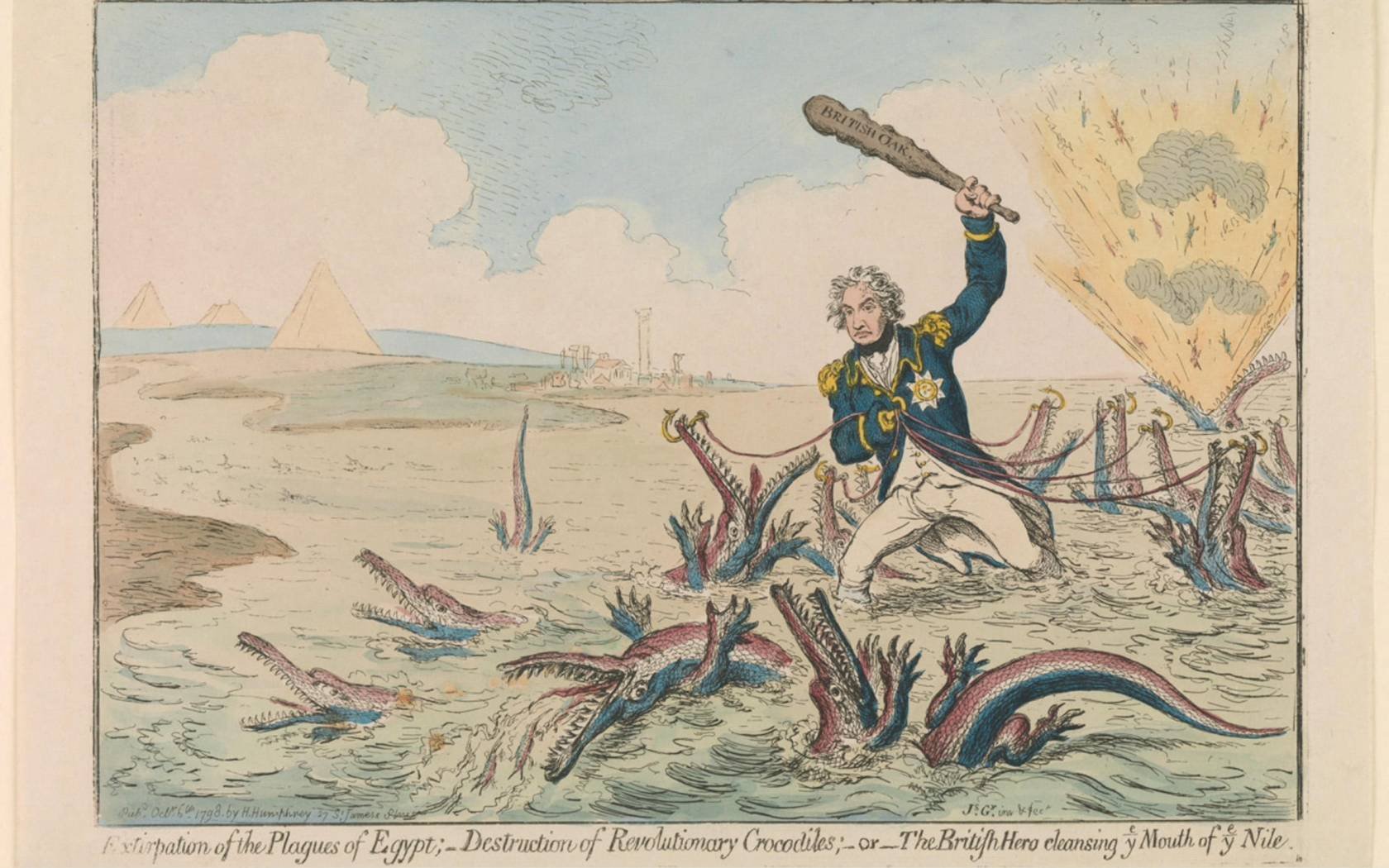
In response to the French surge, Britain advanced towards the Central and Eastern Mediterranean. Admiral Horatio Nelson sailed into Aboukir Bay in 1798 and destroyed the French fleet there, cutting Napoleon’s army off from France. He took a keen interest in the future of the Kingdom of Naples, which was under severe pressure from Jacobin revolutionaries within and French forces from outside. Nelson was famously smitten with Lady Emma Hamilton, the glamorous wife of the leading British diplomat there. After the French were ejected, for the time being, and the rebels had laid down their arms, both Nelson and Emma were implicated in the breaking of the terms of surrender, including the controversial execution of one of the conspirators. This episode seriously damaged Britain’s standing in the region.
Not long after, Malta fell to British forces following a long siege. Its strategic importance at the heart of the Mediterranean was soon recognised and proved to be a sticking point during the peace negotiations with France, which insisted on Britain’s withdrawal. Britain was in the Central Mediterranean to stay, and Malta soon acquired the same architectural accoutrements as Gibraltar, such as barracks, docks and hospitals.
When the French returned to Naples in 1806, the Royal Navy once again evacuated the royal family to Sicily. From that island, British forces harried the French up and down the Italian coastline. That July, they even landed a substantial force in Calabria, defeating the French at Maida. This victory is now immortalised by the London suburb of Maida Vale.
Britain’s presence on Sicily was brief but significant. Nominally, the island was ruled by the Bourbons, but effectively Lord William Bentinck, the British minister, was in charge. He forced through a constitution in 1812, which abolished feudalism and established a bicameral parliament. It never really got off the ground, but remained an inspiration long thereafter. Much later, Giuseppe Tomasi di Lampedusa, author of the epic mid-20th-century novel on the Risorgimento, The Leopard, bitterly regretted the passing of the British presence, which – in his view – had been Sicily’s last chance to escape its dismal history.
The British foray into the Eastern Mediterranean also proved transient, for now. In 1801, a force landed under Ralph Abercromby booted the French out of Egypt. A second expedition to Alexandria in 1807, to force the Turks to give up their alliance with France, was much less successful. That same year, an attack by the Royal Navy on the Dardanelles, designed to capture the Ottoman fleet and to help Russia, also miscarried. It would take another 70 years or so before Britain would return to the region permanently.
Meanwhile, the British were also making themselves felt in the Adriatic and the Ionian islands. The purpose behind these operations was to maintain contact with Austria, to keep an eye on Russia in the region, to keep out France and to deter Napoleon from attacking the Ottoman Empire. The Dalmatian island of Vis was turned into a Royal Navy base, while Šipan, Korčula and Hvar were periodically occupied. The Ionian Islands of Zante, Kefalonia, Ithaca and Kythira were captured in October 1809, Lefkada in April 1810, Paxos in February 1814; the most important base, that of Corfu, was only taken in June 1814. The net result of this activity, apart from the general wear and tear on France, was that Napoleon was deterred from attacking the Ottoman Empire through the Balkans.
In some respects, the increased British presence during the Napoleonic Wars was transient. In the brief lull in the fighting provided by the Peace of Amiens in 1802, the British had returned Menorca to Spain; after the end of hostilities in 1815, the British left Sicily, Naples was restored to the Bourbons, and the Dalmatian islands went to Austria. On the Croatian island of Vis, the British-built Fort George was evacuated; it is now a popular party and wedding venue. The Barbary pirates, who had long harried innocent shipping – as readers of Patrick O’Brian’s novels will know – continued to give trouble. Strategically and psychologically, though, the Royal Navy now dominated the area, even where it had no permanent bases.
At the start of the 18th century, after the withdrawal from Tangier, England had no base in the Mediterranean. When the dust had settled after the Congress of Vienna in 1815 the picture was very different. In the west, Britain’s hold on Gibraltar was, for now, uncontested. In the centre, the British hold on Malta – after a shaky start – was secure. At the mouth of the Adriatic, Britain took over the running of the Ionian Islands. The Mediterranean was fast becoming a ‘British lake’.
Brendan Simms
More from Britain

Britain and Germany: Europe’s original special relationship

Valentine Lawford, the hidden hand behind Britain’s wartime diplomacy

Britain’s information war against Nazi Germany

The end of Romanitas and the coming of the English


