Hitchcock’s secret weapon: Alma Reville
- November 18, 2026
- Olivia Gavoyannis
If Alfred Hitchcock was the master of suspense, then Alma Reville, his wife and sharpest editor, was the unsung sous chef.
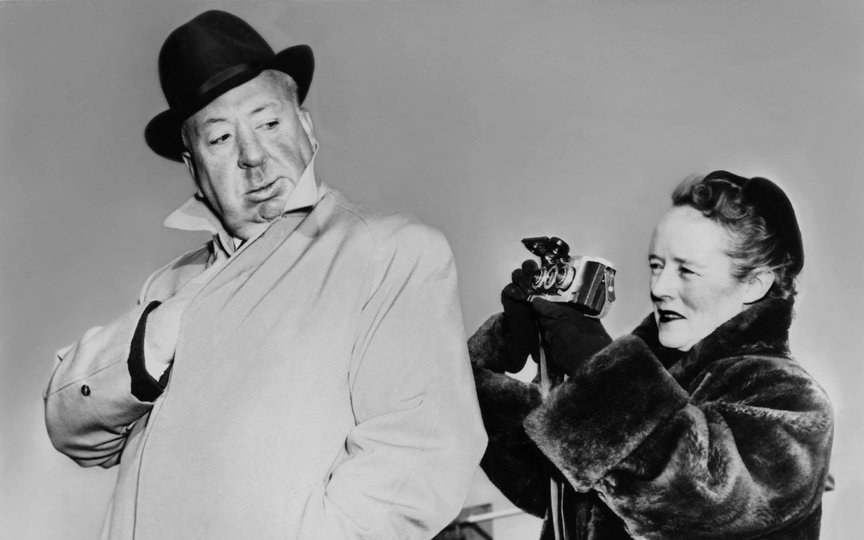
In November 1938, The Lady Vanishes was released in America to critical acclaim. The film, which centres on the mystery of a woman who seemingly disappears into thin air during a train ride through Europe, cemented Alfred Hitchcock’s status as the master of suspense.
As the critic Peter Bradshaw noted in a five-star review when the film was re-released to mark its 70th anniversary: ‘Master chef Alfred Hitchcock brought together the ingredients of mystery, comedy and suspense with sublime ease in this prewar classic. In fact, he invented the dish.’ But if Hitchcock invented it, his wife Alma Reville was the sous chef.
Alma Lucy Reville was born on 14 August 1899, just one day after Hitchcock, but she started her film career some time in advance of her future husband. Aged 16, Reville secured a ‘cutting’ position at Twickenham Studios in London where her father worked in the costume department, and she honed her craft splicing together film by hand. This process of re-ordering large quantities of footage was seen as a manual task akin to sewing, so it was largely given to young women like Reville with little or no experience.
Twickenham Studios swiftly promoted her to studio floor director and then second assistant director, and in 1921 she moved to Famous Players-Lasky in Islington, where she continued her rise as the doyenne of the cutting room and second assistant director. This was where she first crossed paths with Hitchcock – although they didn’t acknowledge one another at the time. ‘Since it is unthinkable for a British male to admit that a woman has a job more important than his, Hitch had waited to speak to me until he had a higher position,’ she later recalled wryly.
He took his opportunity when he was appointed assistant director on Woman to Woman (1923), phoning Reville to offer her a cutting role. She accepted – after negotiating a more agreeable fee – and they continued their partnership for The Blackguard (1925) and then The Pleasure Garden (1925), Hitchcock’s directorial debut on which Reville held the dual role of continuity and assistant editor.
As the film industry grew, women were let go to make way for male editors and directors, making Reville something of an anomaly. Kinematograph Weekly singled her out as ‘a clever and experienced little lady’, while the Picturegoer Magazine wrote that she was ‘nothing like as unsophisticated as she looks, as some tough film guys have discovered to their cost’.
Reville’s talent was not lost on Hitchcock, who began courting her more as a professional collaborator than a romantic partner – a dynamic that would persist throughout their life.
They wed in 1926, but Reville retained her surname. She was already established professionally and did not want to create confusion. And yet by 1951 Reville’s name was dropped completely from Hitchcock’s films, obscuring her influence on his work.
While Hitchcock’s notes were studiously archived, many of Reville’s drafts have been lost to history – even her contemporaries could only guess the extent of her involvement. The screenwriter Jay Presson Allen said: ‘It was very discreet and strictly between them. I never saw the story notes she wrote on my drafts of Marnie (1964), but I knew certain comments were coming from her.’
Patricia Hitchcock O’Connell, their only daughter, later unearthed some of Reville’s drafts to include in her biography Alma Hitchcock: The Woman Behind the Man. ‘They’re quite indicative of her story sense but also of the fact that she liked logic,’ Patricia wrote of her mother’s notes on Marnie. ‘She would point out things that did not completely make sense. Other times, she would suggest changes to improve character development or make new suggestions for the plot.’
Reville’s knack for characterisation offered the perfect counterbalance to Hitchcock’s technical skill, and her input was key when it came to the director’s blind spot: women. ‘I never understood what women wanted. I only knew it wasn’t me,’ he once admitted wistfully.
For Hitchcock’s adaptation of Daphne du Maurier’s Rebecca (1940), Reville helped him audition scores of actresses, settling on the then-unknown Joan Fontaine for the naive second Mrs de Winter. ‘Alma felt that whomever got the role should not play coy or simpering to the point where she would become intolerable and irritating to the audience,’ wrote Hitchcock O’Connell, noting that the film went on to win the Oscar for Best Picture.
Reville’s influence echoes that of the film editor Marcia Lucas, who was fundamental to the success of her then-husband George Lucas’ Star Wars films. ‘I was the more emotional person who came from the heart,’ she said, revealing her decision to kill off Obi-Wan Kenobi and reinsert Harrison Ford’s line: ‘May the force be with you.’ Marcia Lucas’ work was recognised with the Academy Award for Best Film Editing in 1978, but, according to her frank comments in the docuseries Icons Unearthed: Star Wars, her husband’s praise was less forthcoming. ‘I didn’t get much validation when we were together and then when I left there was no validation of any kind… I was erased from history.’
In the absence of such candid interviews with Reville, who shied away from publicity, it fell to those on set to bear witness to her work. The cast of Psycho (1960) were eager to sing her praise. Leading lady Janet Leigh told how Reville’s ‘sharp eye’ saved the film from embarrassment when she noticed Leigh blinking after being ‘killed’ in the shower scene. The script supervisor Marshall Schlom marvelled: ‘We must have run that sequence back and forth in the Moviola a couple of hundred times, we completely missed it.’
Her work on Psycho was explored in the 2012 film Hitchcock, in which Dame Helen Mirren brought her own experience of marriage to the director Taylor Hackford to her portrayal of Reville. ‘There is a part in the film where I give it to Hitch majorly,’ said Mirren. ‘There were elements in that speech that I recognised… of people ruthlessly elbowing you aside at Hollywood parties to get to Taylor.’
Hitchcock’s wife was no wallflower – the actor and director Norman Lloyd recalls how ‘her voice could take on a steely ring if she was displeased’ – but Mirren’s desire to convey Reville’s ‘inner strength’ resulted in some artistic liberties. The film invents a scene where she directs Psycho while Hitchcock is bedridden with flu, and another where she pursues a fling in revenge for her husband’s infatuation with his leading lady.
Mirren is also taller and more glamorous than Reville, who was described as ‘tiny’, ‘plain’ and ‘birdlike’ by collaborators. Imelda Staunton in The Girl, another 2012 film about Hitchcock, is a better physical match, yet she presents Reville as a passive and long-suffering wife, trapped in a hollow marriage – an interpretation that is difficult to square with the recollections of those close to her.
Whitfield Cook, a writer and friend, said: ‘I don’t think she cared that people thought she was in the shadow of Hitch. She adored Hitch, and I know she loved working with him.’
Indeed, Reville appears to have welcomed the anonymity afforded by their working dynamic. ‘She accomplished the work she loved without having to deal with the rules and pretence of the so-called Hollywood life,’ her daughter wrote, adding that she showed no interest in securing her legacy. ‘Someone approached her to be featured in a book on female screenwriters; the offer was politely declined.’ While Sir Alfred Hitchcock, knighted in 1979, was so successful in courting publicity that even his silhouette became a cultural touchstone, Reville remains in his shadow – just out of sight but, it would seem, exactly where she wished to be.


