Simon Armitage’s verse translation of the Mesopotamian epic is the perfect introduction to one of literature’s great works.
Essential reading, viewing, and listening from the EI editors.
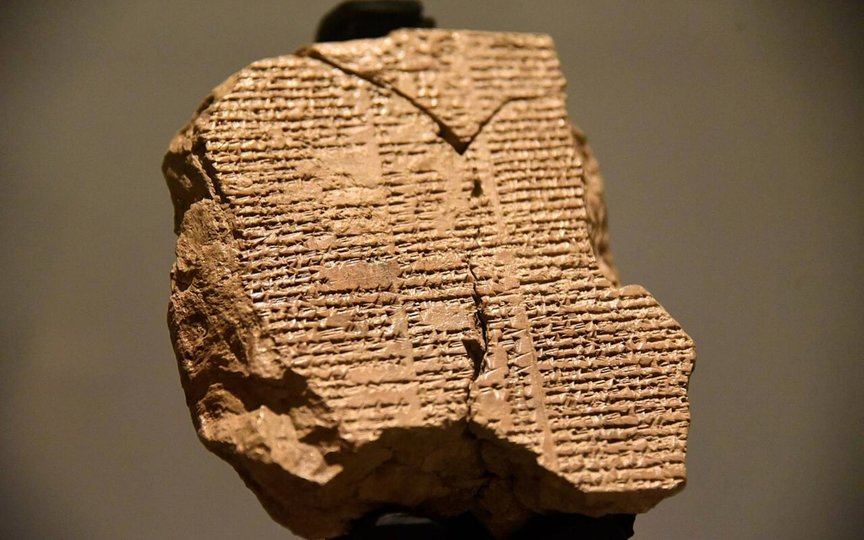
Gilgamesh, the fragmented epic composed 4,000 years ago in Mesopotamia, tells the story of the title character – two-thirds god, one-third human, and king of the city of Uruk. The poet laureate, Simon Armitage, has produced a driven, pulsating new verse translation in contrast to more obviously scholarly versions, such as those of Andrew George, though those who’ve fallen in love with this most magical of texts will devour both.
The ‘bromance’ between Gilgamesh and the ‘wild man’, Enkidu – a being created initially to curb the king’s tyranny – is rendered vivid, as is Enkidu’s death, punishment for cutting down the great Cedar Forest.
Environmentalism is a recurring theme, producing evocative passages, such as this of the forest, whose guardian, Humbaba, the pair slay:
The canopy was knitted and knotted with creepers;
sap and resin came raining down
and flowed away through channels and gorges.
It is a poem of quests: tackling the Bull of Heaven, sent by the goddess Ishtar after her rejection by Gilgamesh; his journey to the end of the world to seek Uta-napishti, survivor of the great flood; above all, the acceptance by Gilgamesh of his body’s mortality and that his legacy should be in stone – the city of Uruk.
This is the perfect introduction – and Armitage’s Introduction is as eloquent as the epic itself – to one of the great works of literature. And, despite its fragmented state – the Akkadian cuneiform tablets from which the text is translated were found only in the 19th century – Armitage’s offering feels complete.
A rousing Resurrection
It is now four decades since I first saw Simon Rattle conduct Mahler’s Second Symphony – his recording from that time, with the City of Birmingham Symphony Orchestra, remains one of the greatest recordings of this epic work. But Rattle clearly remains fascinated by the ‘Resurrection’, evident from his latest session with the Bavarian Radio Symphony Orchestra and Choir, of which he is chief conductor. On this live recording, the beloved fourth movement, ‘Urlicht’, is sung with remarkable, consoling beauty by the Scottish mezzo Beth Taylor, who is joined in the fifth and final movement by soprano Louise Alder. In a catalogue of remarkable interpretations, this is one of Rattle’s finest, a miraculous, ultimately rousing Resurrection.
Patrick Stewart’s first love
The actor Patrick Stewart, who died in October at the age of 86, got lucky when, in 1986, he was spotted at a UCLA literary reading by TV producer Robert H. Justman, who was intent on reviving Star Trek. And so, the ‘unknown British Shakespearean actor’ (LA Times) became very wealthy thanks to his role as Captain Picard in Star Trek: The Next Generation, following a distinguished, though less well-remunerated, career on stage and screen. But the Bard remained his first love, and few were better at turning his words into wonder. Here is Stewart in the role of John of Gaunt chastising the title character Richard II (Ben Whishaw) in the BBC’s superb adaptation, part of its Hollow Crown cycle from 2012. Acting of a high order.


