What middle powers can learn from the Hansa
- November 17, 2026
- Oleksii Reznikov and Dalibor Rohac
- Themes: Geopolitics, History, The Baltics
Seven centuries ago, a league of merchant towns was formed to keep the Baltic open. Today’s middle powers should take note of its model of maritime defence.
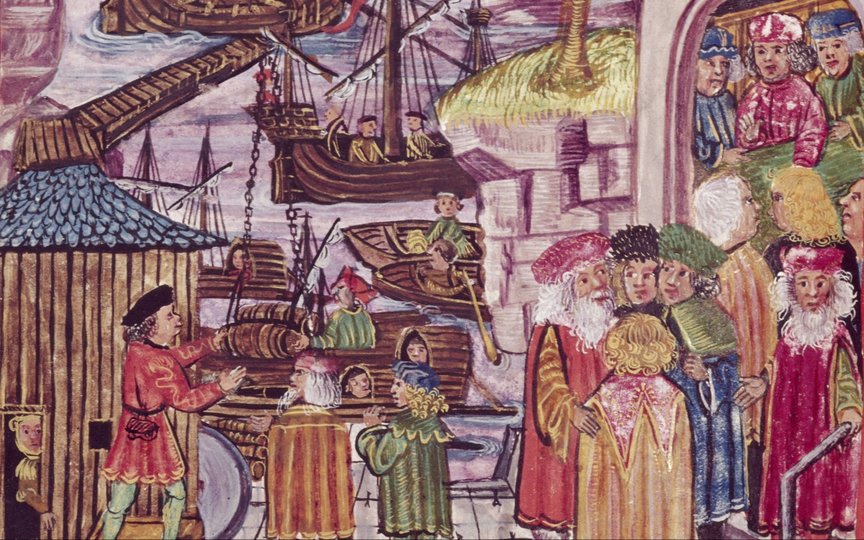
In November 1367, envoys from a string of merchant towns around the Baltic and North Seas – Lübeck, Rostock and Stralsund, Kulm and Thorn, Kampen and Amsterdam – met in Cologne and agreed to go to war with Valdemar IV of Denmark. Asserting control over both shores of the Øresund, Valdemar had an important chokepoint in his hands. In 1361 he sacked the Hanseatic town of Visby and then routed a Hanseatic fleet off Helsingborg in 1362.
The Confederation of Cologne was led by the cities of the Hansa, though it took on crowned allies in Sweden, Mecklenburg and Holstein. In 1368, its fleet sacked Copenhagen, and Valdemar left his kingdom in search of new allies. He never found them. Under the Peace of Stralsund of 1370, the towns won free trade across the Baltic, the fortresses of Malmö, Helsingborg, Skanör and Falsterbo for 15 years with two thirds of their revenues, and a veto over candidates for the Danish throne.
Maritime coercion is making a comeback. After centuries of naval domination by Britain and, later, the United States, a variety of actors are seeking to use their control of geographic chokepoints to create new political dependencies and force others into strategic compromises. Those who value freedom of navigation and free trade can re-learn a lesson or two from the Hanseatic model.
The Hansa – at its height a loose association of close to 200 towns – had no standing navy, no common treasury and no sovereign. Yet it kept its sea lanes open for almost three centuries. It protected convoys and hunted pirates, including the infamous Victual Brothers, who held the island of Gotland. The best-known pirate captain, Klaus Störtebeker, was beheaded in Hamburg in 1401.
Around 70 years later, the Hanseatic League fought off a more formidable enemy: England. After Edward IV seized its London base, the Steelyard, the towns answered with commerce raiding. In 1473 the Danzig captain Paul Beneke captured an Italy-bound galley carrying Hans Memling’s Last Judgment, commissioned by a Medici banker. Today, the triptych hangs in Gdańsk. A year later the Treaty of Utrecht confirmed the Hansa’s privileges, giving it London’s Steelyard outright, together with a claim on part of English customs revenues.
The League also kept discipline among its members. Cologne, unwilling to forfeit its trade with London, sided with England and was expelled – verhanst – until it fell back in line. The system began to lose coherence when its members stopped acting as a united front. In 1494, Ivan III shut the Hanseatic Peterhof in Novgorod and deported its 49 merchants to Moscow, where they were held for three years as hostages – a pattern evident in Russia’s behaviour to this day.
The Hansa is worth revisiting because, as the FT’s Janan Ganesh argues, ours is ‘an era of Davids, not Goliaths’. Look to Ukraine, which has frustrated Russia’s assault for almost five years. Almost every actor, Ganesh notes, has leverage of some kind: ‘If it isn’t control of a strait, it might be an indispensable business… or even just specialised knowledge.’ Sheer size is not enough.
Many of today’s middle powers are illiberal. Iran, choking Hormuz, is a David of sorts. But that is precisely why the more enlightened Davids have to get organised. For centuries, small states threatened by one great power have sought the protection of another, but that blueprint for security is proving unreliable. Again, look to Ukraine, which gave up the world’s third-largest nuclear arsenal in favour of the assurances made in the 1994 Budapest Memorandum. Within NATO, the security of smaller members has come to depend uncomfortably on the shifting positions of a single great power and its mercurial president.
Since the war with Iran began in February, the Strait of Hormuz has been all but shut: on 18 October, IMF PortWatch recorded four transits, against a pre-crisis norm of 85 a day. War-risk premiums have risen from around 0.25 per cent to between three and eight per cent of a ship’s hull value. Oil prices are holding stubbornly near $100 a barrel.
On 9 October, after a call with Vladimir Putin, President Trump announced that Russia would supply 300,000 tons of diesel immediately, with further tranches bringing the total to some 4.8 million tons. Trump, who has repeatedly claimed ‘TOTAL CONTROL’ of the Strait of Hormuz, later thanked Putin. The same day, the Treasury issued General License 135, authorising dealings in Russian diesel through to 7 April 2027. The volume will cover little more than a week of US consumption. The world’s policeman, under pressure from Iran, has responded not by enforcing collective standards and rules but by waiving its sanctions on Russian diesel.
The weaker powers using coercion tactics do not need to win in any absolute sense. Tehran may not be able to use the strait itself, but by closing it, it creates a scarcity rent, collected in this instance by Moscow. Simultaneously, Ukraine’s strikes on Russian refineries are having a dramatic effect on Russian economic viability. The International Energy Agency estimates that Russian diesel output has fallen by about 30 per cent year on year.
David did not win by out-muscling Goliath. The small but resourceful states of today have cheap, rapidly scalable drones in the air, on land, on the water and under it, which can neutralise legacy forms of seapower. In April 2022 Ukraine sank the Moskva, the flagship of Russia’s Black Sea Fleet, with two domestically built Neptune missiles. Sea drones have inflicted serious damage on Russian forces – Magura drones alone had hit 14 of the fleet’s ships by mid-2024 – and missile and drone strikes drove much of the fleet from Crimea to shelter in Novorossiysk. Between the summer of 2023 and the end of 2025, Ukraine’s own corridor through the Black Sea and the Bosphorus carried more than 160 million tons of cargo.
Ukraine is now exporting technology and experience from the battlefield. In March, 228 Ukrainian specialists were helping Saudi Arabia, the UAE, Qatar, Kuwait and Jordan fend off Iranian Shaheds; in April, Kyiv signed drone agreements with Riyadh, Doha and Abu Dhabi.
Against the backdrop of medieval anarchy, the Hansa showed that self-organisation was possible. As the United States reconsiders its global posture, a modern successor to the Hansa could put some meat on the bones of Canadian PM Mark Carney’s middle-power strategy – bringing together trade-exposed economies, including the Nordics and the Baltic states, the UK, the Netherlands, Japan, South Korea, the Gulf states and Ukraine.
A modern-day Hansa could pool escort and mine-clearing capacity built around cheap interceptors and sea drones. Some positive signs are already visible: France and Britain have convened 38 countries to plan a ‘strictly defensive’ Hormuz mission, designed to deploy once the fighting dies down.
A middle-power coalition should also underwrite war-risk insurance, as Ukraine already has. In November 2023, Kyiv launched a facility, alongside insurance broker Marsh McLennan, Lloyd’s underwriters and Ukrainian and German banks, offering up to $50 million in war-risk cover to keep its grain moving.
Like the Hansa, this middle-power coalition needs to discipline its own members. Earlier this year, Bratislava and Budapest acted as today’s Cologne, holding hostage the EU’s 20th sanctions package until Russian oil flowed again through the Druzhba pipeline. Hungary has since changed its government, but Slovakia has not. A modern equivalent of the Hansa’s Verhansung – exclusion from shared intelligence and from the common insurance pool – should await those who break ranks. Such sanctions would not be coercive; they would be written into the rules and agreed by every member voluntarily. And the league should make sure there is an open door for the United States as its politics takes a more auspicious turn.
The Hansa was a cartel policing merchant privileges. It was not a high-minded ‘liberal order’. Its effectiveness was uneven. So could a modern league hold together better? It would certainly possess assets that the Hansa demonstrably lacked: the backing of technologically sophisticated nation-states with vast fiscal and military capacities.
A coalition of Davids would not try to replicate the order America has underwritten since 1945. But its members could, by acting together, achieve more than they would by waiting for Washington to change its behaviour. Even seven centuries ago, a league of merchant towns kept the Baltic open. Today’s Davids have much more to work with.


