My grandfather, the Swedish Stalinist
- October 29, 2026
- Martin Jonols
- Themes: History, Scandinavia, Sweden
My grandfather was a good-natured man – and a communist agent, watched by the Swedish security service and devoted to a cause far more destructive than I once understood.
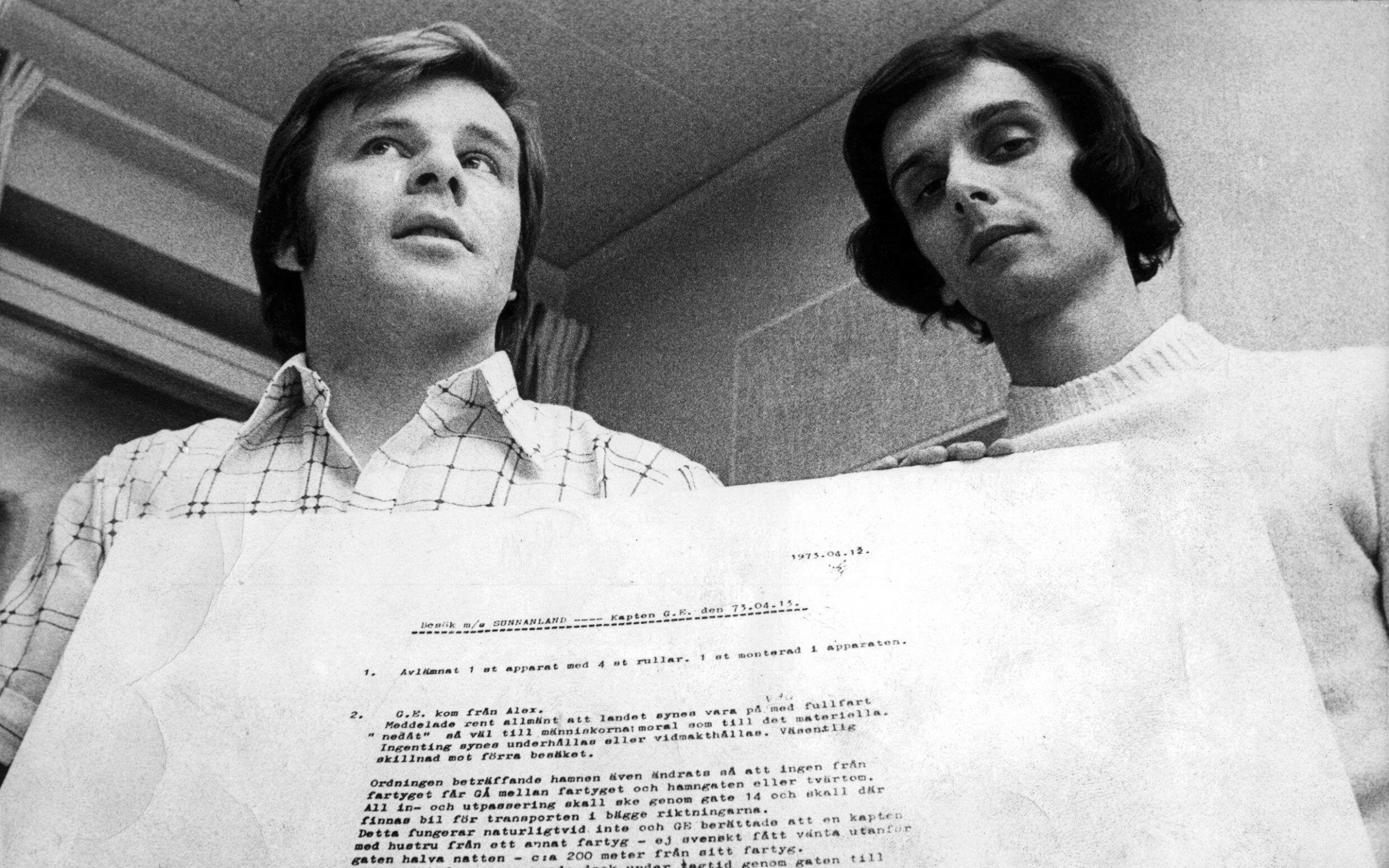
My parents met as students at a Clarté League meeting about Laos. At their wedding, a secret informant from Säpo, the Swedish security service, was present and wrote it up as a report. The informant, who was probably a journalist at my grandfather’s newspaper Ny Dag, wrote that the bride – my mother – was ‘pretty, happy, and pregnant’.
My grandfather was a leading figure in the Communist Party his whole life, having run the Comintern’s covert operations in Sweden during the Second World War. My grandmother was given the Lenin Peace Prize in 1985 for her work promoting relations between Sweden and the Soviet Union. In 1968, my uncle joined the far-left Maoists, the extreme fringe of the revolutionary communists, so extreme that one wavering member was marched off to the local park to be liquidated. Fortunately for him, a police car happened to pass and the execution was called off. (My uncle had already left the movement by then.)
Sometimes when I was little we had visits from ‘Uncle Ho’ from the Chinese embassy. My father had blithely volunteered to spy on Sweden for the People’s Republic of China and Uncle Ho got him to infiltrate a Free Tibet group run by old friends from his elite school.
What circumstances fundamentally alter our perceptions? What can trigger a profound change in how we see the world?
Some years ago, I began to write a book about my grandfather, Gustav Johansson. I wanted to understand my childhood and the family legacy of a communist patriarch. I read old letters and articles, and found endless reports in the Säpo archives. All of his adult life he had been a person of interest. The research affected me more with every passing day. And it was the picture painted by the Säpo material that really gave me pause for thought.
I still treasure the memory of my grandfather. He was a role model, a man of seniority and character. I remember how he loved parties and embassy receptions, never lost his temper or behaved inappropriately after a few pints, wrote loving songs about my grandmother for her birthday, called me his ‘silver medallist’ when I got the most basic of swimming badges, and gave me Romanian lemonade, which he called ‘kiddy beer’.
The author Per Wästberg once told me how his father, the well-known upper-class journalist Erik Wästberg, used to take my grandfather home for a nightcap after a good dinner at Den Gyldene Freden. They used to joke about the drunk Soviet press attaché who had blurted out what would happen when the Soviet occupation came. ‘First we’ll take Moa Martinson, Artur Lundkvist, Arnold Ljungdal and Stellan Arvidson. Stalin trusts communists the least.’
Per Wästberg remembered his father calling through to my grandfather: ‘Bring the large whisky glasses! You know where they are. We must maintain class distinctions so you have something to rebel against. You think you’re making world history, but you’ll be swept away. Have a scotch and face the facts!’
My grandfather was good-natured, but the politics he championed all his life were far more radical and destructive than I had realised.
Even more confusing were my friends’ reactions when I told them what I had found out about my grandfather. It was as if all the communist abuses were just anecdotal: something my leftie friends could laugh about. A colleague at Swedish Radio had a portrait of Stalin on his office wall, and he was only half-joking. If it had been a portrait of Hitler, he would not only have been sacked on the spot, he would have been ostracised.
I know I was just as guilty of relativising everything my grandfather stood for. But a deep dive into the literature about what people suffered under Stalinism forced me to think differently. The story of my grandfather’s friend Allan Wallenius struck a personal chord.
Wallenius was a Finnish-Swedish poet and librarian who escaped, via Switzerland, to Russia after the communist collapse in the Finnish Civil War of 1918. He was a hardliner and one of the Stalinist faithful who made sure the Swedish communists did not deviate from the pro-Moscow line.
In 1938 he fell victim to the purges he himself had helped enforce. That was not unusual. The most loyal of Stalin’s apparatchiks were over-represented among the victims of the purges, especially from the Comintern and the security services. He died in an NKVD prison in 1942; exactly how is not known. He was one of thousands who simply disappeared. In the 1950s, once Stalin was dead, he was rehabilitated. My grandfather never disavowed Stalin, but he was hit hard by Wallenius’s death. For years our family sent Allan Wallenius’ surviving family detective stories and other sorts of easy reading in Swedish so they did not lose contact with the Swedish language.
While Wallenius was in an NKVD prison, Säpo reported that my grandfather was in Riga in Latvia and met Stalin’s deputy foreign commissar, Andrey Vyshinsky, for lunch at the Restaurant Otto Schwarz – a month after the Soviet Union occupied the country.
Vyshinsky had been the chief state prosecutor at Stalin’s show trials in the 1930s. He had come up with his own brand of Marxist-Leninist jurisprudence, which placed great weight on confessions – sometimes the only evidence of a crime – and he was infamous for ranting at the accused in court. My good-natured grandfather had lunch with one of the men directly responsible for the mass executions under Stalin.
In the year after my grandfather’s visit, more than 7,000 Latvians were arrested in the Soviet campaign of terror; hundreds were shot and most of the rest sent to the Gulag. Then, in a single night in June 1941, over 15,000 men, women and children were rounded up and deported to Siberia.
Reading about these and dozens of other episodes from my grandfather’s life, I felt as though I was waking up and realising I had grown up in a cult. I made the choice to stop being complicit in the relativisation of communist atrocities and to finally acknowledge their true impact.
It helped that I was certain my grandfather would not have minded: he was the least conflict-averse person I ever met and often seemed amused by being challenged.
When I read the old Säpo reports about my grandfather and grandmother, it struck me how badly written they were, how amateurish the surveillance had been. My grandfather was shadowed in the middle of the night as he reeled home from a men’s night out, and the reports were peppered with antisemitic remarks and irrelevant gossip.
The rare exception was the author and literary critic Per Meurling, whose reports were genuinely perceptive. He was one of very few academics involved in the early communist movement in Sweden; he defended the Moscow show trials and was even convicted as a Soviet spy. But he gave up, finding it impossible to toe the party line, and it was not long before he became a Säpo informant. He ended up an alcoholic, writing pornography for adult magazines like Piff and Raff, and yet he also published insightful books about Shakespeare, Marx and the writer Erik Gustaf Geijer.
Sweden’s armed forces and the ruling Social Democrats were unhappy with how Säpo went about its job of monitoring communists. In social-democratic circles, Säpo was widely believed to be as suspicious of the Social Democrats as it was of communists. Gradually, the armed forces and the Social Democratic Party became the strangest of bedfellows, and it all centred on a new secret intelligence agency, IB.
IB went after people like me. I had been a member of the Maoist organisation Red Youth. It was all classic revolutionary stuff, with secret cells and code names. The leaders were often young men and women who caused trouble in school and rebelled against their bourgeois families. As far as I know, none of my friends at the time were working class.
What we did have were revolutionary cells at our nice schools, Norra Latin and Djursholms Samskola. We sought out the most authoritarian role models possible, Mao and Stalin. Young men were encouraged to do military service in order to spread the Maoist message among the ranks. There was an almost masochistic devotion to communist discipline, reminiscent of a religious sect where you constantly correct yourself and others.
There is no doubt that IB and its predecessors committed countless abuses, including the harassment of harmless young Vietnam solidarity activists. Many of them were wrongly singled out, while the real security threats were overlooked. Was it really a problem that so many young high achievers, who had the potential to reach positions of power and influence, spent every waking hour trying to establish a Maoist ‘proletarian dictatorship’ in Sweden? The Social Democrat leadership seemed to think so.
My grandfather was larger than life and the most cheerful man I have ever met. But I have become increasingly alienated from the political world in which I grew up. Confronting the past was highly uncomfortable and forced me to rethink.
I went to the magazine Kvartal to suggest an article about the IB affair and, to be fair, they were interested. But when I began to write, I was overwhelmed in a way that was completely new to me. As I sat there in the small hours, I realised it felt like a mortal sin to make excuses for the Social Democrats, IB, and their illegal registration of my comrades’ opinions. For weeks I had difficulty sleeping. When I told friends and acquaintances about it, they were clearly hesitant. The notion that the IB affair was a decisive betrayal by the Social Democrats and Olof Palme was very much alive among them. A psychiatrist friend was more encouraging. ‘If something is causing you that much anxiety, you have to do it. Write the article,’ she said calmly, and prescribed me some sleeping pills. In the end, I not only finished the article; it was also published. Later, when the biography of my grandfather came out, I began work on a new book about the recent history of the left. It deals with factionalism, Bollinger Bolsheviks, revolutionary communists and the repeated splits among the far left.
This article was originally published in our sister publication, Axess Magasin. Translated by Charlotte Merton.
Martin Jonols


More from Scandinavia

Why settled Vikings deserve our attention

Robert Molesworth, denouncer of Danish tyranny
The Russo-German struggle for a Baltic empire

Trygve Lie: the Norwegian who built the United Nations

The early modern battle for Baltic supremacy
More from Sweden
Why settled Vikings deserve our attention

How Sweden’s Social Democrats survived in the capital of capital

Why Sweden’s Tidö bloc needs a majority

Was Hilma af Klint really an abstract artist?


