Why Shenzhen will be no Yalta
- November 9, 2026
- Owen Matthews
- Themes: America, China, Geopolitics, Russia
In dismissing the Kremlin’s idea of a three-way summit, Trump and Xi have made clear that dividing up the world is far above the Russian president’s pay grade.
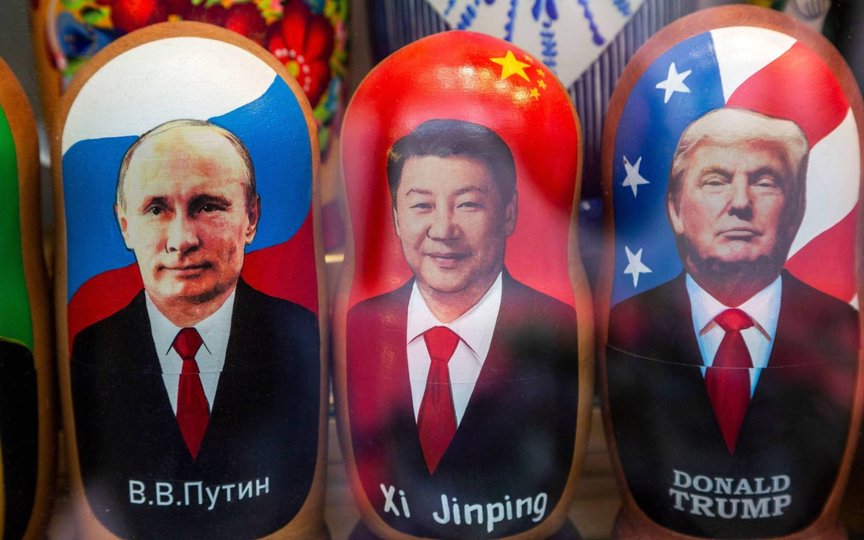
Will Donald Trump, Vladimir Putin and Xi Jinping carve out a new map of Europe just as the Big Three Allied leaders did at the Yalta Conference in February 1945? Ukraine’s president Volodymyr Zelensky has warned that a planned summit in Shenzhen, China, later this month could ‘turn into Yalta 2’, something that ‘Russia wants more than anyone else’.
Zelensky is correct – it has indeed been the Kremlin that has made the running on talk of a trilateral great-power meeting to resolve the war in Ukraine. The idea of a US-Russia-China summit on the sidelines of the Asia-Pacific Economic Cooperation conference was first floated by Kremlin aide Yuri Ushakov (who claimed it was at Xi Jinping’s suggestion). Putin reportedly pushed the idea of a three-way meeting when he spoke to Trump by phone on 9 October to suggest lifting sanctions on Russian diesel exports. Russian Foreign Ministry spokeswoman Maria Zakharova claimed that ‘people are placing a lot of hope on a meeting like this’, and that the summit could mark ‘the start of a return from this slide into absolute chaos to stabilisation’.
Meanwhile, commentators on the nationalist fringes of Russian media delighted in the idea of Moscow, Beijing and Washington partitioning the globe into spheres of influence. We will ‘divide up the world and draw new red lines’, crowed the economist Mikhail Khazin speaking on the Orthodox-nationalist Tsargrad.tv.
Unfortunately for Putin’s exalted self-image, neither Trump nor Xi seem keen on Russia’s plan to resolve the Ukraine war in Shenzhen. Nor, for that matter, do they endorse carving up the world in partnership with Russia in any way at all. Trump said that three-way talks, if they took place, would focus on ‘weapons and de-nuclearization’. And Xi, in a conversation this week with German President Frank-Walter Steinmeier, made it clear that Beijing does not support a format in which the United States, Russia and China determine the terms of a Ukraine settlement without European participation.
So Shenzhen, in a word, will be no Yalta. Yet it is important to acknowledge that Putin’s longstanding hankering for some kind of grand bargain between the great powers – not least because of the essentially 19th-century strategic thinking that underpins it – is likely to be a major obstacle in negotiations to end the war.
Back in June 2020, nearly two years before he launched his full-scale invasion of Ukraine, Putin praised the Yalta deal that carved up Europe into Western and Soviet-controlled blocs for creating a mechanism that ‘allowed the leading powers to remain within the framework of diplomacy in resolving their differences’. Putin at that time also called for a summit of the five permanent members of the UN Security Council – the ‘five states that bear special responsibility for the fate of the world’, as he called them – in order to set up ‘an indivisible system of Eurasian security’ that would take into account ‘the interests of all states on the continent’. In subsequent speeches, Putin has become increasingly adamant that ‘outdated Eurocentric and Euro-Atlantic models’ are crumbling, and has called for ‘a new security architecture [that] must be equal and indivisible’.
Decoded, all Putin’s high-flying rhetoric really means is a demand for NATO to stay out of his backyard, first and foremost in Ukraine and the Caucasus. In any case, all of Putin’s calls have fallen on deaf ears in Europe, Beijing and Washington. The reason is simple: power recognises power and, much as Putin enjoys cosplaying at being a superpower leader, modern Russia stands very far down the totem pole of globally influential players. Russia’s economy is roughly the size of Italy’s in nominal terms. Putin’s army, despite soaking up over 41 per cent of the state budget this year, has, over nearly five years and with the loss of at least half a million soldiers, failed to take more than 22 per cent of its much smaller and weaker regional neighbour. In 1945, Joseph Stalin went to the conference table at Yalta’s Livadia Palace as the victor of Stalingrad and Kursk, the commander of a vast army that had crushed the German war machine and the conqueror of most of Eastern Europe. Putin, by contrast, has failed even to bring Ukraine – a nation with one tenth Russia’s economy and a quarter of its population – to heel.
Putin does, obviously, have two Cold War legacy cards left to play in the form of nuclear weapons and oil, but possessing enough nuclear weapons to destroy the world does not, as Putin has learned, act as a practical force multiplier either in a conventional war or in diplomacy. And oil and gas have only become truly valuable cards for Putin in recent months, and then only as a result of Trump’s attack on Iran and the subsequent closure of the Strait of Hormuz. Once the Gulf starts producing again, Putin’s energy levers turn to pumpkins and vital revenues shrink along with oil prices.
If Putin is no Stalin, then Trump is certainly no Roosevelt either. In a year and a half in office, he has triggered a self-inflicted fiasco with his war against the Iranian regime, derailed the global economy, and repeatedly insulted and threatened his own allies. With historically low approval ratings at home, his party has just suffered a crushing electoral defeat in the midterms.
It is China that sees the reality of Russia’s shrunken position in the world most clearly. Viewed from Beijing, Ukraine appears a small, localised war of limited significance to the world’s economy or geopolitics (not least because Europe has continued to buy Russian gas, grain and fertiliser despite pretending to impose sanctions on Moscow). Xi has no interest in whether one town in Donbas or another is Russian or Ukrainian, nor does he care about Kyiv’s constitutional arrangements or about easing Europe’s self-imposed energy crunch. Being both powerful and serious about power, Xi does, however, care about not alienating Europe – a key market – and about managing his relationship with the volatile Trump White House. In this context, Moscow’s talk of a three-way summit to end the Ukraine war is an impudent attempt to set China’s agenda in public. There is no possible upside to Chinese involvement in a Ukraine deal because that would mean taking responsibility for its outcome and the potential blame for its failure. Most importantly, Beijing’s current arrangement – which is to enable Russia’s war without being formally accountable for it – allows China to reap the advantages of selling into a rich new Russian market and harvesting its raw materials while pretending to be neutral.
The whole idea of a grand international bargain to end this war is a projection of Putin’s own fantasy that Russia is still a superpower with a place at the top table. By casually swatting aside Russia’s idea of a three-way summit, both Trump and Xi have made clear that the business of dividing up the world is far above Putin’s pay grade.